*Important notice: This news reports on an unedited version of an accepted paper and is awaiting final editing. Therefore, the paper should not be regarded as conclusive or treated as established information.
Using controlled kHz laser-driven electrons, researchers have successfully demonstrated what they describe as the first on-demand, in-air irradiation of biological samples using this type of electron source. Their preclinical findings, published in Scientific Reports, may warrant further investigation for sparing normal tissue while maintaining anti-cancer efficacy.
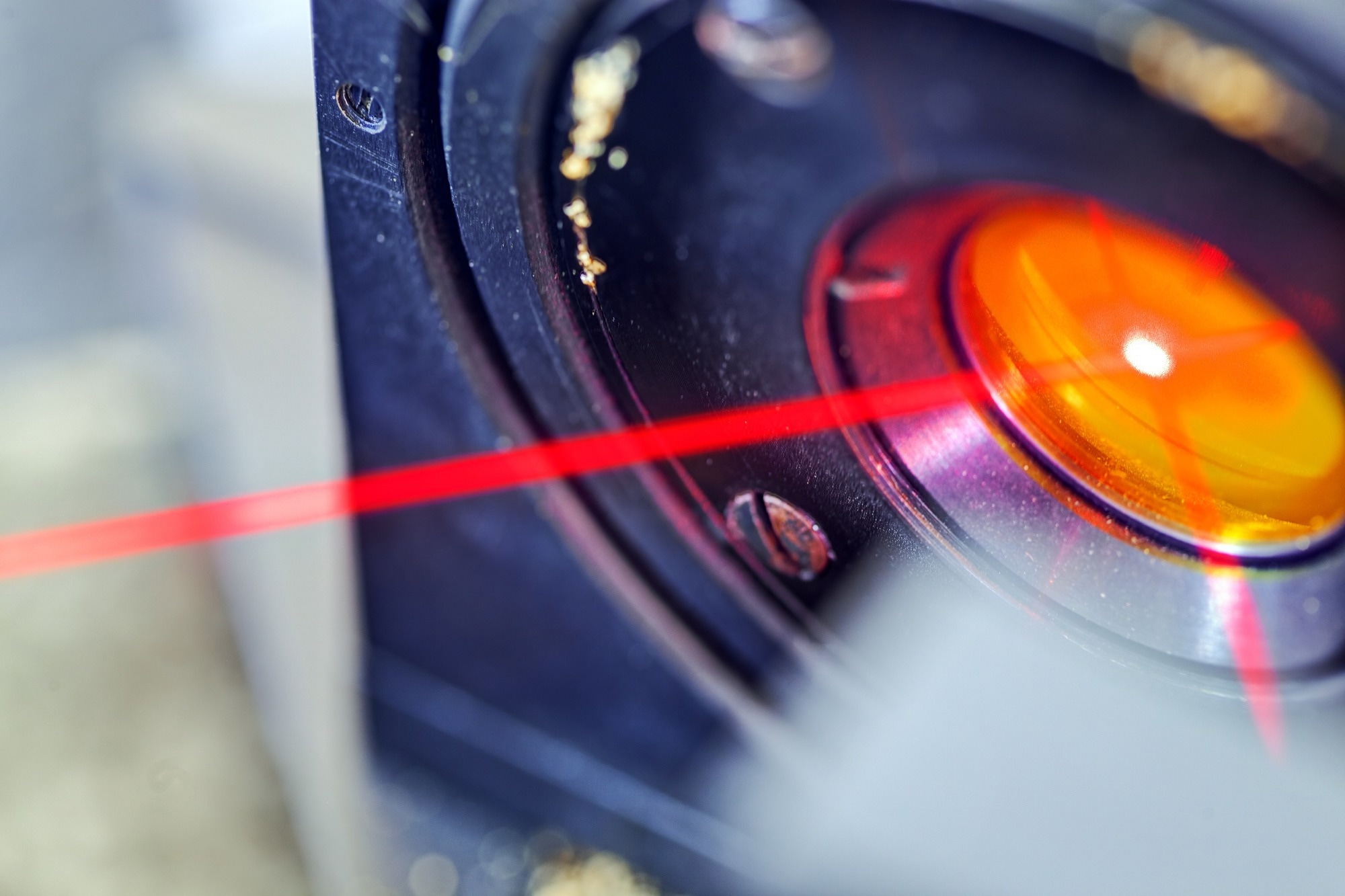 Study: Controlled kHz laser-driven electron irradiations for pre-clinical applications. Image Credit: Vladimir Nenezic/Shutterstock.com
Laser Electron Beam Context
Traditional radiotherapy, while effective for many oncological patients, faces limitations in delivering very-high-energy electrons (VHEE) due to the spatial constraints and accelerating gradient ceilings of conventional radio-frequency linear accelerators.
This often restricts their use to superficial treatments or photon generation, limiting dose rates. The emergence of laser wakefield acceleration (LWFA) offers a compact solution, leveraging the extraordinary electric fields sustainable in plasma to overcome these hurdles.
By employing high-peak-power, ultra-short lasers, especially those using optical parametric chirped-pulse amplification (OPCPA) operating at kHz repetition rates, LWFA can generate ultra-relativistic electron beams.
Precision kHz Electron Delivery
The cornerstone of this research lies in the meticulous control and characterization of the optical system driving the electron acceleration. The
experiments were conducted at the ALFA beamline, which is equipped with a high-power kHz laser system capable of driving laser wakefield acceleration (LWFA).
The laser system generates ultrashort pulses, typically in the femtosecond regime, which are then focused into a gas target to create plasma. The laser's high peak power interacts with this plasma to excite plasma waves in its wake, effectively accelerating electrons to relativistic energies.
Crucial to the success of on-demand irradiations was the development of a stringent in-house protocol for laser system validation. This involved rigorous checks of critical laser parameters before any biological irradiation. Specifically, at T = -50 hours relative to the scheduled irradiation, parameters such as the laser's near-field energy distribution, far-field pointing stability, output energy, pulse compression quality, and the laser spectrum on target were all meticulously verified.
These optical diagnostics ensured that the driving laser pulses had the required spatial and temporal characteristics for stable, reproducible electron beam generation.
Furthermore, the team performed a comprehensive tolerance analysis focusing on how variations in key laser-plasma parameters directly influenced the resultant electron beam properties.
They investigated the sensitivity of the electron beam's pointing stability, current, and divergence to changes in the incident laser energy, plasma density (controlled via gas-target backing pressure), and, crucially, the precise location of the laser focus within the gas density profile.
By scanning the gas target's z-axis along the laser focus, they could tune the electron beam's spectral intensity and maintain optimal operating conditions. This detailed understanding and control of the laser's interaction with the plasma, driven by these optical parameters, was paramount for achieving the stable and predictable electron beams necessary for preclinical studies.
Biological Outcomes
The laser system's stability directly translated into consistent electron-beam properties, achieving an average beam energy of 20 MeV, a high-energy tail extending to 40 MeV, and an average dose rate of up to 30 Gy/minute.
The stringent validation of laser parameters, including near-field energy distribution, far-field pointing, output energy, pulse compression, and laser spectrum, proved critical. The tolerance analysis underscored the profound influence of laser-plasma parameters on the electron beam.
Download a free copy of this page here!
For instance, a drop in laser energy from 39 mJ to 36 mJ resulted in a >10% loss of total electron charge and a noticeable 10 mrad shift in beam pointing, highlighting the laser's direct impact on beam stability. Similarly, careful tuning of the laser focus location within the gas target's density profile was essential for optimizing the electron beam's spectral intensity and maintaining uniformity.
The meticulous control over these optical-plasma interactions enabled the development of an on-demand delivery procedure, in which specific electron-beam parameters could be delivered at pre-agreed times with high accuracy (dose error <10%).
This capability, directly stemming from the stability and tunability of the laser system, facilitated precise preclinical investigations. The researchers achieved high targeting precision (sub-mrad) and maintained dose homogeneity within 10% across the target volume. This level of control, stemming from the optical stability, allowed for repeatable zebrafish embryo treatments and cell culture irradiations.
On-Demand Irradiation Milestones
This research marks a significant stride in the development of laser-driven electron accelerators for preclinical applications, demonstrating the first successful in-air, kHz laser-driven electron irradiations of biological samples.
The core achievement lies in the meticulous control and characterization of the optical system and its interaction with plasma, which enabled the generation of stable, tunable, and reproducible electron beams.
These preliminary, yet promising, biological results support further investigation into whether this technique could offer normal-tissue-sparing effects while retaining activity against cancer cells.
By bridging the gap between advanced laser physics and practical medical applications, this work sets an important milestone toward the clinical translation of laser-plasma accelerators, potentially offering a compact and powerful tool for next-generation radiotherapy.
Journal Reference
Lazzarini C.M., et al. (2026). Controlled kHz laser-driven electron irradiations for preclinical applications. Scientific Reports. DOI: 10.1038/s41598-026-66625-8. https://www.nature.com/articles/s41598-026-66625-8.