What PT Symmetry Means for Light?
Exceptional Points and Symmetry Breaking
Loss as a Mode Filter in Lasers
Designs That Use Loss Alone
Sensing Near Exceptional Points
Faster Optical Signal Processing
Conclusion
References and Further Reading
Engineers have long viewed optical loss as a challenge to minimize, as every photon absorbed by a waveguide or scattered from a rough surface weakens signals. However, a concept borrowed from quantum mechanics has changed this perspective. Parity-time (PT) symmetry describes systems in which gain and loss are balanced and mirror each other.
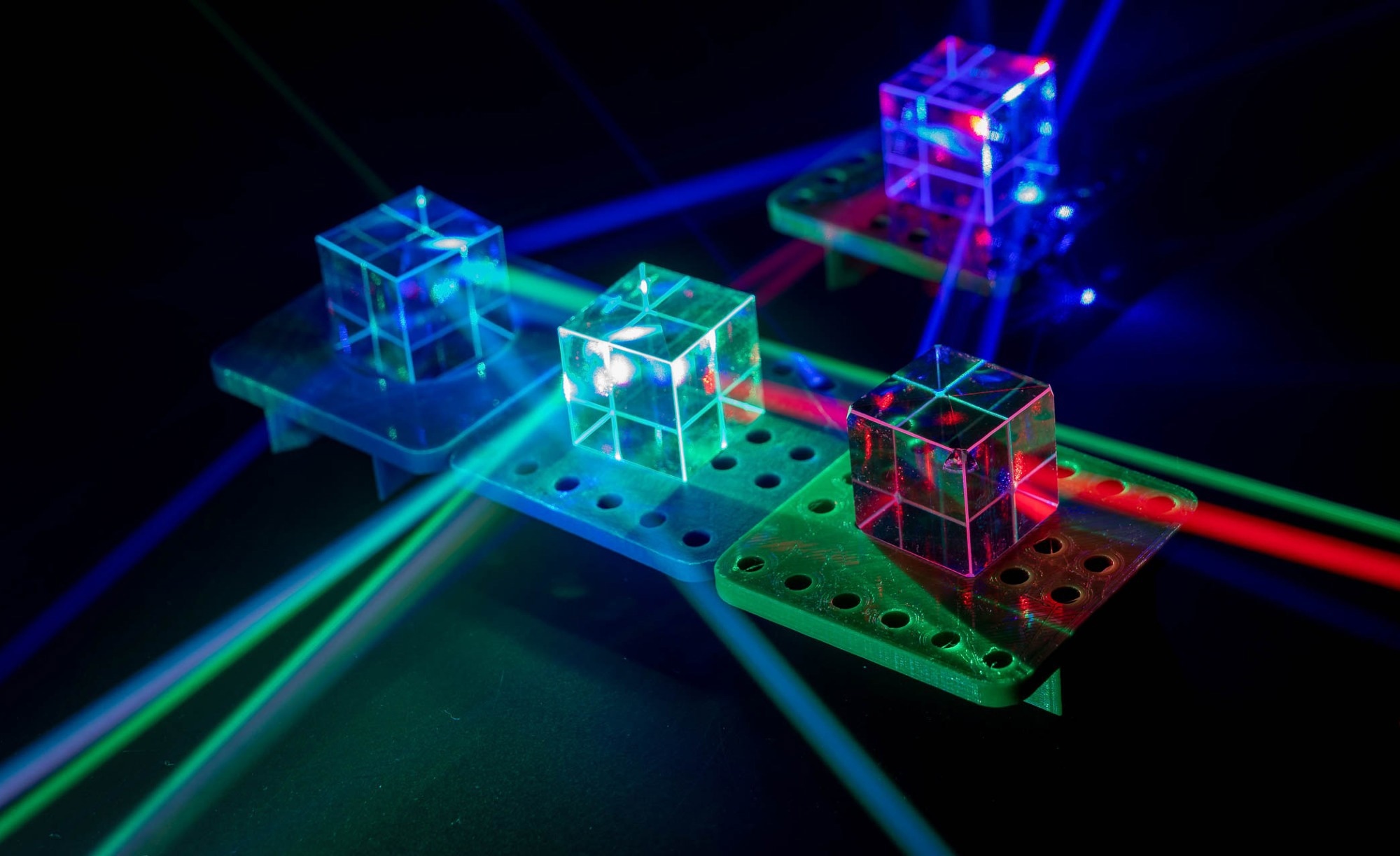 Image Credit: luchschenF/Shutterstock
This article delves into PT symmetry and explains how researchers are using loss to shape lasers, sensors, and signal processors. The field grew from a theoretical insight that some open systems, which trade energy with their surroundings, can still behave in stable and predictable ways. Optics became an ideal testing ground because gain and loss are easy to build into light-guiding structures.1,2
What PT Symmetry Means for Light?
In quantum physics, a closed system is described by a Hermitian Hamiltonian, a mathematical object that guarantees real energy values and energy conservation. Open systems leak or absorb energy, so physicists describe them using non-Hermitian Hamiltonians that incorporate the environment's influence into the equations. PT symmetry is a special case in which the system looks identical after a mirror flip of space combined with a reversal of time.2
Optics translates this abstract rule into a concrete recipe for materials. The refractive index of a structure has a real part that represents the bending of light and an imaginary part that dictates gain or loss. PT symmetry requires the real part to be mirror symmetric across the device and the imaginary part to be antisymmetric. In practice, one waveguide amplifies light while its neighboring partner absorbs light at an equal rate.1
Exceptional Points and Symmetry Breaking
The behavior of a PT-symmetric pair depends on a contest between two quantities. The first is the coupling strength, which indicates how easily light transfers between the waveguides. The second is the contrast between gain and loss. When the coupling strength is predominant, light oscillates between the waveguides, maintaining steady amplitudes in both shared modes. However, when the contrast between gain and loss takes precedence, symmetry is disrupted, and one mode amplifies while the other diminishes.3
The boundary between these two regimes is called an exceptional point. Here, the two modes merge completely, sharing a single frequency and a single field pattern. An ordinary degeneracy keeps two distinct states with the same energy.2
Download the PDF of this page here
An exceptional point keeps only one, which makes the system mathematically defective. Close to this point, the system responds to small disturbances with unusually large shifts, a property that underlies many proposed applications.2
Loss as a Mode Filter in Lasers
Lasers are the clearest example of loss working as a design tool. Many semiconductor lasers exhibit several competing modes that degrade beam quality and spectral purity. By strategically placing gain and loss within coupled cavities, designers can elevate the desired mode beyond the symmetry-breaking threshold, while keeping competing modes below it. As a result, the favored mode becomes concentrated in the gain region and achieves lasing, while the other modes dissipate energy into the lossy counterpart.1
Reported devices demonstrate the effectiveness of this approach. A PT-symmetric distributed feedback laser operating at 1550 nm produced 16 mW per facet. This system, described in MDPI Nanomaterials, achieved a side-mode suppression ratio exceeding 50 dB.1
In a separate study published in Light: Science & Applications, a large, broad-area laser cavity was coupled to an unpumped partner cavity in a quasi-PT-symmetric configuration. This design effectively filtered out higher-order modes, resulting in an output of approximately 400 mW while maintaining a nearly Gaussian, high-quality beam profile.4
Designs That Use Loss Alone
In the context of integrated optical devices, achieving matched gain and loss within a single chip is difficult, due to the associated costs, heat, and noise. Researchers have found a practical workaround called passive PT symmetry. If every element carries some baseline loss, then a region with lower loss acts as an effective gain relative to its neighbor. The physics depends only on the difference in losses, so a device can exhibit PT behavior without any amplifying material present.3
A recent Nature Communications study used laser-written glass waveguides to apply this concept. Straight sections served as effective gain regions, while curved sections lost additional light due to bending. By swapping these roles periodically along the propagation path, the team created Floquet PT symmetry. The modulation period controlled where symmetry breaking occurred, and breaking became possible with minimal contrast loss when the period matched the coupling bandwidth.3
Sensing Near Exceptional Points
The sharp response near exceptional points has attracted many sensor designers. At an ordinary degeneracy, a small perturbation splits two frequencies in direct proportion to its size. At a second-order exceptional point, the splitting follows the square root of the perturbation, which is considerably larger for very weak signals. Higher-order exceptional points further strengthen the effect, since their response scales with progressively smaller fractional powers of the disturbance.2,5
Noise also rises near these points, and it can cancel the benefit of larger frequency shifts. In linear systems, signal enhancement and noise amplification scale in the same way, so the signal-to-noise ratio remains finite at best. A work published in the National Science Review proposed a remedy based on saturable gain in two coupled resonators. Its nonlinear, higher-order exceptional point improved both responsivity and signal-to-noise ratio, pointing to a realistic path for practical, low-noise sensors.5
Faster Optical Signal Processing
PT symmetry is also useful in nonlinear optics, a field in which intense light beams interact within a material to generate new frequencies. For example, four-wave mixing in microresonators can process data entirely in the optical domain, which avoids slow conversion to electronics. But designers have long faced a tradeoff in these devices: high-quality resonators enhance efficiency by storing intense light but have narrow bandwidths that limit data transmission rates.6
Recent advancements involving coupled microresonators operating near an exceptional point have mitigated this tradeoff. A Light: Science & Applications study demonstrated a system built on an aluminum gallium arsenide platform that significantly improved four-wave mixing efficiency while achieving transmission rates approaching 40 Gbps with minimal pump power. Such results point toward compact optical chips with integrated pump lasers for communication networks as well as classical and quantum computing.6
Conclusion
PT symmetry provides a framework in photonics where gain, loss, and coupling can be fine-tuned as design parameters. Balanced arrangements produce phase transitions and exceptional points, and those features translate into working functions. Lasers benefit from this by selecting a single, pure mode at high power, while passive waveguides operate without active components.
Similarly, sensors capitalize on their sensitivity, and nonlinear chips address historical limits in speed and efficiency. Although challenges such as noise, fabrication precision, and increased laser losses persist, the strategic application of optical loss, guided by PT symmetry, enables precise light manipulation and enhanced device performance.1,2
References and Further Reading
- Sha, H. et al. (2024). Advances in Semiconductor Lasers Based on Parity–Time Symmetry. Nanomaterials, 14(7), 571. DOI:10.3390/nano14070571. https://www.mdpi.com/2079-4991/14/7/571
- Xiao, L. et al. (2025). Non-Hermitian physics in photonic systems. Photonics Insights 4(3), R09. DOI:10.3788/PI.2025.R09. https://www.spiedigitallibrary.org/journals/photonics-insights/volume-4/issue-03/R09/Non-Hermitian-physics-in-photonic-systems/10.3788/PI.2025.R09.full
- Liu, W. et al. (2024). Floquet parity-time symmetry in integrated photonics. Nature Communications, 15(1), 946. DOI:10.1038/s41467-024-45226-x. https://www.nature.com/articles/s41467-024-45226-x
- Seker, E. et al. (2023). Single-mode quasi PT-symmetric laser with high power emission. Light: Science & Applications, 12(1), 149. DOI:10.1038/s41377-023-01175-6. https://www.nature.com/articles/s41377-023-01175-6
- Bai, K. et al. (2023). Nonlinearity-enabled higher-order exceptional singularities with ultra-enhanced signal-to-noise ratio. National Science Review, 10(7). DOI:10.1093/nsr/nwac259. https://academic.oup.com/nsr/article/10/7/nwac259/6831649
- Wan, W., & Jiang, X. (2024). Parity-Time symmetry helps breaking a new limit. Light: Science & Applications, 13(1), 257. DOI:10.1038/s41377-024-01577-0. https://www.nature.com/articles/s41377-024-01577-0
Disclaimer: The views expressed here are those of the author expressed in their private capacity and do not necessarily represent the views of AZoM.com Limited T/A AZoNetwork the owner and operator of this website. This disclaimer forms part of the Terms and conditions of use of this website.