IS-Instruments’ Notus gas Raman instrument has been developed to deliver fast, stable, and in situ compositional analysis for complex gas mixtures.
In this interview, Dr Michael Foster, Co-Founder and Director at IS-Instruments, explains how Raman spectroscopy, hollow-core microstructured optical fibres, and robust optical design are helping overcome the limitations of traditional gas analysis methods, while supporting applications from industrial process monitoring to future fusion energy technologies.
Could you introduce IS-Instruments’ work in Raman gas analysis and explain the original need that led to the development of the Notus gas Raman instrument?
IS-Instruments specializes in advanced optical instrumentation, including Raman spectroscopy systems for demanding measurement environments. Our work in gas Raman analysis grew out of the need for faster, more direct compositional measurements in applications where conventional techniques can be slow, maintenance-intensive, or difficult to integrate close to the process.
Notus was developed to provide stable, in situ Raman gas analysis, delivering immediate insight into gas composition. The aim was to create a compact, robust instrument capable of monitoring multiple gas species simultaneously, without the need for chromatographic separation, carrier gases, or regular consumable replacement.
Gas analysis is critical in applications where composition affects process performance, product quality, safety, or regulatory compliance. What kinds of measurement challenges were you aiming to address with Notus?
GC remains the industry benchmark for many gas analysis applications, but it is inherently batch-based and requires consumables, carrier gases, and regular maintenance. In processes where gas composition can change rapidly, the time between sampling and obtaining a result can constrain operational responsiveness.
Notus was developed to address the need for stable, in situ gas analysis that provides immediate compositional insight. While other Raman-based gas analyzers exist, our focus was on creating a robust platform capable of continuous measurement with minimal maintenance and without the workflow complexity associated with chromatographic separation techniques.
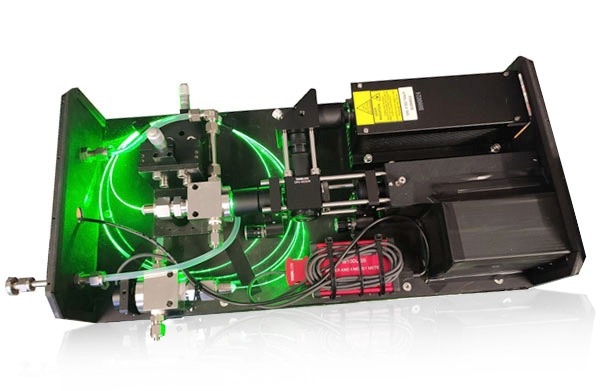
Image Credit: IS-Instruments
How does Raman spectroscopy allow Notus to provide simultaneous, species-specific measurements in complex gas mixtures?
Raman spectroscopy measures the interaction between laser light and molecular vibrations. Each gas species produces a characteristic Raman signature, effectively providing a spectral fingerprint. This allows multiple components within a gas mixture to be identified and quantified from a single spectrum.
For Notus, this means the system can monitor several gases simultaneously rather than measuring them one at a time. This is particularly valuable in complex or changing mixtures, where understanding the relationships between different species is as important as measuring a single component.
Many traditional gas analysis techniques rely on consumables, sample preparation, or sequential workflows. How does an in-line Raman approach change how users monitor gas composition?
The key difference is that users shift from waiting for results to continuously monitoring the process. Traditional techniques often involve sample handling, consumables, and sequential analytical workflows. In contrast, an inline Raman system measures multiple gas species simultaneously and provides real-time compositional information.
This gives operators immediate insight into process behavior, enabling faster decision-making, tighter process control, and reduced reliance on consumables and routine maintenance. Rather than taking periodic snapshots of a process, users gain a continuous view of what is happening as conditions change.
Notus uses hollow-core microstructured optical fibers to extend the laser interaction path. Could you explain how this design improves sensitivity for gas-phase Raman measurements?
Gas-phase Raman measurements are inherently challenging because gases contain far fewer molecules per unit volume than liquids or solids, producing weaker Raman signals. To overcome this, Notus uses hollow-core microstructured optical fibers, enabling the laser light and gas sample to interact over a significantly longer distance.
Within the hollow core, the light is guided directly through the gas, effectively extending the measurement path while keeping the instrument compact. This longer interaction length increases the number of Raman scattering events that can be collected, thereby improving signal strength and measurement sensitivity.
In practical terms, this enables the reliable measurement of lower gas concentrations while retaining the advantages of a compact, in situ Raman analyser.
Gases typically produce weaker Raman signals than liquids or solids. What were the main technical challenges in developing a robust gas Raman instrument for real-time use?
The main challenge was achieving sufficient sensitivity and stability in a format suitable for real-world operation. Gas Raman signals are weak, so the optical design, laser delivery, signal collection, and detector performance must all work together efficiently.
A second challenge was robustness. An instrument intended for real-time monitoring must deliver reliable data over extended periods, often in non-ideal laboratory conditions. This requires maintaining optical alignment, managing background signals, preserving calibration stability, and ensuring the system can operate consistently with minimal user intervention.
Which applications are proving especially well-suited to Notus, such as gas blending, process monitoring, modified-atmosphere packaging, or specialist research environments?
Notus is particularly well-suited to applications where gas composition needs to be monitored continuously or where rapid changes in composition are critical. This includes gas blending, process monitoring, quality control, and modified-atmosphere packaging, where users need confidence that the gas mixture is correct and stable.
It is also valuable in specialist research environments where multiple gas species need to be tracked simultaneously, particularly when users want to reduce sample handling or avoid consumables-heavy workflows. The ability to generate real-time compositional data makes it useful across both industrial and research settings.
IS-Instruments has worked with UKAEA through the Fusion Industry Programme to explore Raman spectroscopy for tritium detection*. How did that project build on the existing Notus platform?
The UKAEA Fusion Industry program project examined how the core Notus approach could be applied to the specific challenge of tritium detection and monitoring. The existing platform already provided the key advantages of Raman gas analysis: simultaneous species measurement, in situ monitoring, and reduced reliance on consumables.
The fusion application builds on that foundation but introduces additional technical demands. Hydrogen isotopologues are closely related species, and distinguishing between them at low concentrations is essential.
The project therefore focuses on adapting and optimising the Raman approach to meet the sensitivity, selectivity, and reliability required in fusion-relevant gas environments. As of 2026, our work with the UKAEA FIP is ongoing.
What makes measuring hydrogen isotopologues, including tritium, at low concentrations particularly challenging in complex gas mixtures?
Hydrogen isotopologues are challenging because they are chemically similar yet differ in mass, leading to subtle differences in their Raman spectra. Detecting and distinguishing these species requires high spectral resolution, strong signal sensitivity, and careful control of background noise.
The challenge increases at low concentrations and in complex gas mixtures, where overlapping signals or interfering species may be present. For tritium, there are also strict safety and containment requirements, so the chosen analytical approach must be not only sensitive and selective but also suitable for controlled, reliable operation in a radioactive environment.
Looking ahead, how do you see advanced Raman spectroscopy supporting both industrial gas monitoring and future fusion energy technologies?
Advanced Raman spectroscopy has strong potential wherever users need fast, reliable, multi-species gas analysis without the complexity of traditional workflows. In industrial settings, it can support better process control, faster decision-making, reduced downtime, and less reliance on consumables.
For fusion energy, Raman spectroscopy could play an important role in monitoring hydrogen isotopologues and supporting safe, efficient fuel-cycle management.
As fusion technologies move closer to deployment, robust analytical tools will be needed to provide real-time insight into complex gas systems. Raman offers a promising route because it combines molecular specificity with simultaneous measurement and the potential for in situ operation.
Where can readers find more information?
Articles about the gas Raman system can be found in the news section of our website: https://is-instruments.com/news/.
About Dr Michael Foster 
I am the Co-Founder and Director of IS-Instruments, where I lead the development of advanced Raman and optical-sensing technologies for industrial and research applications. With a background in space instrumentation and remote sensing, I have focused my career on translating high-precision optical measurement techniques into robust tools for real-world environments.
At ISI, I am central to advancing Raman spectroscopy for challenging applications, including gas analysis, process monitoring, and fusion research. I have been involved in the development of several instruments from initial concept to market, including our ODIN system and HES Raman spectrometers.
About IS-Instruments
Founded in 2010, IS-Instruments is a UK-based developer and manufacturer of spectrometers, laser-based instrumentation, and bespoke LIDAR solutions for scientific, industrial, and research applications.
Specialising in Raman spectroscopy, the company draws on extensive expertise in optical engineering and system integration to develop technologies for applications such as process monitoring, gas analysis, fusion energy, pharmaceuticals, healthcare, aerospace, and environmental monitoring.
Its portfolio includes the Notus Raman gas analyser, the Odin deep-UV spectroscopy platform, and freeze-drying monitoring technologies.
Working closely with industry, academia, and government organizations, IS-Instruments combines scientific innovation with practical engineering to deliver robust instrumentation for demanding real-world environments.
For more information, visit www.is-instruments.co.uk.
* This project has been supported by the UK Atomic Energy Authority through the Fusion Industry Programme. The Fusion Industry Programme is stimulating the growth of the UK fusion ecosystem and preparing it for future global fusion powerplant market.
More information about the Fusion Industry Programme can be found online: https://ccfe.ukaea.uk/programmes/fusion-industry-programme/
This information has been sourced, reviewed, and adapted from materials provided by IS-Instruments Ltd.
For more information on this source, please visit IS-Instruments Ltd.
Disclaimer: The views expressed here are those of the interviewee and do not necessarily represent the views of AZoM.com Limited (T/A) AZoNetwork, the owner and operator of this website. This disclaimer forms part of the Terms and Conditions of use of this website.