In this interview, AZoOptics speaks with Gustavo Ciardi, Optics and Photonics Application Manager at Zurich Instruments, about mastering periodic signal analysis in advanced optical experiments. Drawing on his background in ultrafast and terahertz spectroscopy, Ciardi explains how modern lock-in amplifiers and boxcar averagers enable researchers to extract ultra-small signals, optimize signal-to-noise ratios, and improve measurement precision in cutting-edge photonics applications.
Can you please introduce yourself and your role at Zurich Instruments?
My name is Gustavo Ciardi. I have a background in photonics, and during my research, I worked extensively on ultrafast and terahertz spectroscopy.
At Zurich Instruments, I am responsible for optics and photonics applications, supporting researchers in designing and optimizing their measurement strategies, particularly for challenging signal recovery problems in advanced optical setups.
Why is periodic signal analysis so critical in optics and photonics experiments?
Optical measurements can achieve some of the highest levels of precision in modern science. For example, interferometric measurements in gravitational wave detection have resolved length changes on the order of 10-21 meters, while attosecond laser experiments have pushed time resolution down to 10-17 seconds.
However, once an optical signal is detected and converted into the electronic domain, the challenge is preserving its information content. Using the right approach to analyze these signals can make the difference between a breakthrough discovery and an unsuccessful measurement.
Many optical effects, such as weak absorption, polarization changes, or stimulated Raman gain, are extremely small. Appropriate periodic signal analysis tools help recover these small effects from noise and large background signals by shifting the measurement to a more favorable frequency range.
Mastering Periodic Signal Analysis for Optics & Photonics Applications | Zurich Instruments Webinar
Video Credit: Zurich Instruments
What types of effects are typically measured in photonics experiments?
We often measure linear absorption or transmission through a sample, polarization changes in terahertz spectroscopy, or pump-induced changes in transmission and absorption in pump-probe experiments. In stimulated Raman scattering, for example, we measure very small gain signals on top of a much larger background.
In many advanced experiments, researchers need to detect relative signal changes as small as 10-6, 10-7, or even 10-8. These signals may either be buried below the detector noise floor or sit on top of a large DC background. In both cases, extracting the signal requires careful signal-to-noise optimization.
How do noise sources affect optical measurements?
Noise in optical experiments typically includes 1/f noise at low frequencies, white noise dominated by detector shot noise at higher frequencies, and discrete noise peaks such as 50 or 60 Hz power line interference.
If we employ the simplest approach "digitize and average" we are effectively low-pass filtering our signal around DC, i.e., the noisiest part of the frequency spectrum. Instead, by modulating the optical signal and shifting it to a higher frequency, we move into a region dominated by white noise, where detection performance is often significantly better.
How do lock-in amplifiers enable effective periodic signal analysis?
A lock-in amplifier multiplies the measured signal by a reference signal at the modulation frequency. This mixing process shifts the signal of interest to DC, where it can be extracted using a low-pass filter. The output provides both amplitude and phase information relative to the reference.
In modern digital instruments, all this processing is performed in the digital domain, enabling flexible bandwidth selection, adjustable filter orders, and simultaneous demodulation across multiple harmonics.
The key advantage is that the lock-in acts as a narrow-bandpass filter centered on the modulation frequency. By selecting the appropriate time constant and filter order, researchers can balance noise rejection against signal dynamics.
How can researchers optimize the signal-to-noise ratio using lock-in amplification?
Two main parameters influence performance: measurement bandwidth, inversely proportional to the low-pass filter time constant, and filter order.
Reducing bandwidth improves noise rejection but increases settling time. Increasing filter order sharpens the filter roll-off, helping suppress nearby interference frequencies, but also increases response time.
There is always a physical trade-off between noise suppression and temporal resolution. The optimal setting depends on the signal's dynamics. In practice, researchers often test multiple bandwidths to determine the best compromise.
When is boxcar averaging more advantageous than lock-in detection?
Boxcar averaging is particularly useful for low-duty-cycle signals, such as those in pump-probe spectroscopy with ultrafast lasers operating at low repetition rates.
In these experiments, the signal is confined to very short time windows. A boxcar averager multiplies the signal with a gated square window and integrates only during the time of interest. This approach can recover information distributed across multiple harmonics of the pulse repetition frequency, which a single-frequency lock-in measurement would miss.
For certain applications, such as stimulated Raman microscopy, researchers have shown that boxcar averaging can achieve the same signal-to-noise ratio in roughly half the measurement time compared to lock-in detection.
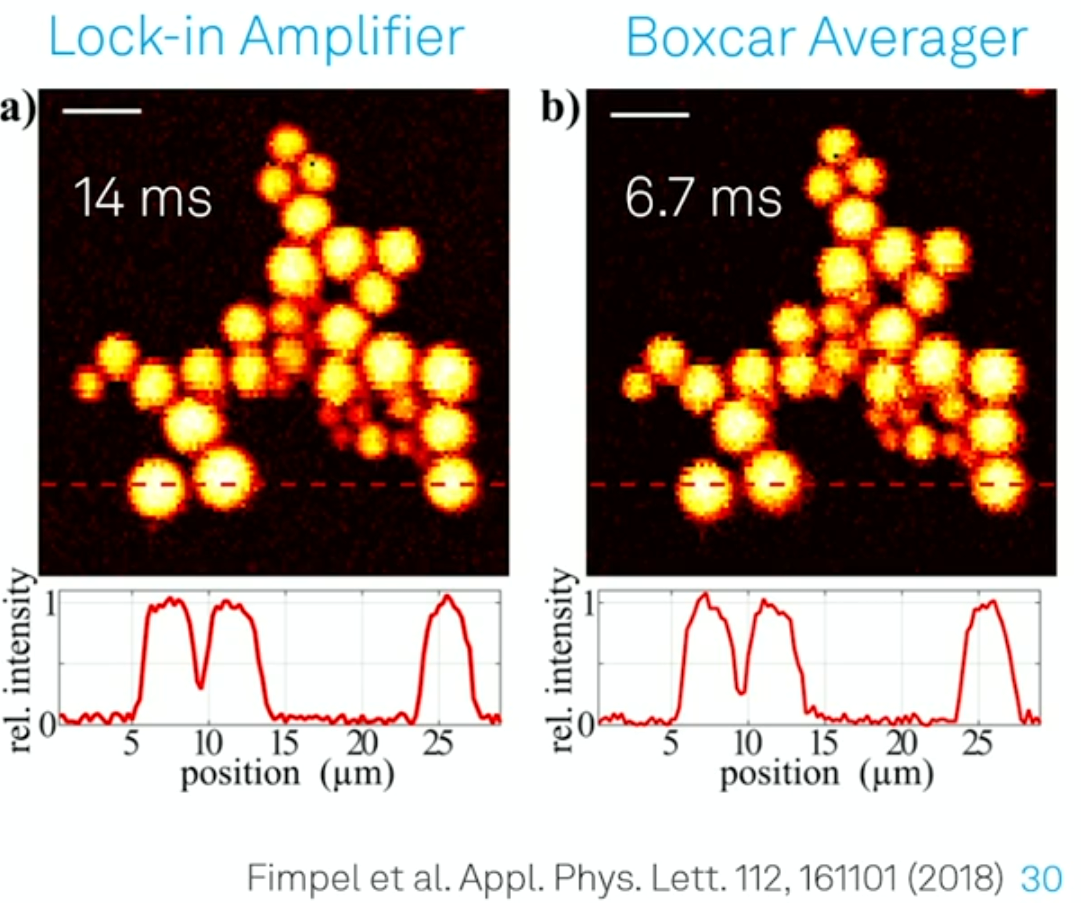
Lock-in Amplifier vs. Boxcar Averager: difference in pixel integration time in Stimulated Raman Scattering (SRS) microscopy measurement.
Image Credit: Zurich Instruments
Can you provide examples of periodic signal analysis in real-world optical applications?
One example is tunable diode laser absorption spectroscopy (TDLAS), used for gas sensing. By applying a small sinusoidal modulation to the laser wavelength and detecting with a lock-in amplifier, researchers significantly enhance sensitivity when measuring very low gas concentrations.
In terahertz time-domain spectroscopy or pump-probe measurements, boxcar averaging is often used to recover ultrafast transient electric fields with high temporal resolution.
Image Credit: Shutterstock.com/OlegDoroshin
What practical advice would you give researchers working on optics experiments?
First, characterize your noise sources before starting measurements. Understand the laser’s relative intensity noise and the detector’s noise spectrum.
Second, choose the modulation frequency as high as possible while remaining within the instrument bandwidth and avoiding known interference sources. This helps move into the white noise regime.
Third, select the measurement approach based on signal characteristics. Compare the lock-in and boxcar techniques, if necessary, and evaluate the signal-to-noise ratio directly.
Finally, carefully balance noise rejection and signal dynamics when setting filter bandwidth and order. Avoid filtering out meaningful information.
About Gustavo Ciardi

Gustavo Ciardi is an Optics and Photonics Application Manager at Zurich Instruments. He holds a background in photonics and conducted extensive research in ultrafast and terahertz spectroscopy during his academic career. His work has focused on precision time-domain measurements, polarization-resolved spectroscopy, and advanced signal recovery techniques. At Zurich Instruments, Ciardi supports researchers worldwide in implementing advanced periodic signal analysis strategies using digital lock-in amplifiers and boxcar averagers. His expertise bridges fundamental spectroscopy and practical instrumentation, helping laboratories improve signal-to-noise performance, reduce measurement time, and accelerate publication in cutting-edge optics and photonics research.

This information has been sourced, reviewed and adapted from materials provided by Zurich Instruments AG.
For more information on this source, please visit Zurich Instruments AG.
Disclaimer: The views expressed here are those of the interviewee and do not necessarily represent the views of AZoM.com Limited (T/A) AZoNetwork, the owner and operator of this website. This disclaimer forms part of the Terms and Conditions of use of this website.