Limitations of Mode Locking
Carving Pulses from Steady Light
Resonators Stretch the Spectrum
Switched Diodes Reach the Femtosecond Range
Moving the Hard Work Outside the Cavity
Conclusion
References and Further Reading
Ultrafast lasers produce light pulses lasting femtoseconds, or millionths of a billionth of a second. Such short bursts enable scientists to image living tissue, machine delicate materials, and measure light frequencies with high precision. For decades, these lasers have used a method called mode locking, in which multiple light waves synchronize within an optical cavity to produce sharp pulses. However, this approach limits pulse timing, stability, and cost due to the intricate physics involved.
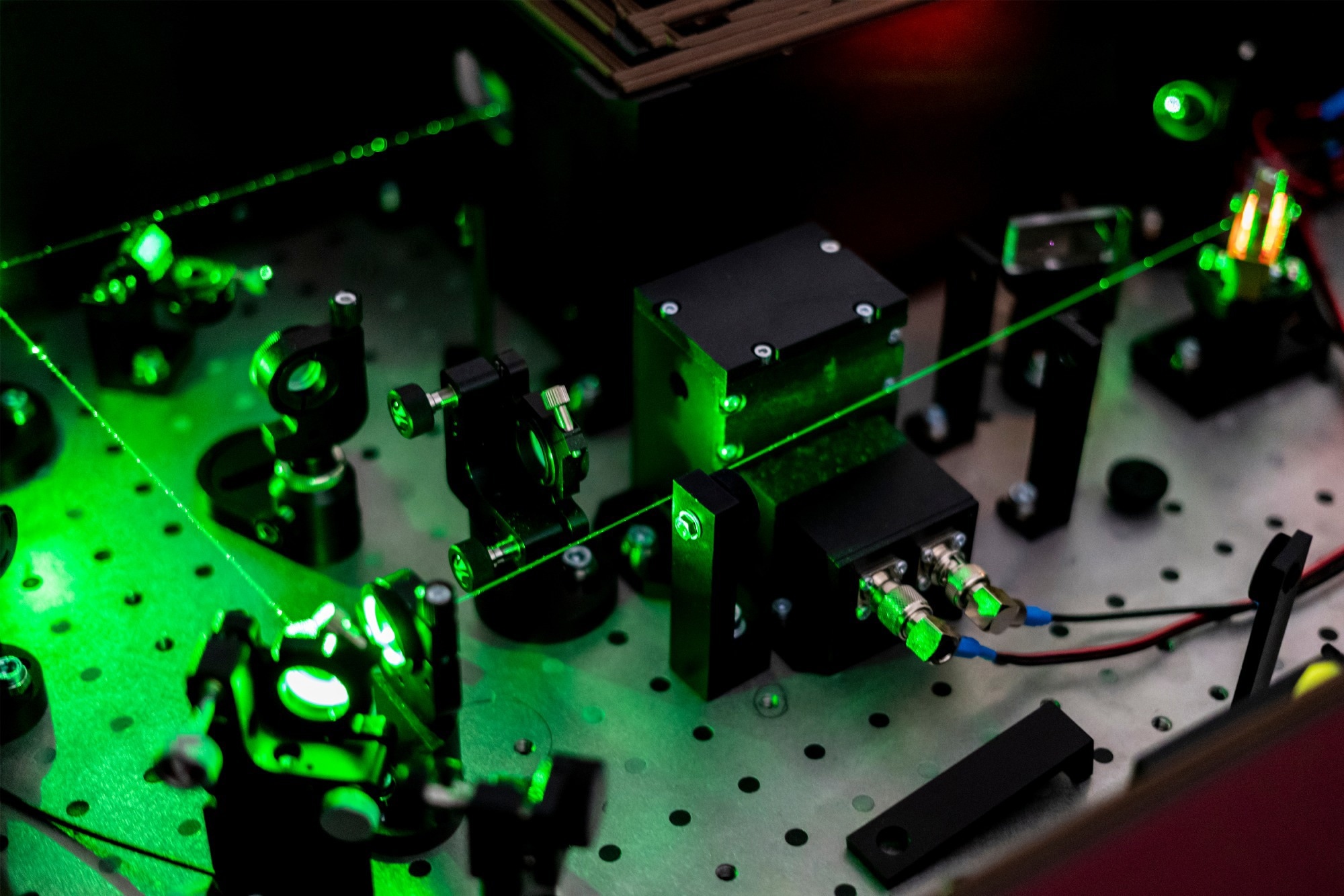 Image Credit: Mike_shots/Shutterstock
Recently, researchers have explored alternatives that offer greater flexibility and expand design options for engineers. This article highlights the limitations of mode locking and examines three promising alternatives: electro-optic pulse carving on chips, compressed pulses from electrically switched diodes, and external stages that shorten pulses after emission from the laser.1
Limitations of Mode Locking
In a mode-locked laser, the time light takes to complete one round trip inside the cavity sets the pulse repetition rate. Changing that rate usually means rebuilding the cavity and reoptimizing its performance. For stable operation with single pulses, it is crucial to control factors like dispersion, nonlinearity, and polarization in the fiber or crystal. Small variations in temperature or mechanical vibration can disrupt this balance and compromise reliability outside of lab conditions.1
Many modern applications require features that a traditional cavity struggles to provide. Optical communications, precision ranging, and spectroscopy increasingly favor pulse trains repeating at tens of GHz with broad tunability. Manufacturers also want sources that can be reprogrammed electronically and produced at scale. These demands, along with the need for lower costs, have led researchers to seek simpler, more controllable methods for producing ultrashort pulses.2
Carving Pulses from Steady Light
The first alternative starts with a continuous-wave laser that emits a steady beam and shapes its output electronically. Electro-optic modulators change the intensity and phase of light whenever a voltage is applied. Driving them with a microwave signal slices the steady beam into a regular sequence of pulses. The microwave frequency alone then decides how often those pulses arrive, so no cavity length needs adjusting or rebuilding at all.2
A team led by Harvard researchers turned this idea into a chip-scale time lens. A glass lens focuses light in space, and a time lens bunches light in time. Their device, based on thin-film lithium niobate, combined amplitude and phase modulators with a chirped Bragg grating. The setup was pumped by an ordinary semiconductor laser chip and a microwave source, producing 520 fs pulses at 30 GHz without stabilization electronics.3
Thin-film lithium niobate makes this approach practical by pairing a strong electro-optic response with low optical loss and wafer-scale fabrication. A recent Harvard research has explored on-chip pulse and comb generation in this material as an alternative to bulky mode-locked lasers. The same work reports a packaged pulse source built with photonic wire bonding, an important step toward devices that can leave the optical bench.4
Resonators Stretch the Spectrum
Pulses carved by a single pass through modulators have limited bandwidth. To enhance this, researchers place the modulator inside a tiny optical ring, allowing light to circulate multiple times. With each lap, the light gains new frequency sidebands. As a result, the output forms a broad frequency comb, which is a spectrum of evenly spaced colors, with the spacing corresponding to the microwave drive. Such combs serve as rulers for measuring light in spectroscopy, timekeeping, and communications.2
Download the PDF of this page here
Power efficiency has held this method back, since common electrode designs reflect most of the microwave energy toward the driving electronics. A work published in Photonics Research replaced them with an on-chip microwave resonator. The device generated a comb spanning more than 85 nm at 25.6 GHz using 740 mW, cutting electrical power needs more than threefold, and removing the need for protective isolators.2
Switched Diodes Reach the Femtosecond Range
A second approach uses gain switching, in which a brief electrical jolt prompts a semiconductor laser diode to emit short bursts of light. These diodes are compact, cost-effective, and fully electronic, allowing users to adjust repetition rates and power on demand. However, their primary limitation is pulse length, with typical gain-switched pulses restricted to tens of picoseconds due to modulation speed and photon lifetime constraints.1
Researchers at the University of Southampton addressed this issue at 1.87 μm, a wavelength valued for multiphoton deep-tissue imaging, medicine, and mid-infrared generation. They first amplified 40 ps diode pulses, broadened their spectrum in a highly nonlinear fiber, and filtered out distorted frequency components.1
A length of standard single-mode fiber squeezed the pulses to 1.2 ps, and a final amplifier compressed them further through soliton formation. The finished all-fiber system delivered 509 fs pulses with 4.7 nJ of energy, about 80 times shorter than the seed, from a compact and robust package.1
Moving the Hard Work Outside the Cavity
A third strategy uses a simple, robust oscillator while relying on external optics to handle most of the shortening. In a multipass cell, light reflects many times between curved mirrors while interacting with a nonlinear medium. Each pass broadens the spectrum a little, and dispersive optics, such as chirped mirrors, afterward compress the pulse. Mode locking provides the initial pulses, and the cell determines the final duration.5
Researchers at Helmut Schmidt University demonstrated how far this idea can go using a compact setup. They sent 120 fs pulses from a thin-disk oscillator through two multipass cells in series. The output reached 7.2 fs, only a few optical cycles, at 146 W of average power with 81% throughput. This is the highest average power reported for an amplifier-free few-cycle source known to the team.5
Conclusion
These advances in ultrafast lasers reflect a shift towards specialized components to enhance performance. Microwave electronics can precisely control pulse timing, while lithium niobate chips effectively modify and broaden spectra. Similarly, inexpensive diodes provide seed light, and either fiber or mirror-based systems compress pulses to femtosecond durations. Each approach trades some performance for gains in flexibility, ruggedness, or integration, and allows designers to avoid dependency on a single finely tuned cavity.1-5
Mode-locked oscillators will continue to play a role in critical applications, often serving as seeds for external compression. Meanwhile, advancements in electronic control and chip-scale fabrication are paving the way for more compact, cost-effective, and tunable femtosecond pulse lasers. This shift will carry femtosecond science into clinics, factories, and communication networks far beyond today’s laboratories.
References and Further Reading
- Abughazaleh, I. H. et al. (2025). Femtosecond thulium fiber laser utilizing a gain-switched laser diode. Optical Letters, 50, 3636-3639. DOI:10.1364/OL.564071. https://opg.optica.org/ol/fulltext.cfm?uri=ol-50-11-3636
- Chen, H. et al. (2025). Microwave-resonator-enabled broadband on-chip electro-optic frequency comb generation. Photonics Research, 13, 426-432. DOI:10.1364/PRJ.546194. https://opg.optica.org/prj/fulltext.cfm?uri=prj-13-2-426
- Yu, M. et al. (2023). Femtosecond Pulse Generation via an Integrated Electro-Optic Time Lens. ArXiv. DOI:10.48550/arXiv.2112.09204. https://preprints.opticaopen.org/articles/preprint/Femtosecond_Pulse_Generation_via_an_Integrated_Electro-Optic_Time_Lens/21884073?file=38820333
- Cheng, R. H. (2024). Integrated Sources on Thin-Film Lithium Niobate. Harvard University Graduate School of Arts and Sciences. https://dash.harvard.edu/entities/publication/80e95f22-b291-4a20-b5a7-1bd21b98f2f1
- Goncharov, S. et al. (2024). 146 W, 7 fs, 11 μJ thin-disk oscillator compressed with multiple cells. Proc. SPIE 12864, Solid State Lasers XXXIII: Technology and Devices. DOI:10.1117/12.3025383. https://www.spiedigitallibrary.org/conference-proceedings-of-spie/12864/3025383/146-W-7-fs-11-uJ-thin-disk-oscillator-compressed/10.1117/12.3025383.full
Disclaimer: The views expressed here are those of the author expressed in their private capacity and do not necessarily represent the views of AZoM.com Limited T/A AZoNetwork the owner and operator of this website. This disclaimer forms part of the Terms and conditions of use of this website.