*Important notice: This news reports on an unedited version of an accepted paper and is awaiting final editing. Therefore, the paper should not be regarded as conclusive or treated as established information.
Optical lenses have been manufactured aboard the International Space Station (ISS) using a novel fluidic shaping technique. Researchers achieved ultra-smooth surfaces and scalable liquid-lens fabrication under microgravity conditions. Their findings were published in npj Microgravity.
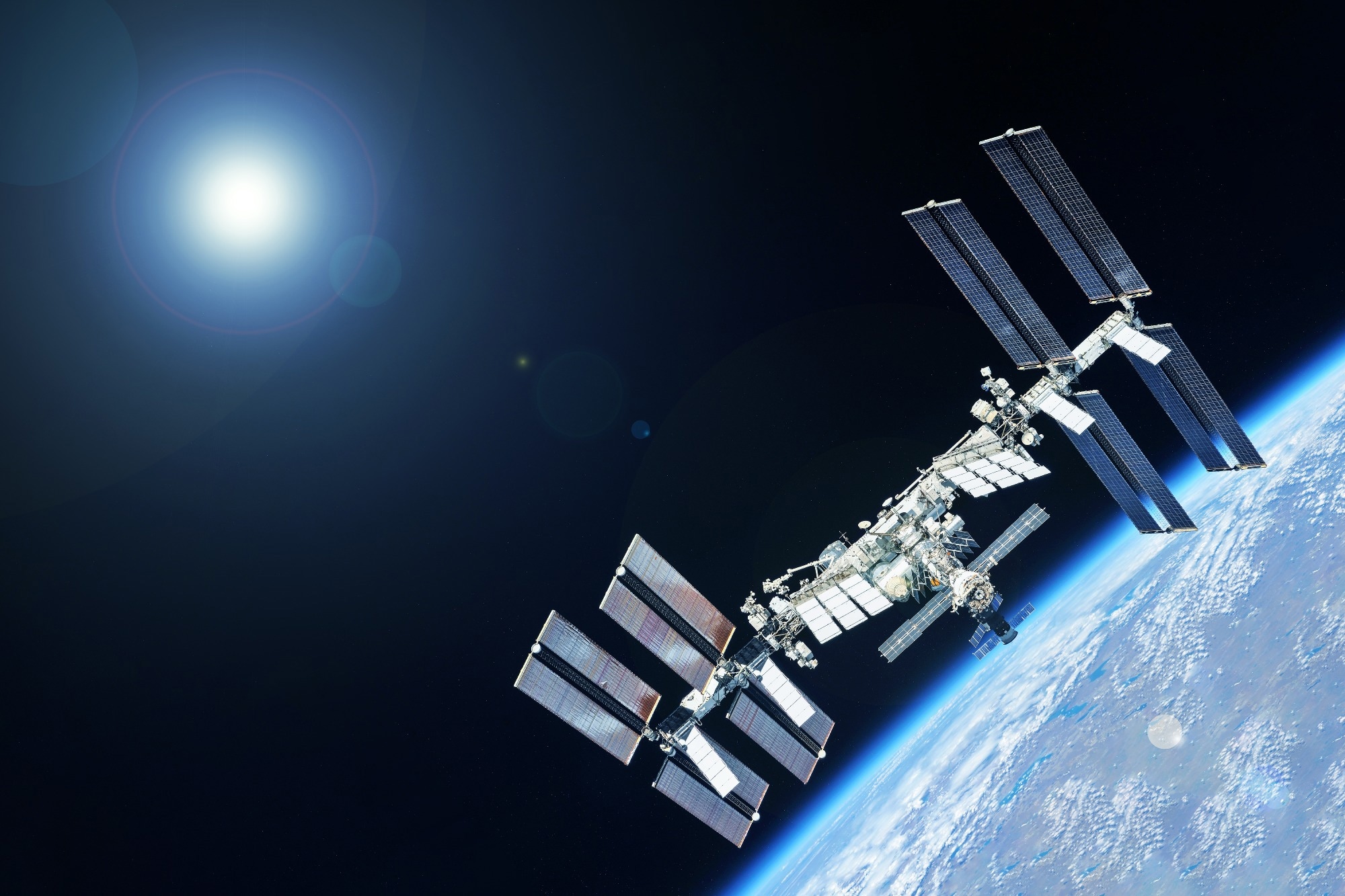 Study: In-space manufacturing of optical lenses: Fluidic Shaping aboard the International Space Station. Image Credit: Artsiom P/Shutterstock.com
Challenges in Space Optics
In-space manufacturing of optical components is critical for enabling sustained and advanced space exploration missions. Traditional methods for producing optical lenses, such as grinding and polishing, rely on heavy machinery and resources, making them impractical for space applications.
Busy now? Download a free PDF of this news piece for later!
While additive manufacturing has advanced mechanical parts onboard the ISS, it fails to achieve the ultra-smooth surfaces necessary for high-quality optics, which require nanometer-scale surface roughness. Additionally, optical elements in space need to be scalable beyond launch-vehicle size constraints, as with large telescopes.
Microgravity presents unique opportunities to leverage fluidic shaping, a technique that uses surface tension to form optical lenses with extremely smooth surfaces without mechanical intervention. Fluidic shaping is inherently well-suited to weightless conditions, enabling the formation of lenses by injecting a liquid into a bounding frame and curing it when photopolymeric materials are used.
Fluidic Shaping Implementation
The research involved two experiments performed onboard the ISS during the Axiom Space Ax-1 mission in April 2022. The first experiment targeted the fabrication and curing of centimeter-scale polymer lenses using UV-curable photopolymers.
The experiment hardware comprised a lens manufacturing chamber designed to inject optical liquid into a circular bounding frame, then cure it under UV light to form a solid lens. Astronauts were trained extensively on Earth using neutral buoyancy simulations to replicate microgravity conditions, practicing injection, bubble removal, edge pinning, and curing lenses. Three polymers were used: TJ-3704A, NOA 63, and NOA 61, with volume injection and UV curing protocols optimized before flight.
The second experiment assessed scalability by deploying a large 172 mm diameter liquid lens made from water. The deployment occurred in the open cabin of the ISS Destiny module, where astronauts filled an acrylic circular frame with water taken from the station’s drinking system. They manually injected and pinned the liquid to the frame edges, removing trapped air bubbles by aspiration with syringes and controlling the lens curvature by altering liquid volume.
The optical functionality was demonstrated visually and analyzed quantitatively through modulation transfer function (MTF) estimation based on video footage captured with a high-definition camcorder. MTF analysis applied the slanted-edge method standardized in ISO 12233 to assess the resolving ability of the water lens, accounting for factors such as compression from video encoding and possible aberrations.
ISS Lens Fabrication Outcomes
The first experiment successfully produced cured polymer lenses with sub-nanometric surface roughness, confirmed through atomic force microscopy and optical profilometry after returning samples to Earth. The NOA61 lenses exhibited smooth, near-ideal spherical surfaces, demonstrating excellent optical quality and refractive capability, as verified by the distortion of grid patterns through the lens. However, some bubbles were seen near their surfaces.
However, lenses made from the TJ-3704A polymer showed unexpected dimples on their surfaces. Subsequent investigation linked these defects to localized boiling caused by heat generation during polymerization under microgravity, highlighting complex thermochemical polymerization dynamics unique to space environments. This points to the necessity of further research optimizing polymerization kinetics and thermal management for in-space curing processes.
The large liquid-lens experiment demonstrated the scalability aspect of fluidic shaping, confirming that a stable, plano-convex lens form can be achieved by manually injecting water under microgravity without an immersion fluid.
The lens exhibited clear magnification effects visible to the astronauts. MTF analysis of the video footage revealed modulation transfer functions below ideal lens simulations, attributable primarily to lossy video compression, optical aberrations from slight deviations in lens shape, potential boundary imperfections due to dust or oil residues, mechanical vibrations, airflow disturbances from ventilation systems, and trapped air bubbles within the lens.
These aberrations collectively degrade image quality and underscore the challenges of achieving perfect spherical curvature and optical performance in large fluidic lenses under practical space conditions. Despite these limitations, the experiment validates the potential of fluidic shaping for producing large-scale optics in microgravity and identifies critical factors for refining deployment methods to minimize bubbles and ensure proper wetting and pinning.
Future Directions in Space Optics
This work represents the first successful demonstration of in-space manufacturing of optical lenses using fluidic shaping aboard the ISS. The approach exploits microgravity to form ultra-smooth liquid-lens surfaces determined solely by surface tension and bounding frames, which can then be solidified if curable materials are employed.
These findings establish fluidic shaping as a promising path toward self-sufficient optics fabrication in space, which could prove useful for future large space telescopes and corrective eyewear for astronauts during long-duration missions. Continued research is needed to optimize material behavior under microgravity and to refine liquid-handling techniques, paving the way toward practical, high-quality in-space optical manufacturing.
Journal Reference
Luria O., Elgarisi M., et al. (2026). In-space manufacturing of optical lenses: Fluidic Shaping aboard the International Space Station. npj Microgravity. https://www.nature.com/articles/s41526-026-00629-6.