Surface-enhanced Raman spectroscopy (SERS) is a fast, sensitive method for identifying proteins. It works by amplifying the weak vibrational signals of proteins near special metal surfaces. SERS has been an important tool in proteomics, the study of proteins’ structure, function, and abundance in complex biological samples.
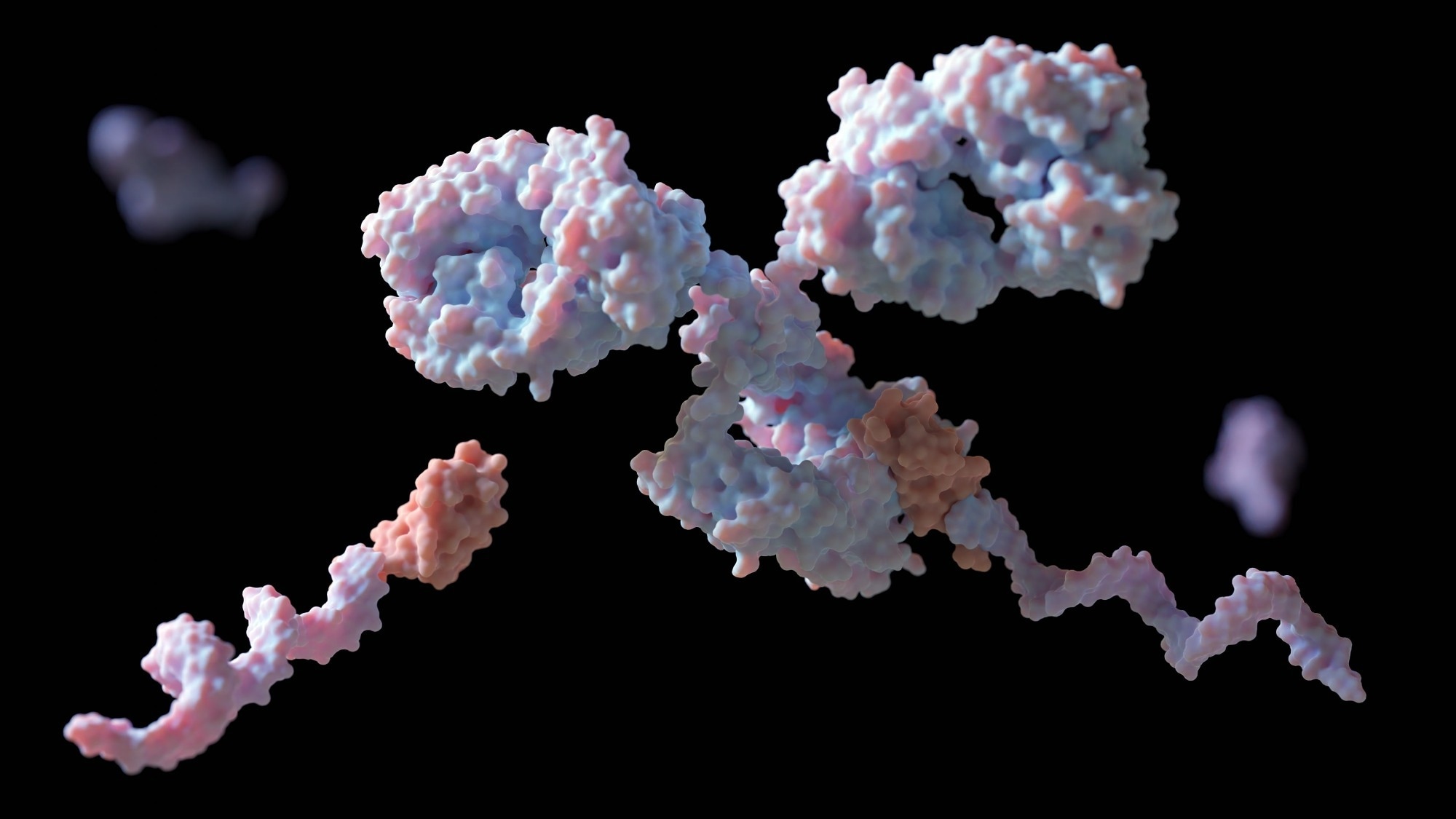 Image Credit: Love Employee/Shutterstock
How does SERS Detect Proteins?
Raman spectroscopy measures how light scatters off molecular bonds, producing a spectral fingerprint unique to each substance. Proteins naturally produce weak Raman signals, which limits their detection at low concentrations. Metal nanostructures made from gold or silver amplify these signals by factors of up to a million, allowing scientists to observe proteins that would otherwise remain invisible to standard Raman techniques.1
This amplification occurs through localized electromagnetic fields generated when light interacts with the nanostructured metal surface. Proteins positioned near these surfaces experience a dramatic increase in their scattering intensity. The observed spectra reveal details about amino acid composition, secondary structure, and even how a protein folds under different conditions.2
Because SERS captures intrinsic molecular vibrations, it does not require any fluorescent tags or radioactive labels in many applications. Label-free detection preserves the native state of the protein during analysis. This allows scientists to discover new structural details that some labeled techniques might obscure due to chemical modifications of the target molecule.1
Advances in Substrate Design
The performance of any SERS experiment depends heavily on the substrate, meaning the nanostructured surface where signal amplification happens. Early substrates were made of simple silver colloids, which produced inconsistent results due to random clustering of nanoparticles. Newer designs use engineered silver nanocubes and gold nanostructures with precisely controlled geometry to generate reproducible hot spots.3
Immuno-SERS, also known as iSERS, combines antibody-based recognition with SERS nanotags to target specific proteins within complex mixtures. Gold nanoparticles get functionalized with Raman-active molecules and conjugated to antibodies, creating probes that bind selectively to disease markers. This approach improves specificity while retaining the sensitivity advantages of traditional SERS methods.4
Substrate innovation has also addressed reproducibility problems that once limited clinical adoption. Researchers now fabricate substrates with lithographic precision, producing arrays of nanostructures with uniform spacing and shape. Consistent hot spot geometry translates directly into more reliable quantification across repeated measurements and different sample batches.4
Sample Preparation and Workflow
Sample preparation shapes the quality of every SERS in a proteomics study because proteins respond strongly to surface chemistry, salt concentration, and pH. Clean and controlled preparation helps preserve native structure and supports more stable spectra, especially when researchers analyze blood, tissue extracts, or cell lysates.1
Download the PDF of this page here
A typical workflow begins with sample collection, followed by stabilization, deposition on a SERS-active substrate, and spectral acquisition under controlled laser settings. Each step affects signal quality, so researchers often optimize buffer conditions and incubation time before concluding the spectra.4
Proteomics applications also benefit from enrichment steps that concentrate low-abundance proteins before analysis. This is useful in biomarker research, where the target protein may appear at trace levels inside a much larger background of abundant proteins. Careful workflow design improves both sensitivity and interpretability.3,5
Single Molecule and Quantification
SERS has reached sensitivity levels sufficient to detect individual protein molecules, a milestone that opens possibilities for early disease diagnosis. Researchers developed two-step detection processes in which a protein binds to a linker molecule in solution before transferring onto a SERS-active surface for analysis. This method demonstrates a working proof of concept for ultrasensitive medical diagnostics.5
Quantification is more challenging than detection. SERS signals fluctuate based on molecular orientation and distance from the metal surface. Scientists tackle this issue using similarity analysis techniques that compare spectra from antibody-only samples to those from protein-conjugated samples. Additionally, centrifugation-based coating methods create uniform nanoparticle layers that improve measurement consistency across samples.1
These quantification strategies achieve detection limits reaching sub-picomolar concentrations, a sensitivity range relevant for biomarkers present at trace levels in blood or other body fluids. Imaging capabilities extend this precision to micrometer-scale spatial resolution, letting researchers map protein distribution across tissue samples. Such spatial detail supports research into disease progression at the cellular level.1
Combining SERS with Machine Learning
Raw SERS spectra contain overlapping peaks from different amino acids, making manual interpretation difficult when analyzing complex protein mixtures. Machine learning algorithms now process these spectral datasets to identify patterns invisible to conventional analysis. Trained models classify protein signatures with accuracy that exceeds traditional peak-matching approaches used in earlier decades.3
Deep learning architectures analyze thousands of spectral features simultaneously, correlating subtle intensity variations with specific protein identities or concentrations. This computational approach helps researchers distinguish between structurally similar proteins that produce nearly identical Raman signatures. Diagnostic applications benefit directly from these improvements in spectral classification accuracy.5
Predictive models built from spectral libraries allow researchers to estimate protein composition even in mixed or contaminated samples. This reduces reliance on separate purification steps that traditionally preceded spectroscopic analysis. Combining SERS hardware with computational analysis creates a workflow suited for high-throughput proteomic screening in research and clinical settings.5
Challenges and Clinical Outlook
Reproducibility across laboratories remains a persistent obstacle for SERS adoption in clinical proteomics. Variations in substrate fabrication, laser calibration, and sample preparation introduce inconsistencies that complicate cross-study comparisons. Standardized protocols for substrate manufacturing could help address these barriers as the field matures toward routine diagnostic use.6
Multi-component analysis presents another technical hurdle, since biological fluids contain thousands of proteins alongside lipids, sugars, and metabolites that generate overlapping spectral signals. Researchers continue developing separation techniques and selective nanotags to isolate target proteins from this molecular crowd. Progress in this area determines how quickly SERS moves from research laboratories into hospital diagnostic panels.3
Despite these obstacles, SERS shows strong promise for detecting disease biomarkers at ultra-low concentrations. Collaboration between chemists, physicists, and data scientists continues to refine substrate materials and analytical algorithms. This interdisciplinary effort points toward practical clinical tools built on SERS technology within the coming years.6
Proteomics research depends on tools that combine sensitivity with structural detail, and SERS delivers both qualities through its unique signal amplification mechanism. As substrate engineering and computational analysis continue to improve, SERS is poised to play an increasingly important role in biomarker discovery and disease diagnostics in research and clinical laboratories worldwide.4
Referencing and Further Reading
- Cai, L. et al. (2022). Label-Free Surface-Enhanced Raman Spectroscopic Analysis of Proteins: Advances and Applications. International Journal of Molecular Sciences, 23(22). DOI:10.3390/ijms232213868. https://www.mdpi.com/1422-0067/23/22/13868
- Bruzas, I. et al. (2018). Advances in surface-enhanced Raman spectroscopy (SERS) substrates for lipid and protein characterization: sensing and beyond. Analyst, 143 (17): 3990–4008. DOI:10.1039/c8an00606g. https://pubs.rsc.org/an/article-abstract/143/17/3990/630500/Advances-in-surface-enhanced-Raman-spectroscopy
- Zhang, Q. et al. (2026). Surface-enhanced Raman spectroscopy for protein detection: Challenges and countermeasures. Talanta, 298, 128901. DOI:10.1016/j.talanta.2025.128901. https://www.sciencedirect.com/science/article/abs/pii/S003991402501392X
- Choi, N. et al. (2024). iSERS: from nanotag design to protein assays and ex vivo imaging. Chem. Soc. Rev. 53 (13): 6675–6693. DOI:10.1039/d3cs01060k. https://pubs.rsc.org/cs/article/53/13/6675/804046/iSERS-from-nanotag-design-to-protein-assays-and-ex
- Srivastava, S. et al. (2024). AI-Driven Spectral Decomposition: Predicting the Most Probable Protein Compositions from Surface Enhanced Raman Spectroscopy Spectra of Amino Acids. Bioengineering, 11(5). DOI:10.3390/bioengineering11050482. https://www.mdpi.com/2306-5354/11/5/482
- Cialla-May, D. et al. (2024). Recent advances of surface enhanced Raman spectroscopy (SERS) in optical biosensing. TrAC Trends in Analytical Chemistry, 181, 117990. DOI:10.1016/j.trac.2024.117990. https://www.sciencedirect.com/science/article/pii/S0165993624004734
Disclaimer: The views expressed here are those of the author expressed in their private capacity and do not necessarily represent the views of AZoM.com Limited T/A AZoNetwork the owner and operator of this website. This disclaimer forms part of the Terms and conditions of use of this website.