Most Deltech furnaces are built for maximum operating temperatures ranging from 1500 to 1800 °C for air operation; hence, molydisilicide heating elements are used due to their ability to quickly reach and maintain high temperatures and their affinity for oxidizing atmospheres.
Despite their robust appearance, they are a fragile, glass-like material with low mechanical shock resistance.
Essentially, the molybdenum core is coated with quartz glass. As the elements approach their maximum temperature, they become liquid, and the glass surface reacts with oxygen in the air to build a new layer of protective glass on the element surface. This layer holds the element together through surface tension.
The maximum element temperature is always 100 °C higher than the maximum rated furnace temperature. For example, Deltech uses 1800 °C elements in its 1700 °C furnaces.
Operation in inert atmospheres necessitates either the adoption of a higher temperature element (for example, 1800 °C elements for 1600 °C operation in argon) or a limit on the maximum furnace operating temperature to accommodate element constraints.
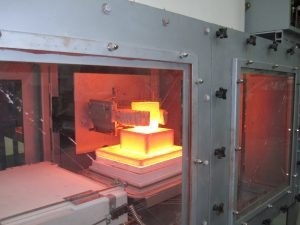
Image credit: Deltech Furnaces, Inc.
Molydisilicide Heating Element Temperature in Atmospheres (°C)
Source: Table adapted from the Kanthal Super Handbook
| Column 1 |
Column 2 |
Column 3 |
Column 4 |
| Element grade |
1700 |
1800 |
1900 |
| Air |
1700 |
1800 |
1900 |
| Nitrogen |
1600 |
1700 |
1800 |
| Argon, Helium |
1600 |
1700 |
1800 |
| Dry hydrogen, dewpoint -80 °C |
1150 |
1150 |
1150 |
| Moist hydrogen, dewpoint 20 °C |
1450 |
1450 |
1450 |
| Endogas |
1400 |
1450 |
1450 |
| Cracked and partially burnt ammonia |
1400 |
1400 |
1400 |
Temperatures shown are element temperatures; furnace temperatures will be 100 °C lower.
Many variables affect an element's life, so manufacturers only provide warranties against manufacturing defects. For example, operating in a reducing environment or performing rapid heating and cooling cycles can be dangerous to the element's health.
Here are some suggestions for extending the life of the molydisilicide heating elements in a furnace:
- Condition new heating elements by heating the empty furnace to 1550 °C and holding for an hour. Then reduce the heat or turn off the furnace. This adds a thin, protective glass covering to the elements.
- To recondition the furnace’s surfaces, follow the first firing procedure if operating at temperatures below 800 °C for an extended duration.
- Reduce ramp rate to 60–100 °C per hour at temperatures 100–200 °C lower than the furnace's maximum rated temperature.

This information has been sourced, reviewed, and adapted from materials provided by Deltech, Inc.
For more information on this source, please visit Deltech, Inc.