Tailored long-wave infrared (LWIR) space telescopes play a critical role in sophisticated aerospace remote sensing applications, such as Earth observation, environmental monitoring, and target detection.
Engineering these systems requires overcoming substantial obstacles in temperature stability, infrared material selection, aberration correction, dual-band performance, and survivability in the space environment.
By employing advanced optical design, passive athermalization, precision aspherical production, aerospace-grade coatings, and stringent qualification procedures, high-performance LWIR optical systems are able to operate reliably under harsh mission conditions.
An integrated engineering approach is crucial to ensuring that flight-ready optical solutions meet rigorous performance criteria.
From Optical Design to Space Qualification
Long-wave infrared (LWIR) imaging systems functioning in the 7–12 μm spectral range are critical for contemporary aerospace and remote sensing applications. Their ability to detect thermal radiation without relying on visible illumination makes them valuable for Earth observation, environmental monitoring, target detection, space surveillance, and meteorological evaluation.
As aerospace missions require greater imaging performance, extended operational lifetimes, and minimized payload mass, conventional commercial infrared optics frequently fail to satisfy the necessary requirements. As a result, custom-engineered LWIR telescope systems are becoming crucial for next-generation spaceborne and airborne platforms.
Avantier specializes in the design, production, assembly, and qualification of high-performance infrared optical systems. This article investigates the technical obstacles involved in engineering a tailored LWIR telescope for aerospace applications and demonstrates how an integrated engineering strategy ensures flight-ready optical solutions comply with stringent specifications.
The Importance of LWIR Telescopes for Aerospace Remote Sensing
In contrast to visible imaging systems, LWIR sensors capture thermal emissions produced by objects themselves. This facilitates reliable imaging day and night, even in harsh atmospheric conditions.
Common use cases include:
- Earth observation and environmental tracking
- Wildfire detection and disaster management
- Defense and target recognition systems
- High-altitude airborne sensing platforms
- Meteorological observation
- Maritime surveillance
- Space situational awareness
To support these missions, optical systems must provide elevated sensitivity, exceptional image quality, thermal stability, and long-term dependability under extreme operating conditions.
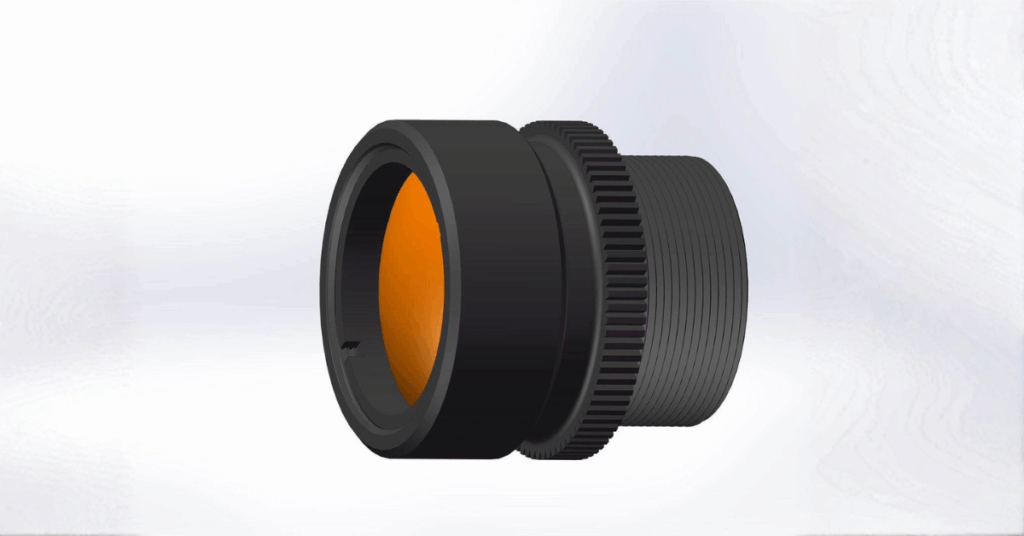
LWIR Lens Design by Avantier. Image Credit: Avantier Inc.
Example System Specifications
Consider a representative aerospace LWIR telescope with the following requirements:
Source: Avantier Inc.
| Parameter |
Specification |
| Spectral Range |
7–12 μm |
| Dual-Band Coverage |
7–9 μm and 10–12 μm |
| Effective Focal Length |
380 mm |
| F-Number |
F/2 |
| Field of View |
0.8–1.6 ° |
| Energy Encirclement |
≥ 8 8% within 60 μm |
| Operating Temperature |
0–50 °C |
| Weight Target |
≤ 2 kg |
| Space Qualification |
Radiation, vibration, and vacuum compatible |
While these requirements may seem straightforward individually, achieving all of them concurrently poses substantial engineering challenges.
Key Engineering Obstacles
1. Limited Material Options in the LWIR Band
In contrast to visible optics, long-wave infrared systems can use only a relatively small number of optical materials. Common candidates include:
- Chalcogenide glasses
- Zinc Selenide (ZnSe)
- Germanium (Ge)
- AMTIR materials
Each material involves trade-offs in:
- Temperature sensitivity
- Mechanical durability
- Refractive index
- Dispersion
- Radiation resistance
As an example, germanium provides exceptional infrared transmission and high refractive power but exhibits a large temperature-dependent refractive index shift, making thermal compensation especially difficult.
2. Large-Aperture Aberration Correction
A 380 mm F/2 telescope functions in a regime where aberration control becomes increasingly challenging. Engineers must concurrently manage:
- Spherical aberration
- Coma
- Astigmatism
- Field curvature
While maintaining these factors, they must also preserve diffraction-limited or near-diffraction-limited performance across the full field of view. Obtaining a spot diameter under 20 μm frequently necessitates advanced aspherical surface optimization and extensive design iteration.
3. Passive Temperature Stability
One of the most exacting specifications for aerospace optics is maintaining focus over broad thermal fluctuations without active refocusing mechanisms. In orbit, thermal variations can readily degrade image quality if temperature effects are not appropriately compensated. An effective passive athermalization approach requires:
- Controlled optical power distribution
- Meticulous material pairing
- Structural thermal matching
- Precision mechanical design
The objective is to maintain focal position stability throughout the operating thermal range without introducing moving components that could reduce system dependability.
4. Dual-Band Performance Optimization
Supporting both the 7–9 μm and 10–12 μm bands within one optical architecture substantially increases design complexity. Since dispersion behavior differs between the two wavelength ranges, image quality must be balanced concurrently in both bands. This frequently requires multiple infrared materials and global methods for optimization to ensure consistent performance on a common focal plane.
5. Space Environment Survivability
Optical performance by itself is insufficient for aerospace deployment. Space-qualified systems must also endure:
- Long-duration operational stress
- Launch vibration and shock
- Thermal vacuum cycling
- Ionizing radiation exposure
- Vacuum outgassing impacts
These environmental variables affect every design decision, from material selection and coating development to structural design and assembly techniques.
Engineering Solutions for Aerospace LWIR Systems
Advanced Optical Design
Architecture optimization is the first step of the development process. For this class of telescope, a multi-element refractive configuration delivers an effective balance between:
- Thermal management
- Mechanical simplicity
- Optical performance
- System mass
By incorporating optimized aspherical surfaces and carefully distributed optical power, image quality can be preserved across the full field of view.
Passive Athermal Optical Architecture
Combining germanium and chalcogenide materials enables passive compensation of thermally induced focus shifts. When integrated with a thermally optimized housing structure, focal plane movement can be minimized to well within permissible tolerances across the operational thermal range.
This strategy removes the need for motors or active focusing mechanisms while substantially enhancing long-term dependability.
Aerospace-Grade Materials and Coatings
Material selection extends beyond optical performance; parts must also meet aerospace specifications for:
- Long-term environmental durability
- Radiation resistance
- Mechanical stability
- Minimal outgassing
Broadband antireflection coatings manufactured using ion-assisted deposition (IAD) technology can achieve transmission levels exceeding 97% while maintaining robust adhesion during temperature cycling and radiation exposure.
Precision Aspherical Production
Multiple LWIR systems depend on ultra-precision single-point diamond turning (SPDT) to produce infrared aspheres. This procedure facilitates:
- Efficient manufacturing of infrared materials
- Enhanced aberration correction
- High surface precision
- Intricate aspherical geometries
For manufacturing programs, precision replication technologies can further minimize production expenses while maintaining consistent performance.
Tolerance Evaluation and Qualification
Before manufacturing starts, in-depth Monte Carlo tolerance evaluation is carried out to analyze producibility and performance robustness. The qualification procedure often includes optical performance verification, assessment of temperature, vibration, and shock, and environmental validation.
These procedures guarantee that the final system performs as intended during both launch and operational conditions.
From Concept to Flight-Ready Optical Systems
The development of a high-performance LWIR telescope is a multidisciplinary engineering effort covering optical design, materials science, precision fabrication, thermal engineering, and aerospace qualification.
Success depends on achieving optical requirements and providing a reliable system that can survive the harsh environments encountered during launch and long-term operation.
Avantier delivers end-to-end support for tailored infrared optical systems, from initial feasibility research and optical design through production, assembly, evaluation, and qualification.
Whether the use case involves satellites, high-altitude platforms, airborne sensors, or sophisticated remote sensing payloads, Avantier’s engineering teams collaborate closely with clients to transform demanding performance specifications into practical, producible solutions.

This information has been sourced, reviewed, and adapted from materials provided by Avantier Inc.
For more information on this source, please visit Avantier Inc..