Sponsored by MKS NewportReviewed by Olivia FrostJul 10 2026
Precise alignment is essential in laser design to simultaneously provide optimal power and beam stability in position and quality. To satisfy this requirement, the laser designer must precisely control the optical path inside the laser.
Image Credit: Pixel B/Shutterstock.com
By ensuring high accuracy and enabling nanometer-level linear displacement and µrad rotation level, Newport™ piezo products serve as ideal components to ensure long-term laser beam performance and quality and enable design flexibility.
Problem
Laser design requires considerable accuracy in assembling the components and sub-assemblies that constitute it. The optical path, in particular, must be accurately aligned to prevent power loss or damage to internal components, given the energy carried by the laser beam.
The Picomotor™ and Agilis™ series actuators, when used with Newport optical mounts, can control laser beam positioning/alignment and perform the necessary trajectory corrections to maintain an optimal optical path.
This degree of accuracy is especially valuable in optical designs that extend to several meters inside the laser. MKS identified three applications for piezo actuators and optical mounts in lasers:
- The first application is maintaining accurate laser beam positioning between the various internal components and, if required, being able to adjust the alignment without manual service operation.
- The second application involves moving the laser’s point of incidence on a non-linear crystal after surface damage or wear, thereby increasing the crystal's useful life.
In this case, a new region of the crystal surface is used, lengthening its lifetime without replacing it or conducting a time-intensive maintenance procedure. An additional benefit is that this can be performed without opening the laser, avoiding any risk of contamination.
- The third application is precision linear motion (e.g., Agilis) to enable moving optics to compress or stretch the pulse width and to act on the group-delay dispersion (GDD) in ultrafast lasers.
The Picomotor actuators and optical mounts associated with the dedicated controllers provided by MKS Newport are ideal for these applications due to their significantly fine resolution steps.
In addition, they allow for stable and exact positioning (step < 30 nm, angular resolution <1.5 µrad, no backlash) for the optical component, which can be a mirror or lens, while occupying a restricted volume.
State of the Art
A number of laser producers use Newport products in their laser systems. Their optical path includes the picomotor and the Super Agilis series, both associated with Newport optical mounts. These devices are regarded as industry standards for the previously mentioned applications.
In the laser optical path, frequently longer than one meter, MKS Newport’s products ensure correct beam travel from one internal module to another. Using these devices extends the lifetime of the module comprising the non-linear crystal, which has the shortest lifespan, and thus minimizes the total cost of ownership (TCO) of the complete laser.
The system typically includes a feedback loop to identify when system alignment occurs. It could be a photodiode measuring either position or power through signal reflection. The end-user initiates the laser beam recalibration operation.
Importantly, this operation must not occur when a job is ongoing, as it may damage the sample. Rather, it must be executed following adequate system warm-up (stable environment).
The nanometer-/μrad-level steps and the highly dependable, power-free position holding offered by Newport’s piezo products make them well-suited to ensuring process stability and enhancing durability, as the laser beam is precisely controlled and operates continuously under optimal conditions.
Piezos do not generate overheating. Additionally, these devices are fully compatible with the level of cleanliness required in lasers, as they do not emit any particles or organic material. These products can also be used in vacuum conditions.
This monitoring and calibration system is not only useful for minimizing maintenance but also enhances the quality of the fabricated components or processed operations, as the laser always works in optimal conditions at the required accuracy and quality levels.
Moreover, the quality of fabricated components or operations can be linked to laser calibration parameters in an Industry 4.0 environment. This enables the planning of preventive maintenance campaigns when the quality of the results begins to deviate from optimal values.
The Newport piezo actuator family distinguishes itself by providing exceptionally small steps, excellent repeatability, and compactness. Additionally, the range of Newport controllers provides a highly miniaturized and cost-effective solution for driving piezo actuators (picomotor and Super Agilis), with closed-loop control for fine-tuning and absolute positioning.
Solutions
The following examples are reference use cases that illustrate the aforementioned applications where Newport piezo actuators are particularly well-suited.
Principle of Laser Beam Alignment (Figure 1)
- Two adjustable mirrors are used to align the laser beam inside the laser and maintain a fixed optical path to prevent any drift or position change at the output. The mirrors can be arranged in different configurations inside the laser, according to the manufacturer’s design constraints, but the principle remains the same.
Manual or motorized mirror mounts can be used to perform the operation. Motorized mirrors can automate the alignment sequence, avoiding the need to open the laser and making the process faster while eliminating the risk of particle contamination from opening.
- To carry out tuning, some leading laser producers employ tailored picomotor-actuated pint-sized corner mounts with MKS Newport’s Tiny Picomotor actuators, available in a vacuum-compatible model depending on required environmental constraints.
For example, Newport’s 8887 Corner Mounts with 8353 Actuators are often used for laser beam θxθy alignment. The high compactness, degrees of freedom, and exceptional customization capabilities for ambient and vacuum use are highly valued by laser producers.
- Motorized θxθy mirrors can align the laser with the optimal path. If the laser design and embedded characteristics also require accurate beam centering, then additional degrees of freedom are needed for the mirror mount.
The Newport 8081 XYZθxθy (Figure 2) Motorized Five-Axis Tilt Aligner is used for laser alignment and an in-tune system by laser producers seeking five degrees of freedom, compactness, and very high-resolution adjustment (< 30 nm) in a compact product.
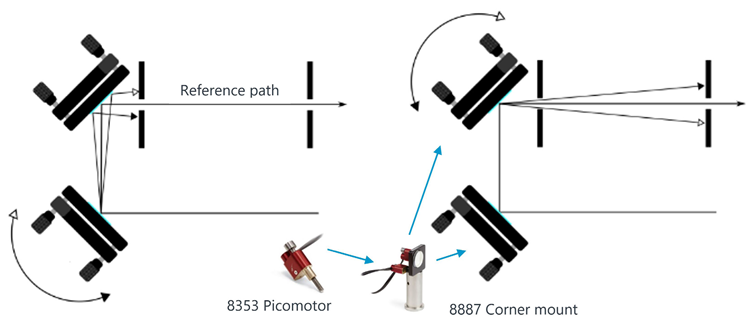
Figure 1. Laser Alignment Optimization. Image Credit: MKS Newport
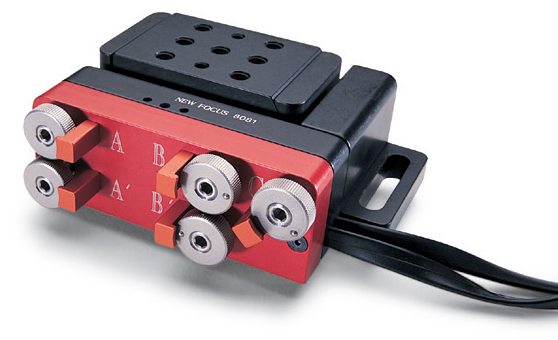
Figure 2. Newport 8081 XYZθxθy Motorized Five-Axis Tilt Aligner. Image Credit: MKS Newport
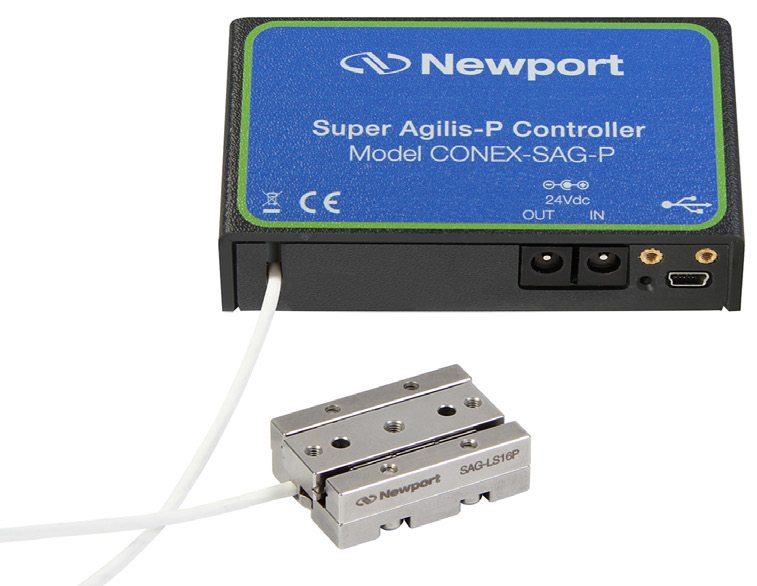
Figure 3. CONEX-SAG Super Agilis. Image Credit: MKS Newport
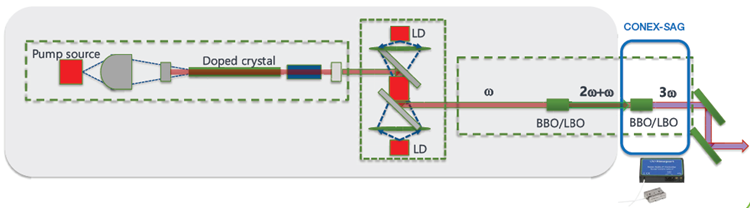
Figure 4. Schematic of the application changing the position of a nonlinear crystal for a UV solid-state laser. Image Credit: MKS Newport
The two aforementioned applications employ a Super Agilis stage with a controller.
Figure 4 illustrates the CONEX-SAG used in a UV laser to move the beam spot to a clear (undamaged) region of the BBO/LBO crystal in the laser system. The laser beam is focused on a nonlinear crystal (BBO (Beta Barium Borate)/LBO (Lithium TriBorate)) to produce UV light.
After several thousand hours, the crystal surface may degrade, and the laser beam must be shifted to a pristine region of the crystal to recover the laser characteristics and restore optimal operation.
The laser beam's incidence remains unchanged as long as the CONEX-SAG (Figure 3) is not energized, allowing the system to change position while remaining highly stable.
Figure 5 depicts a similar configuration that uses a CONEX controller and a Super Agilis actuator to adjust the pulse width of ultrafast lasers, providing one way to implement a variable pulse-compression system in an ultrafast amplifier.
The primary components used for pulse-length adjustment (diffraction grating, vertical retroreflector (VRR), and horizontal retroreflector (HRR)) are located in a module illustrated in the dashed green box. Upon entering this module, the laser light first encounters the diffraction grating.
This spatially disperses the different frequency components of the laser pulse, with higher frequencies (shorter wavelengths) diffracted at greater angles than lower frequencies (longer wavelengths).
The beam subsequently encounters the HRR, which folds the optical path and directs it to the VRR. The VRR reflects the dispersed beam right back toward the grating. By moving the HRR, the relative overall path length traveled by the different frequency components of the pulse is changed.
When the HRR is moved farther from the grating, the total path-length difference between the frequency components increases, which in turn increases the pulse length.
In contrast, bringing these components closer together reduces the path-length difference and shortens the pulse duration. Newport Super Agilis devices are well-suited for both applications due to their compact design, high precision, and submicron step.
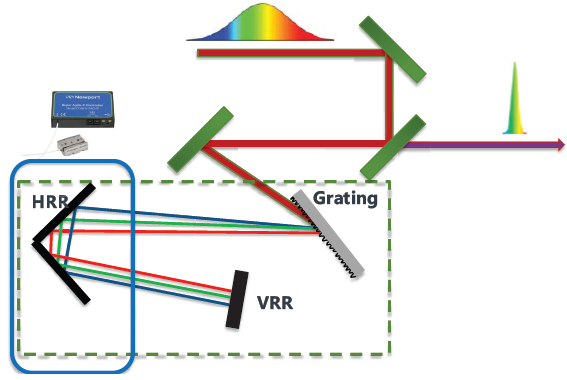
Figure 5. Schematic of the CONEX-SAG is used to adjust the pulse duration for ultrafast lasers. Translation movement delivered by the CONEX-SAG stage on the HRR mirror. Image Credit: MKS Newport
Conclusion
Newport piezo-based nanopositioning and optical mount solutions (Newport or New Focus™ Picomotor, Agilis, CONEX™) are ideally suited to challenging laser applications.
The product suite includes a broad range of picomotors, stages, actuators, mirrors, and lens mounts for alignment control, as well as demanding instantaneous compensation and adjustments when needed.
Newport’s broad product range enables clients to find components perfectly suited to their application (form factor, travel range, mounting, vacuum technology, or closed-loop options).
All of these factors are easily controlled with Newport’s plug-and-play controllers designed exclusively for these actuator types. The compactness of the components, their excellent precision, resolution, and stability performance make them compelling options.
The standard piezo actuators and picomotors can be used as is or tailored to suit specific client requirements, and will remain simple to adopt and use thanks to Newport’s dedicated controllers and accessories.
Support Products
8081: Motorized XYZθxθy Tilt Aligner, 3 mm, 8°
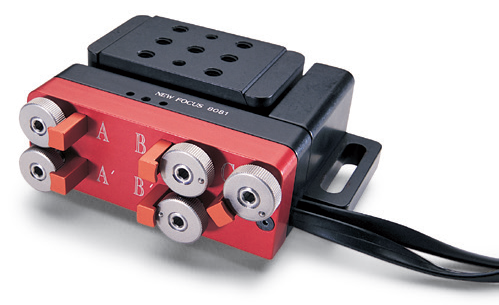
Image Credit: MKS Newport
The 8081 XYZΘxΘy Motorized Five-Axis Tilt Aligner enhances the utility of MKS Newport’s popular kinematic stages by motorizing each axis. Equipping each stage with picomotor actuators enables remote high-resolution (< 30 nm) adjustment of various combinations of X, Y, Z, θx, and θy.
Model 8081 five-axis aligners are well-suited for positioning modulators or isolators and for coupling light into waveguide devices. They are available with metric or SAE tapped holes.
CONEX-SAG-LS48P: High Speed Piezo Linear Stage, 48 mm Travel, Direct Encoder, Integrated Controller
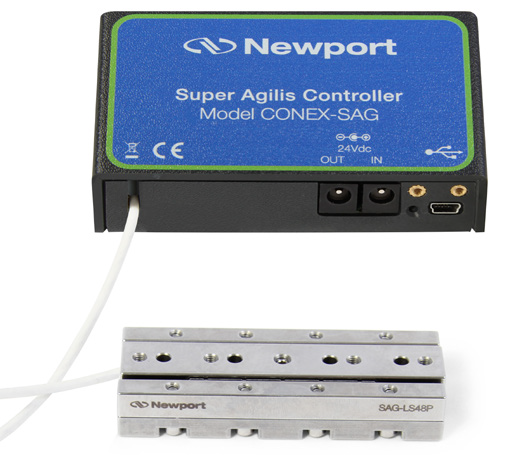
Image Credit: MKS Newport
The Super Agilis CONEX-SAG-LS48P is a piezo motor linear stage integrated with a closed-loop piezo motor controller/driver that delivers 48 mm travel and speeds of up to 10 mm/second.
This miniaturized linear stage includes an integrated direct-read linear encoder that enables high position repeatability in settings such as sample positioning, optics insertion, and focusing. This innovative encoder technology allows the footprint to be maintained while providing submicron bidirectional repeatability.
The CONEX-SAG-P controller combines a closed-loop algorithm with a direct-read linear encoder to achieve a system bidirectional repeatability of 25 nm. For positional stability, users can adjust the dead band parameter that stops dithering when the stage is within a set position tolerance.
The CONEX-SAG-LS48P is a highly miniaturized, cost-effective single-axis motion controller that is delivered pre-configured for the stage. The controller is accessible via USB, with options for other serial connections, from a user-friendly GUI or proprietary solution using a comprehensive command set.
With a 25 nm MIM, this stage is perfectly suited for high-accuracy applications also requiring high speed. In addition, stacking stages into an XY configuration is simple without requiring an adapter.
8885: Piezo Mirror Mount, Pint-Sized, Center Mount, 0.5 inch Diameter
The 8885 Picomotor Actuated Pint-Sized Center Mounts eliminate issues commonly associated with small systems, where there is little space for adjustments and high sensitivity to manual adjustments. The two picomotor actuators that enable remote tip adjustment and tilt axes add just 0.5 inches of depth to this 0.5 inch (12.7 mm) diameter mount.
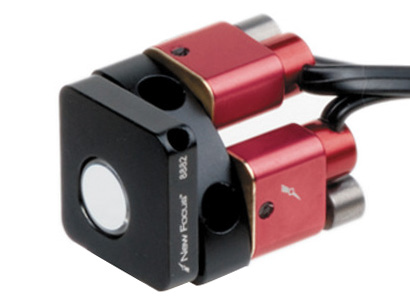
Image Credit: MKS Newport
MKS Newport’s Tiny Picomotor actuators support a 1.5 μrad angular resolution, allowing for subtle, controlled movements of client optics. The Tiny Picomotor actuator provides the added benefit of using the integrated knobs for rapid manual adjustment of all axes.
The picomotor actuator moves when voltage is applied to the piezo, altering its length and, in turn, moving the jaws, which turn the screw; when no power is applied, the actuator does not move. This ensures that mounts stay in place, even when the system is powered down.
Sapphire seats, optimized spring locations, and spring force enable smooth, dependable motorized adjustment while maintaining a high degree of thermal and mechanical stability.
8353-V: Piezo Actuator, Tiny Picomotor
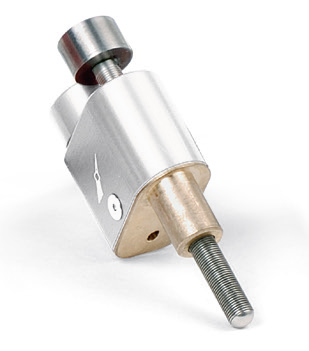
Image Credit: MKS Newport
The 8353 Tiny Picomotor Actuator is a smaller version of MKS Newport’s standard picomotor actuators. The company has enhanced the design to better satisfy clients' compact-area requirements.
The 8353-V Vacuum Compatible Tiny Picomotor Actuator is engineered for environments down to 10-6 Torr. Ideally suited for moving small optics and stages in vacuum chambers, MKS Newport’s picomotor actuators offer a step size of less than 30 nm, enabling very small, controlled movements.
It should be noted that the step size for open-loop picomotors varies from step to step as well as between forward and backward directions, and is directly related to payload. As a result, an external signal should provide position feedback when operating an open-loop picomotor. For applications requiring absolute position calibration and high repeatability, a closed-loop picomotor actuator should be considered.
TRA25CC: Motorized Actuator, Miniature, 25 mm Travel, DC Servo Motor
The TRA25CC Miniature DC Servo Actuator delivers 25 mm travel in a package that is slightly larger than other TRA actuators, while providing a 0.2 μm minimum incremental motion.
It is the recommended option for motorizing longer travel linear stages and other devices with extended travel ranges. TRA actuators feature an exceptional space-saving design that enables use across a broad range of linear stages, mirror mounts, and OEM applications.
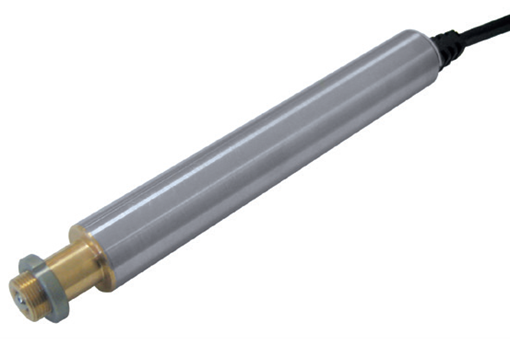
Image Credit: MKS Newport
TRA actuators provide a form factor similar to micrometer drives, making them easy to use for upgrading manual stages. They also feature a hard-coated steel ball tip that reduces contact surface wear compared to other designs using standard steel ball tips.
All TRA actuators include integrated optical limit switches. These highly dependable switches safeguard investments against over-travel damage while also providing a technique for repeatable referencing/homing, such as after shut-downs.

This information has been sourced, reviewed, and adapted from materials provided by MKS Newport.
For more information on this source, please visit MKS Newport.