Modern defence networks demand communication links that are fast, secure, and resistant to interception. Free-Space Optical Communications (FSOC) delivers exactly that, using laser beams to transmit data through open space or the atmosphere, without any physical cables. As the volume of sensors, intelligence, surveillance, and reconnaissance (ISR) data, and the speed of battlefield decision-making continue to escalate, FSOC is attracting significant investment from military agencies worldwide.
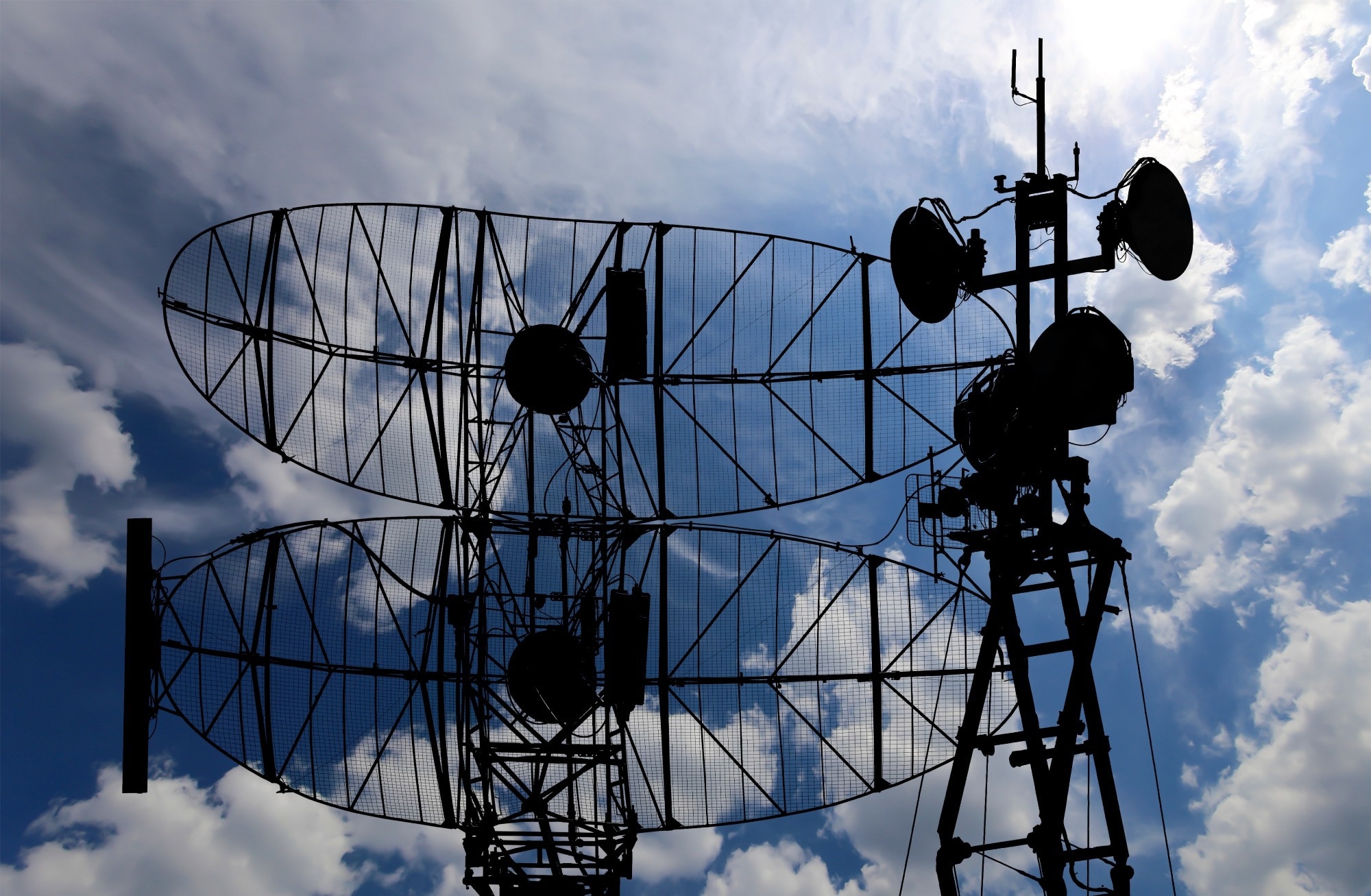 Image Credit: VLADJ55/Shutterstock
The Fundamentals of FSOC
FSOC transmits data by modulating a laser beam and directing it from a transmitter to a precisely aligned receiver. The receiver has a photodetector, which collects the optical signal and converts it back into an electrical signal that retains the original data. The system operates in the near-infrared spectrum, primarily at wavelengths of 850 nm and 1550 nm. In this range, atmospheric attenuation drops below 0.2 dB/km, and components benefit from compatibility with existing fiber-optic infrastructure.1
A typical FSOC system includes three core elements: the transmitter, the optical channel, and the receiver. The transmitter modulates data onto a laser source, passes it through beam-forming optics, and directs a collimated beam across free space. At the receiver end, the optical energy is focused onto a photodiode that converts photons to current, which is then amplified and decoded. The entire link demands strict line-of-sight alignment between both terminals.1
The Defence Case for FSOC
Radio-frequency (RF) systems have long been the backbone of military communications. However, they have a critical vulnerability: each RF transmission creates a detectable electromagnetic signature. Adversaries use direction-finding techniques to locate and strike high-value assets based on their RF footprint.
FSOC eliminates this risk because the laser beam travels as a narrow, highly directional path between two terminals. Interception of this laser requires an adversary to be physically present within the beam's path, making it operationally impractical.2
The security properties of FSOC extend further. Because the beam occupies no licensed spectrum and produces no radio emission, it is immune to jamming and spectrum-based interference tactics. Unlike RF links, FSOC links operate without interfering with one another, which simplifies spectrum management in multinational operations and reduces the administrative burden of coordinating frequencies with allied forces. These properties directly address the electromagnetic vulnerability that makes conventional military communications a tactical liability.2
High data throughput is another decisive advantage. FSOC systems achieve data rates in the gigabit-to-terabit range, far exceeding what current RF links sustain. As surveillance platforms, unmanned aerial vehicles, and connected sensors generate exponentially increasing volumes of ISR data, defence networks require links capable of transporting it in near real time. FSOC provides a scalable path to meet that demand without occupying regulated spectrum.3,4
Atmospheric Challenges and Mitigation
Despite strong operational advantages, deploying FSOC in terrestrial military environments involves confronting atmospheric physics. Fog, smoke, and aerosol particles attenuate the laser beam through scattering, reducing received signal strength over distance. Atmospheric turbulence causes random fluctuations in the refractive index that distort the optical wavefront and produce intensity scintillation at the receiver.3
Adaptive optics (AO) systems address turbulence by measuring wavefront distortions and applying real-time corrections using deformable mirrors. Ground-to-satellite experiments have demonstrated that pre-distortion AO reduces scintillation at the receiver and improves the efficiency of optical coupling, even at low elevation angles where the atmospheric path is longest. Acquisition, Tracking, and Pointing (ATP) systems handle alignment by dynamically adjusting beam direction to compensate for platform vibration, pointing error, and beam wander.3,5
For environments where fog or heavy obscurant reduces FSOC availability, hybrid FSO/RF architectures offer a practical solution. In a hybrid system, the FSO link handles the bulk of traffic under clear conditions, while the RF channel activates as a backup during periods of degraded optical transmission. Hard-switching and soft-switching mechanisms use channel-state feedback to transition between links based on signal-quality thresholds, maintaining continuity without manual intervention.3
Multi-Domain Military Applications
FSOC serves military communication needs across every operational domain. On land, optical datalinks between dispersed command posts reduce the RF signature of divisional headquarters operating in contested environments. A low-detectability link between two command nodes can carry high-bandwidth data while denying adversaries a targeting signature.2
In the space domain, inter-satellite optical links already carry operational data. The European Data Relay Service demonstrated that laser links between geostationary and low Earth orbit satellites sustain continuous broadband connectivity. The UK Ministry of Defence invested £9.5 million in the Titania LEO satellite specifically to validate military FSOC applications, including rapid ISR data downlinks at multi-gigabit-per-second speeds to the Puck Optical Ground Station. This mission aims to demonstrate high-speed direct-to-earth optical links that enable faster decision cycles for ground commanders.2,4
Saving this for later? Download a PDF here.
Airborne and maritime applications gain additional capability through FSOC. High-altitude platforms and UAVs equipped with optical terminals create high-capacity backbone links across ranges exceeding 100 km. In the naval domain, optical links between ships and submarines reduce fleet electromagnetic signatures by orders of magnitude compared to conventional RF. These links deliver bandwidth that current shipboard RF systems cannot approach, supporting sensor fusion and joint fires data flows.2
AI Integration and Future Development
Machine learning is accelerating FSOC performance by enabling dynamic link management in changing atmospheric conditions. Algorithms trained on multi-year weather datasets can proactively predict channel conditions and switch modulation schemes, maintaining bit-error rates within acceptable limits without operator input. Research using random-forest classifiers applied to hybrid FSO/RF systems showed that soft-switching strategies guided by learned atmospheric models improve link reliability in real time.3
FSOC also carries a dual-use advantage for military platforms. Optical terminals can switch between communication mode and active sensing functions such as 3D mapping and long-range target identification using vibrometry. This multifunctionality delivers extraordinary value on size-, weight-, and power-constrained platforms, where separate systems for communication and sensing would be logistically impractical.2
Full-scale military deployment still requires resolving hardware durability issues under extreme field conditions, reducing acquisition time for airborne and space terminals, and hardening ATP systems against platform vibration. Standardized protocols for hybrid switching remain an open research gap.
However, the combination of proven satellite demonstrations, active national investment, and rapid advances in adaptive optics and machine learning positions FSOC as a fundamental communication technology for next-generation defence networks.6
References and Further Reading
- Alimi, I. A., & Monteiro, P. P. (2024). Revolutionizing Free-Space Optics: A Survey of Enabling Technologies, Challenges, Trends, and Prospects of Beyond 5G Free-Space Optical (FSO) Communication Systems. Sensors, 24(24). DOI:10.3390/s24248036. https://www.mdpi.com/1424-8220/24/24/8036
- Free Space Optical Communications. QinetiQ. https://www.qinetiq.com/en/what-we-do/mission-support-and-operations/cyber-and-intelligence/secure-solutions/secure-communications-solutions/free-space-optical-communications
- Phuchortham, S., & Sabit, H. (2025). A Survey on Free-Space Optical Communication with RF Backup: Models, Simulations, Experience, Machine Learning, Challenges and Future Directions. Sensors, 25(11). DOI:10.3390/s25113310. https://www.mdpi.com/1424-8220/25/11/3310
- £9.5m investment for military space communications. (2021). UK Ministry of Defence. https://www.gov.uk/government/news/95m-investment-for-military-space-communications
- Hristovski, Ilija R. et al. (2024). Pre-distortion adaptive optics: experimental results from bi-directional tracking links between DLR's optical ground station and Alphasat's TDP-1 terminal. Proceedings of the SPIE, Volume 12877, id. 1287718. DOI:10.1117/12.3001682. https://www.spiedigitallibrary.org/conference-proceedings-of-spie/12877/3001682/Pre-distortion-adaptive-optics--experimental-results-from-bi-directional/10.1117/12.3001682.full
- Free-Space Optical Communication (FSOC) - Market and Technology Forecast to 2033. (2025). Aerospace & Defense News. https://www.asdnews.com/news/communications/2025/09/29/freespace-optical-communication-fsoc-market-technology-forecast-2033
Disclaimer: The views expressed here are those of the author expressed in their private capacity and do not necessarily represent the views of AZoM.com Limited T/A AZoNetwork the owner and operator of this website. This disclaimer forms part of the Terms and conditions of use of this website.