Spike-like repeating radio-burst pairs have been found in the solar corona. Using high-resolution advanced radio imaging spectroscopy, astronomers have identified and mapped 613 dual pulse events, providing a detailed view of previously unresolved coronal plasma activity. These findings were published in Nature Communications.
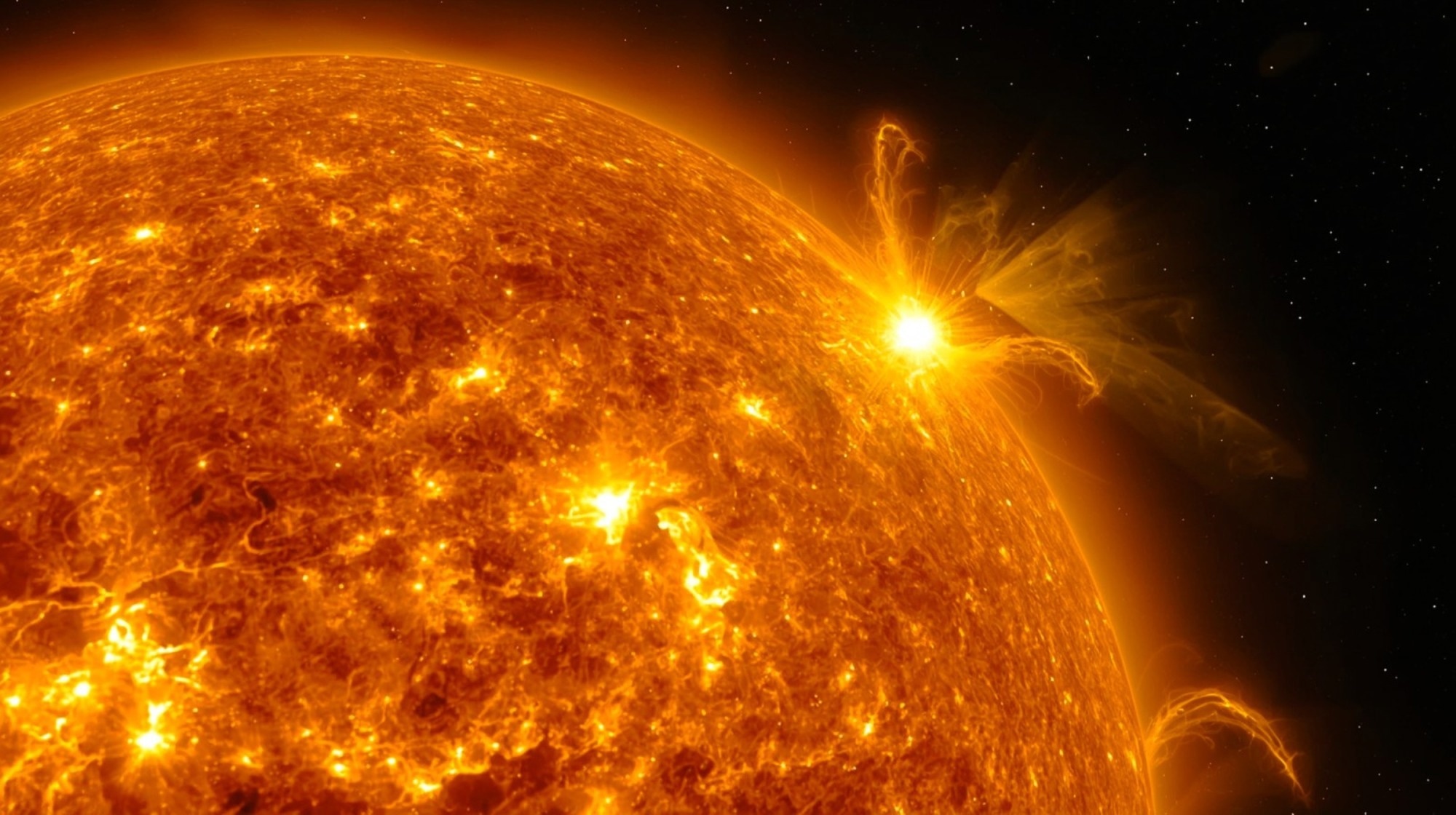 Study: Imaging spectroscopy reveals spike-like repeating radio burst pairs in the solar corona. Image Credit: Open stock 01/Shutterstock.com
The analysis showed that the secondary bursts are echo-like emissions produced by reflections from dense plasma structures in the solar atmosphere. This is consistent with magnetic reconnection and particle acceleration at high altitudes, showing that repeating radio-burst pairs offer a promising diagnostic for studying coronal dynamics and space weather processes.
Dynamics of Solar Radio Emissions
The solar atmosphere is a highly turbulent, magnetized environment where the release of magnetic energy generates emissions across the electromagnetic spectrum. Among these, solar radio emissions occur near the local plasma frequency or its harmonic when non-thermal electron beams propagate through the corona, exciting Langmuir waves.
Saving this for later? Download now.
As the electron beams travel outward through regions of decreasing plasma density, the emitted radio signals drift from high to low frequencies. In dynamic spectra, these frequency drifts trace the paths of the electron beams and the plasma environments they encounter. Embedded within broader radio bursts are fine structures such as striae and narrowband radio spikes, which are associated with localized energy release processes.
During propagation through the corona, radio waves are influenced by density irregularities that scatter and refract the radiation, altering their apparent duration and position. These effects can produce delayed secondary echoes, presenting a challenge in understanding how fine-scale radio bursts propagate through the turbulent coronal plasma.
Methodology: Using LOFAR for Imaging
To investigate these radio bursts, researchers used the Low Frequency Array (LOFAR) in its low-band outer configuration, operating across 30-80 MHz. The interferometric system combined tied-array beamforming with over 200 synthesized beams, enabling radio mapping out to a distance of three solar radii with high temporal and spectral resolution.
The analysis began with a semi-automated screening process to identify isolated burst pairs and longer chains of repeating pulses within a two-hour dataset. For each event, frequency-integrated flux profiles were extracted and fitted with an asymmetric Gaussian model to capture the rapid rise and exponential decay of the bursts.
To determine the spatial origin of the emissions, the study applied two-dimensional (2D) tilted Gaussian fitting to calibrated radio maps. Weaker signals were processed using masking techniques to ensure reliable fitting, while centroid positions were corrected for ionospheric distortions.
To place the radio observations within their coronal context, researchers incorporated extreme ultraviolet (EUV) data from the atmospheric imaging assembly (AIA) and magnetic field measurements from the helioseismic and magnetic imager (HMI) aboard the Solar Dynamics Observatory (SDO). These observations were combined with potential-field source-surface models (PFSS) to reconstruct the three-dimensional magnetic field surrounding the radio sources.
Distinct Characteristics of Repeating-Burst Pairs
The experimental outcomes of more than 600 burst pairs showed clear differences between the primary and delayed components. The primary bursts (E) were brief and intense, with a median duration of 0.31 seconds, while the delayed components (D) were longer and more diffuse, with a median duration of one second. The peak intensities of the two signals were separated by a consistent median delay of approximately 4.3 seconds.
Despite these temporal differences, both components occurred at the same central frequency within the instrument’s spectral resolution and exhibited similarly narrow bandwidths. However, their frequency drift characteristics differed significantly. The primary bursts displayed rapid negative frequency drifts, consistent with outward propagation through the corona, while the delayed bursts showed reduced drift rates.
Spatial mapping revealed a systematic separation between the two components' source locations. The primary bursts remained concentrated above the negative-polarity region of the active source area. In contrast, the delayed emissions were displaced outward into the upper corona, extending across distances ranging from tens to hundreds of arcseconds.
Understanding Coronal Structure and Space Weather
The discovery of these radio echo pairs provides an important tool for probing the structure of the solar atmosphere. By analyzing the time delay and spatial characteristics of the secondary emissions, researchers can estimate coronal density gradients and density scale heights. These measurements enhance understanding of the plasma conditions that influence the propagation of energetic particles and space weather phenomena.
The findings also address a limitation of the unexpectedly weak echoes returned by radar signals directed toward the Sun. It shows that anisotropic scattering can redirect and disperse radio waves away from the original viewing geometry, reducing the strength of the received signal and providing new insights into radio-wave propagation in the solar corona.
Advancing Solar Plasma Research
Spike-like repeating radio burst pairs have been seen to originate from harmonic plasma emission processes in the solar corona. The delayed components exhibited lower intensities, longer durations, reduced frequency drift rates, and clear displacements relative to the main bursts, consistent with radio echoes produced by anisotropic scattering in the coronal plasma.
These observations indicate that magnetic reconnection and electron acceleration occur at altitudes approaching one solar radius above the solar surface, higher than predicted by conventional flare models.
By confirming the role of field-aligned density variations in shaping radio-wave propagation, the study provides a framework for exploring coronal turbulence and magnetic structures. Overall, these findings advance understanding of plasma processes in the atmosphere and improve studies of solar activity and space weather.
Journal Reference
Ma, S., et al. (2026). Imaging spectroscopy reveals spike-like repeating radio burst pairs in the solar corona. Nature Communications. 17. https://www.nature.com/articles/s41467-026-74137-2
Disclaimer: The views expressed here are those of the author expressed in their private capacity and do not necessarily represent the views of AZoM.com Limited T/A AZoNetwork the owner and operator of this website. This disclaimer forms part of the Terms and conditions of use of this website.