Sponsored by MKS OphirReviewed by Olivia FrostAug 3 2026
Surface microstructuring with ultra-short-pulse (USP) lasers is a distinct technology with a range of applications, including the creation of optically absorptive and anti-reflective surfaces; superhydrophilic or hydrophobic surfaces with antibacterial properties; thin-film ablation; and surface texturing for enhanced bonding strength.
USP lasers perform well-defined jobs throughout the semiconductor and display industry, such as drilling vias in a PCB with precise diameter and depth or cutting glass along a straight line. These applications necessitate precise control of laser beam parameters to ensure optimal results.
A surface treated with USP laser for microstructuring has a random aspect, however, meaning that laser parameters are not always considered critical.
Despite this, several processes, such as optical interference, thermal ablation, and surface hydrodynamic effects, affect microstructuring. The onset of each of these processes and its resulting impact depend significantly on the material in use and the laser beam properties.
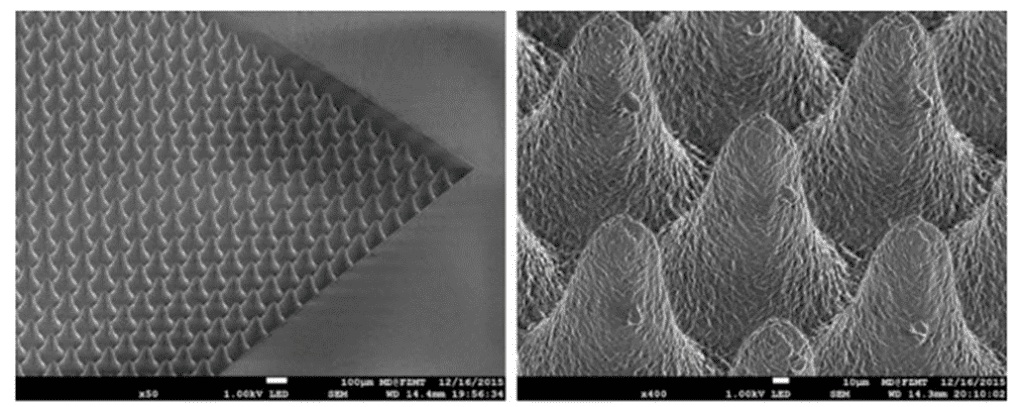
Figure 1. Super hydrophobic surface created using USP. Image Credit: https://www.spectra-physics.com/en/n/laser-surface-texturing.
A recent paper from the Center for Physical Sciences and Technology in Vilnius, Lithuania, describes a novel system using a femtosecond laser for large-area surface microstructuring.
The system leverages a diffractive optical element (DOE) to increase coverage and throughput by splitting a 515 nm, 300 fs laser beam into an 8×8 array of beams. Superhydrophobic properties were obtained in stainless steel using this system.
The researchers employed Ophir’s F150(200)A-CM-16 sensor. This sensor has been especially designed for USP lasers, allowing it to accurately measure the laser’s power before the DOE and monitor the energy dose delivered to the surface.
Surface texture was found to be highly dependent on laser fluence, with an optimal value resulting in maximal surface hydrophobicity.
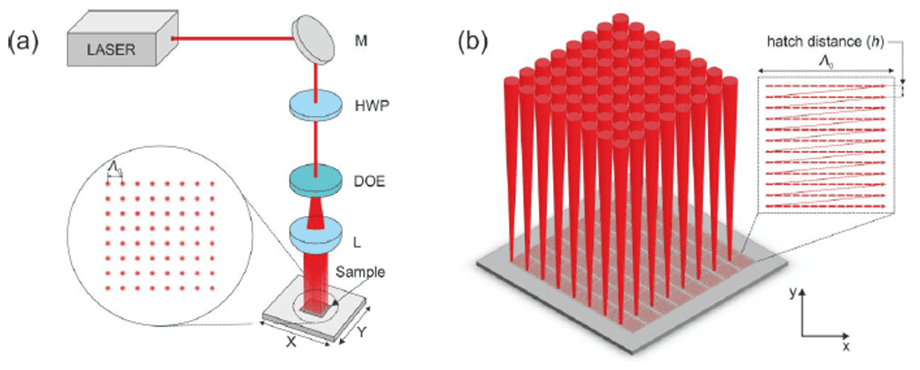
Figure 2. Optical system used for increasing throughput of laser microstructuring. Image Credit: Indrišiunas, S., et al. (2022)1
References and Further Reading
- Indrišiunas, S., Svirplys, E. and Gedvilas, M. (2022). Large-Area Fabrication of LIPSS for Wetting Control Using Multi-Parallel Femtosecond Laser Processing. Materials, 15(16), p.5534. DOI: 10.3390/ma15165534. https://www.mdpi.com/1996-1944/15/16/5534.
Acknowledgments
Produced from materials originally authored by Dr. Efi Rotem from Ophir Photonic Group.

This information has been sourced, reviewed, and adapted from materials provided by MKS Ophir.
For more information on this source, please visit MKS Ophir.