Sponsored by MKS OphirReviewed by Olivia FrostJul 31 2026
Since Columbia University graduate student Gordon Gould and Bell Laboratories scientists Charles Townes and Arthur Schawlow (among others) coined the term LASER in the 1950s, the technology's applications have appeared unlimited.
Image Credit: luchschenF/Shutterstock.com
Working with these new findings must have been exhilarating, but applying hundreds of kilowatts of laser power, such as the ones being used in directed energy laser systems, was beyond comprehension at the time.
The use of massive amounts of laser power to neutralize threats has been shown to be a promising improvement in weapons systems across Army and Navy programs over the years. The advantages of employing lasers over conventional bullets are too many to overlook.
Some key advantages: because they employ coherent light, the rounds are unaffected by gravity; they travel at the speed of light and produce no sound; the output may be regulated at both deadly and non-lethal levels; if the device does not malfunction, the soldier or sailor will have a limitless supply of ammo.
Even if the surroundings affect the laser's performance, optical-mechanical compensations can mitigate this effect. In addition, these advantages may frequently be supplied in the form of a less expensive system than traditional weaponry.
Challenges with High-Power Laser System Development
The development of these high-power laser systems involves a unique set of obstacles, many of which are inherent in the usage of such powerful lasers.
Lasers that emit photons with multiple kilowatts of average or continuous-wave power are more prone to heat impacts on their components, as well as greater safety issues owing to the danger of eye and skin damage.
At greater power levels, component deterioration might occur faster, resulting in less efficient system performance.
Understanding how these impacts and adjustments to the laser system affect the overall system performance, both during development and after commissioning, is crucial to guaranteeing mission success.
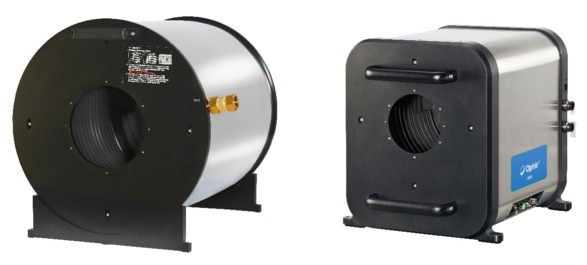
Figures 2 and 3. As laser power is constantly rising, Ophir's new high-power sensors can also be used as beam dumps. Left: the Ophir 150 kW sensor; on the right, the Ophir 70 kW sensor. Image Credit: MKS Ophir
Advancements in Beam Management
During the development of these systems, researchers frequently encounter problems with "beam management." When a large amount of laser light is focused toward an intended target, what happens to the beam before and after the target is destroyed is a key safety problem because of the possibility of accidental reflection.
To regulate the laser light, an operator can employ a "beam dump," often constructed from a highly absorbent material and designed to prevent the beam from damaging nearby items in the test area.
Beam dumps often include a sacrificial item, such as graphite bricks, ceramic tiles, hard-anodized aluminum, or even a brick wall in the back of the room. These items are often affordable and easily available.
These types of objects typically degrade fast and become useless, either being destroyed or transformed into highly reflective glass. They occasionally emit carcinogenic metabolites. This poses unneeded hazards to research scientists.
Fortunately, techniques for beam control have advanced in lockstep with laser technology throughout time. Ophir created a solution in 2015 that effectively collects over 99% of a laser beam with an average or continuous-wave power of 100 kW.
This device has improved over the years, and MKS has just launched an Ophir extreme high-power sensor capable of measuring up to 150 kW. MKS has also satisfied client needs for beam termination and power measurement of lasers more than 30 kW with the recent release of the Ophir 70 K-W product.
This device provides an industrialized solution for increasing the power of material-processing lasers while also lowering the cost of measuring and terminating lasers ranging from 30 kW to 70 kW.
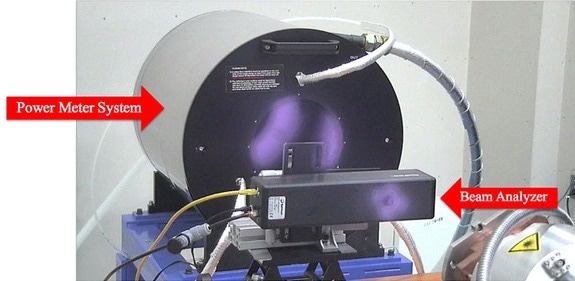
Figure 4. Ophir 120 K-W power sensor combined with a non-contact beam analyzer. Image Credit: MKS Ophir
The high-power sensor is made up of water-cooled channels with a unique coating. It has a high damage threshold, allowing for fast removal of the heat added by the laser throughout the test.
The 120 K-W power sensor is often located horizontally in close proximity to the test location. The laser is fired at the target substance until it is completely destroyed. The 120 K-W then temporarily captures the beam until the test is completed, measuring the power and dispersing the heat generated by the laser via the cooling channels.
Provided the product's damage threshold values are not exceeded by applying the laser to greater power levels for the incoming beam size, the device will absorb more than 99% of the beam for years of operation.
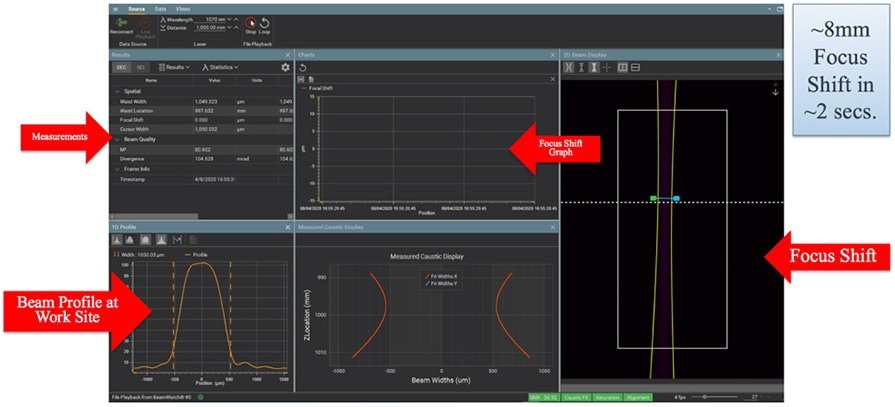
Figure 5. Beam profile of 100 kW fiber laser with reflective optics. Image Credit: MKS Ophir
Understanding Laser System Behavior
It is true that the success of these laser systems is heavily reliant on how effectively the source laser functions inside the system into which it is incorporated. Fiber lasers are now largely employed in directed energy systems due to their inherent high quality and stability.
Various other factors must be considered while developing these systems. Even if the laser source is steady, the laser system's components are prone to deterioration and failure due to their physical nature. The environment in which these laser systems are used might be hostile, compromising long-term performance.
Beam delivery components, protective housings, and beam-shaping optics can all deteriorate over time, either via regular usage or due to laser heat effects. Understanding how these factors influence the entire system's performance is critical to its success.
Several external environmental elements can influence the system's capacity to neutralize targets. Only the appropriate amount of power, along with a precisely positioned beam, can safeguard warfighter troops and sailors.
Measuring and adjusting for variations in laser power and beam location on the target is crucial to determining how to compensate for environmental losses. One of the most important parameters is laser power density.
Laser Power Density
The power density (W/cm2) of a laser can be used to determine its performance, whether it is a pointer with a few milliwatts, a micro-welding laser with a few joules of energy per pulse, or a drone-disabling laser with tens or hundreds of kilowatts of continuous-wave power.
Power density refers to the quantity of laser light (given in watts for average or continuous-wave power) compared to the beam size (expressed in cm2), also known as a "spot size".
Too high a power density, caused by a comparatively greater laser power or a relatively smaller spot size, typically causes the laser to overwork or cause unintended harm to items in its beam path.
In contrast, too low a power density, either by a comparatively low laser power level or a relatively bigger spot size, will result in the laser doing no work at all. Understanding the laser's power density in relation to the material being treated is critical to determining how the whole system will perform.
The top of the power density equation (W/cm2) indicates the quantity of laser light being applied. This is accomplished by determining the laser's average or continuous-wave power. For directed energy lasers, this translates to tens or even hundreds of kilowatts of power.
While many people believe this would be difficult to calculate, there are certainly instruments that can measure laser powers that high. Water-cooled thermopile sensors can accurately measure laser power from 1 kW to 30 kW with ± 3% NIST traceability.
The 150 kW power measuring device measures laser average or continuous-wave power with ± 5% NIST-traceable precision, ranging from 10 kW to 150 kW and beam diameters up to 200 mm.
The power density equation includes a measurement of the laser's beam profile. Beam profiling is a set of laser parameters that correspond to the laser's quality. It typically includes the size and shape of the laser beam, as well as the spatial or energy distribution throughout the beam.
Caustic metrics, including Rayleigh length, M2, beam parameter product (BPP), and K value, indicate the laser's ability to concentrate and hence its quality.
When a laser source is created, the producer adds one or more of these ratings in the product specifications to demonstrate the quality of the laser being purchased. For a single-mode Gaussian laser, an M2 rating of 1 indicates the greatest attainable quality.
Conclusion
The time is approaching when military personnel will no longer be put in harm's way. High-powered directed energy laser systems have been shown to be an efficient and effective means of neutralizing threats.
Changes readily occur within a laser system, whether due to multi-kilowatt laser thermal effects or the influence of the surrounding environment.
Understanding how these modifications affect overall system performance requires measuring the system's performance. Tools are now available to undertake these measurements and hence enhance system designs. Our fighting men and women deserve the best possible weapons.
Acknowledgments
Produced using materials originally authored by John McCauley, Senior Business Development Manager at Ophir.

This information has been sourced, reviewed and adapted from materials provided by MKS Ophir.
For more information on this source, please visit MKS Ophir.