A recent review article published in Advanced Materials examines the persistent barriers facing blue quantum dot light-emitting diodes (QD-LEDs), with a focus on the physical and device-operational mechanisms that continue to limit performance. While red and green QD-LEDs have reached impressive efficiency and stability milestones, blue devices remain significantly behind, particularly in terms of operational lifetime, which the authors identify as the primary obstacle to commercialization and the central barrier distinguishing blue devices from their red and green counterparts.
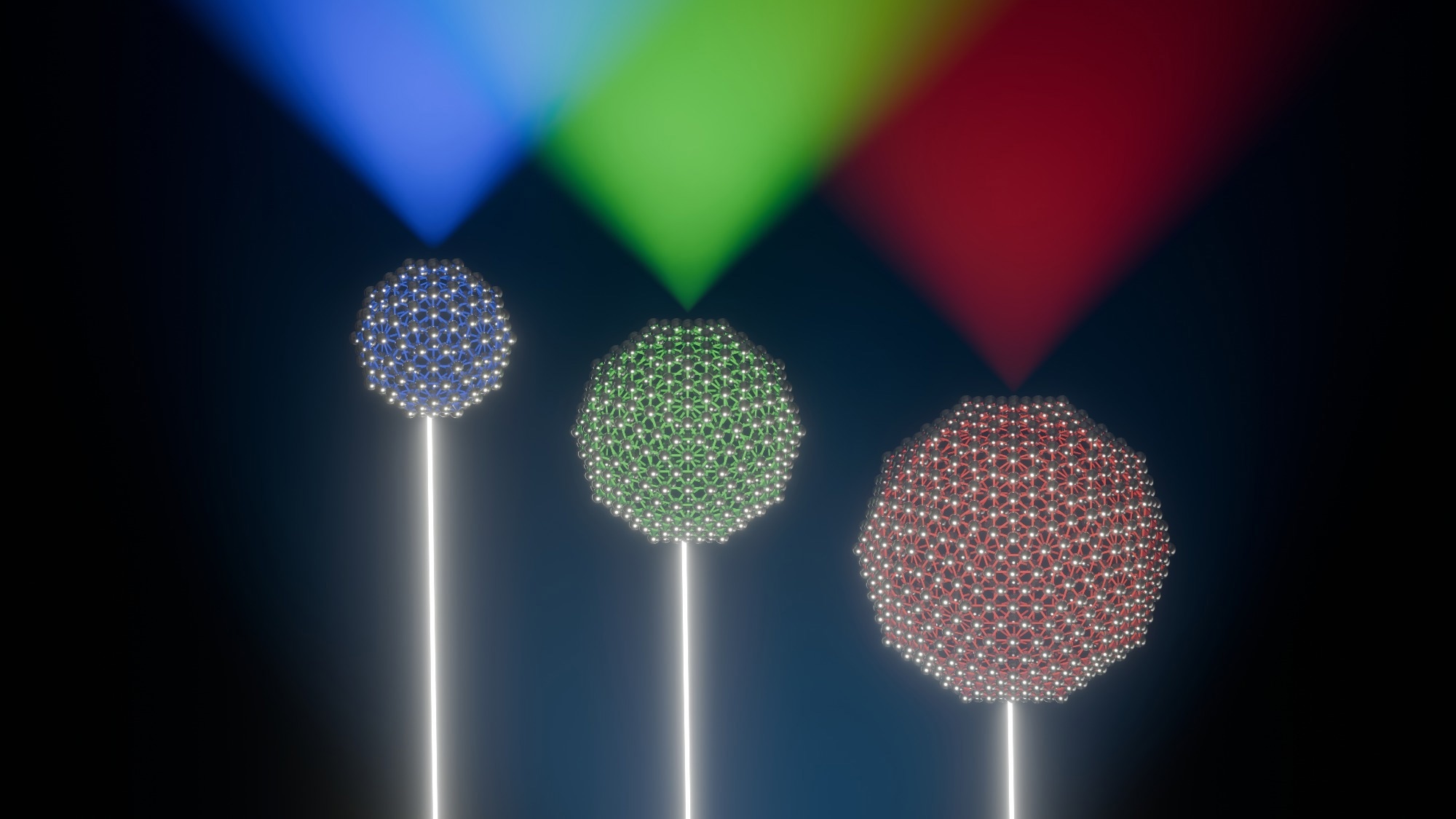
Image Credit: atdigit/Shutterstock.com
Blue is the Toughest Color
Colloidal quantum dots, typically a few nanometers in size, exhibit size-dependent optical properties through quantum confinement effects, enabling tunable emission wavelengths. While quantum dot color converters for down-conversion of blue backlight emissions into red and green have reached commercialization, fully electroluminescent QD-LEDs remain primarily in development.
Blue emission is defined in the wavelength range 450–495 nm, with pure blue specified between 460 and 475 nm; industry standards, such as Rec. 2020, pinpoint a blue primary at 467 nm with precise chromaticity coordinates.
Assessing color purity relies significantly on emission linewidths, with narrower full width at half maximum (FWHM), ideally under 20 nm, being desirable for color accuracy. The widely studied blue-emitting QDs predominantly use II-VI materials like Cd-based compounds, which can achieve external quantum efficiencies (EQEs) above 20% and lifetimes near 10^4 hours in laboratory demonstrations but raise toxicity concerns. Heavy metal-free alternatives such as ZnSeTe and ZnSeS also show blue emission but suffer from broader emission features and trap-related emissions. The optical performance of blue QDs is often compromised by a combination of surface defects, lattice mismatch-induced strain, and dopant-related mid-gap states, all influencing their photoluminescence quality.
Keep this for later - Download the PDF of the page here
Inside the Materials
Several studies on blue II–VI QDs focus on the ZnSeTe system, where tellurium alloying is used to adjust emission wavelengths. Spectroscopic measurements show that lightly Te-doped ZnSe QDs display a distinct red-shifted shoulder in their photoluminescence spectra, pointing to additional radiative pathways beyond conventional excitonic recombination. Notably, this shoulder remains even after synthetic refinements, such as the introduction of ZnSe/ZnS core/shell/shell heterostructures and hydrofluoric acid (HF) treatment during shell growth, which raise photoluminescence quantum yields (PLQYs) to near unity but do not fully eliminate spectral broadening or asymmetry. Density functional theory (DFT) calculations suggest that these sub-bandgap emissions arise from Te-cluster states localized below the valence band maximum, rather than from typical surface trap states.
Further studies on Te content show that at higher doping levels above 20%, the broadening is more symmetric and related to a distribution of alloy compositions and cluster motifs, which affects ensemble spectral features. Time-resolved and temperature-dependent photoluminescence reinforce the assignment of the red shoulder to Te-cluster emissions with slower radiative lifetimes and weaker temperature dependence compared to exciton peaks, complicating color purity control.
The review also highlights progress in synthetic design strategies to mitigate nonradiative losses and improve exciton confinement, critical optical parameters for blue QD performance. For instance, the construction of compositionally graded core/shell QDs such as CdZnSeS with a Se-rich core and S-rich outer regions generates non-monotonic band edge profiles, reducing lattice strain-induced defects and fostering stronger confinement.
Such structures have yielded blue QD-LEDs with EQEs of 24%, luminance exceeding 57,000 cd m-², and operational lifetimes around 27,000 hours at 100 cd m-² under reported testing conditions. Other designs employing ZnCdSe/ZnSeS/ZnCdS/ZnS heterostructures introduce inner shells with wider bandgaps to engineer favorable energy barriers, narrowing emission linewidths to approximately 20 nm and achieving T_50 lifetimes surpassing 80,000 hours with EQEs near 20%, emitting at 467 nm, the industry-preferred pure blue target. These advances underscore that precise band structure engineering and control of heterointerface quality are crucial optical factors improving blue QD emission stability and color fidelity.
In addition to II–VI systems, the review evaluates III–V blue quantum dots, particularly InP-based materials, which aim to reduce heavy-metal content while pursuing deep-blue emission with competitive efficiency and stability. These materials face parallel challenges in achieving narrow linewidths, strong confinement in wide-bandgap regimes, and long operational lifetimes, underscoring that blue emission constraints are not limited to a single material family.
Why Blue QD-LEDs Still Fall Short
The optical limitations of blue QD-LEDs arise from multiple interconnected phenomena. The prominence of mid-gap states, particularly in tellurium-alloyed ZnSe QDs, introduces additional radiative channels with emission energies lower than the excitonic transitions, broadening emission spectra and reducing color purity. The difficulty in eliminating these states even after extensive surface passivation and shell growth suggests that Te clustering and related localization effects are intrinsic to the material system.
This constitutes a fundamental challenge to realize narrowband blue emission in heavy metal-free QDs. Moreover, synthetic methods that produce graded core/shell structures contribute significantly to improved exciton confinement, suppressing nonradiative recombination and enhancing PLQY, but full mitigation of spectral broadening remains elusive.
Another critical optical obstacle involves fluorescence intermittency and transient electroluminescence phenomena, including “positive aging”, which destabilize emission intensity and spectral consistency. These effects, more pronounced in blue QDs than in longer wavelength counterparts, may originate from variable carrier trapping/detrapping dynamics and energetic disorder associated with material inhomogeneity and interface quality. The role of device architecture and charge transport layers in modulating these optical dynamics is underscored, as they influence carrier injection balance and recombination zones within the QD layer.
Download the PDF of the article here
Closing the Lifetime Gap
Despite considerable advances in blue QD-LED materials and device designs, achieving the combination of high operational lifetimes, efficient exciton recombination, and narrow emission linewidths required for practical applications remains an open challenge. As emphasized in the review, closing the lifetime gap with red and green QD-LEDs remains the defining hurdle for commercialization. Future research focusing on single-particle spectroscopy at cryogenic temperatures and refined heterostructure engineering holds promise to deepen understanding and improve blue QD-LED optical performance, facilitating their deployment in next-generation display and lighting technologies.
Source:
Journal Reference
Tan S., et al. (2026). Challenges of II‐VI and III‐V Blue Quantum Dot Light‐Emitting Diodes. Advanced Materials, 38, e12379. DOI: 10.1002/adma.202512379, https://advanced.onlinelibrary.wiley.com/doi/full/10.1002/adma.202512379