Posted in | News | Optics and Photonics

Researchers Create Surface Plasmons for Optical Computing Devices

University of Tübingen researchers are collaborating to develop the next generation of computers. Tiny gold wires of the order of a thousandth of a mm were made to interact with cold atoms.

Surface plasmons were generated using laser light to illuminate the gold wires and focus the light on the wire surface in a unique manner. These light fields may allow construction of optical computing devices and quantum information devices.
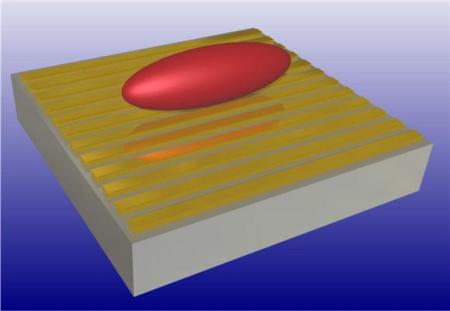
A Bose-Einstein condensate is applied to plasmonic nanowires.

Optical computing devices can make circuits faster and more efficient than existing technologies. Surface plasmons are helpful for transfer of data and they must be attached to elements for data storage for building of optical computing devices. Junior scientist, Dr. Sebastian Slama, has developed techniques for positioning the cold atoms close to the surfaces so that the atoms could interact with the bound light waves.

Atomic gases can be cooled to very low temperatures in vacuum chambers. Atoms do not behave like a classical gas at nanokelvin temperatures. They attain a stage wherein all atoms stay in a quantum state, by forming a Bose-Einstein condensate. This condensate can be considered as an equivalent to a large sized, single super-atom. External magnetic fields can be applied to move the super-atom to the surface, where the plasmon will influence the atom.

The results of the study were published in a recent issue of Nature Photonics. The scientists aim to make hybrid devices for quantum information and optical computing.

Citations

Please use one of the following formats to cite this article in your essay, paper or report:

  • APA

    Choi, Andy. (2019, February 28). Researchers Create Surface Plasmons for Optical Computing Devices. AZoOptics. Retrieved on February 03, 2026 from https://www.azooptics.com/News.aspx?newsID=14220.

  • MLA

    Choi, Andy. "Researchers Create Surface Plasmons for Optical Computing Devices". AZoOptics. 03 February 2026. <https://www.azooptics.com/News.aspx?newsID=14220>.

  • Chicago

    Choi, Andy. "Researchers Create Surface Plasmons for Optical Computing Devices". AZoOptics. https://www.azooptics.com/News.aspx?newsID=14220. (accessed February 03, 2026).

  • Harvard

    Choi, Andy. 2019. Researchers Create Surface Plasmons for Optical Computing Devices. AZoOptics, viewed 03 February 2026, https://www.azooptics.com/News.aspx?newsID=14220.

Tell Us What You Think

Do you have a review, update or anything you would like to add to this news story?

Leave your feedback
Your comment type
Submit

Sign in to keep reading

We're committed to providing free access to quality science. By registering and providing insight into your preferences you're joining a community of over 1m science interested individuals and help us to provide you with insightful content whilst keeping our service free.

or

While we only use edited and approved content for Azthena answers, it may on occasions provide incorrect responses. Please confirm any data provided with the related suppliers or authors. We do not provide medical advice, if you search for medical information you must always consult a medical professional before acting on any information provided.

Your questions, but not your email details will be shared with OpenAI and retained for 30 days in accordance with their privacy principles.

Please do not ask questions that use sensitive or confidential information.

Read the full Terms & Conditions.