Shrinking a Spectrometer
Portable Spectroscopy in the Field
In-Line Optical Systems in Production
Turning Spectra into Reliable Numbers
Conclusion
References and Further Reading
For most of its history, optical spectroscopy has lived on laboratory benches, where instruments measure how light interacts with matter to reveal chemical composition. Samples had to be collected, transported, and queued, which often delayed results. However, advancements in miniaturized optics, affordable detectors, and improved software have led to the development of portable and in-line spectrometers.
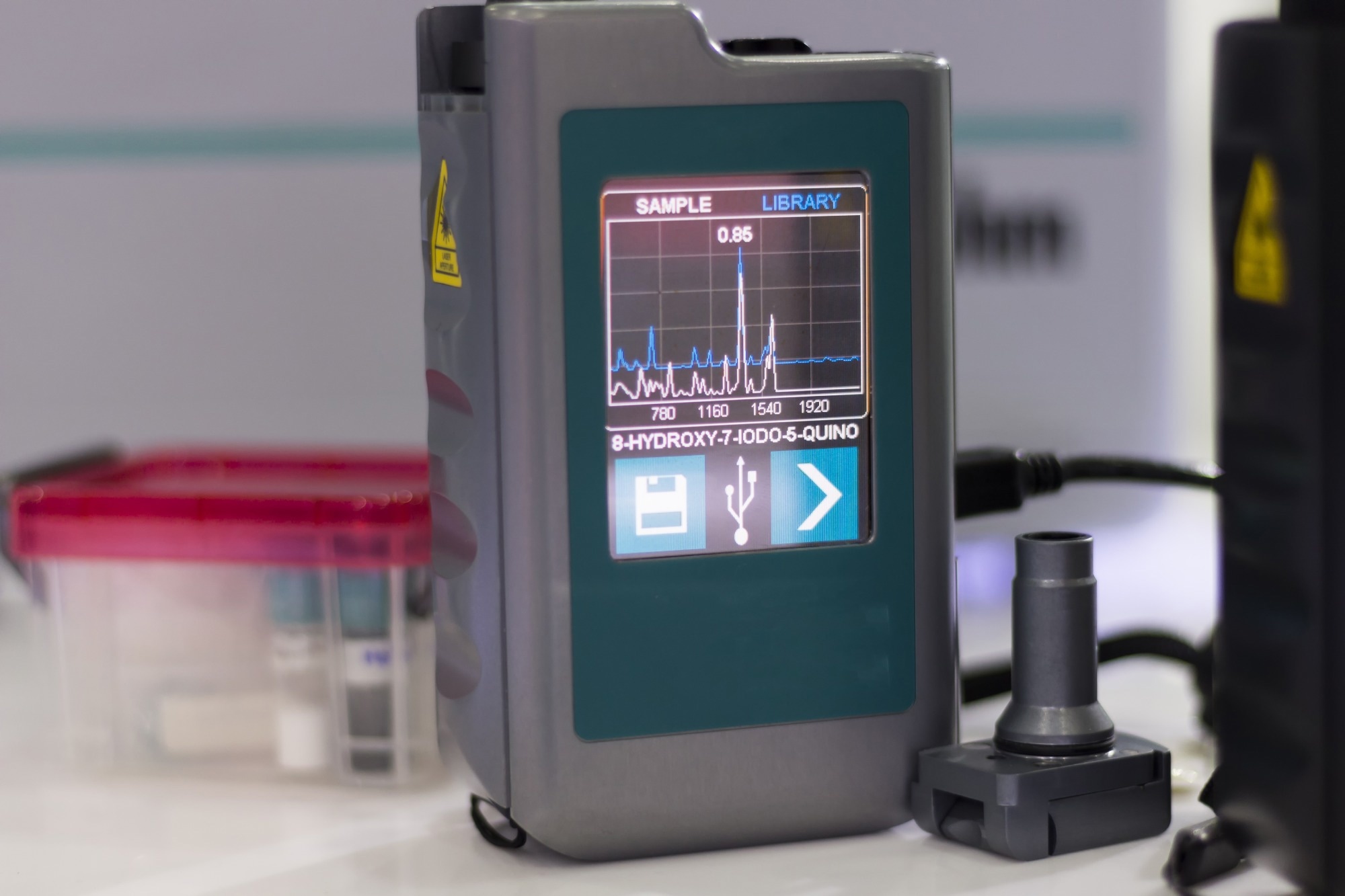 Image Credit: Mr.1/Shutterstock
Portable spectrometers can be taken to locations like farms, warehouses, and clinics, while in-line systems are integrated into production equipment to monitor processes in real time. This article discusses the miniaturization of spectrometers, the practical applications of both portable and in-line options, and the calibration and data challenges that must be addressed for broader use in agriculture and industry.1,2
Shrinking a Spectrometer
Every spectrometer performs the same basic task. It separates light into its component wavelengths and measures the intensity of each one, producing a spectrum that acts like a chemical fingerprint. Benchtop instruments achieve fine wavelength separation with long optical paths, large gratings, and cooled detectors. Making the instrument smaller compresses those paths, so designers must find other ways to retain enough spectral detail for useful chemical analysis.3
Researchers have miniaturized designs into a few families:
- Dispersive chips: They use tiny waveguide gratings to spread light across detectors, and filter-based chips use resonant structures that pass narrow bands of light.3
- Fourier transform-based spectrometer: This kind of device relies on interference to gain signal strength.3
- Reconstructive spectrometer: It captures light through many broadband filters and recovers the spectrum computationally, an approach that moves part of the instrument’s work from glass and metal into software.3
Each design carries trade-offs that engineers must match to a specific task. A report in MDPI Sensors about integrated spectrometers notes that resolving closely spaced wavelengths usually requires longer optical paths, which runs counter to the goal of a smaller footprint. Some on-chip devices still achieve sub-nanometer resolution, though usually only over narrow spectral windows. Fast, coarse measurements suit medical screening and routine quality checks, whereas chemical fingerprinting needs finer resolution and more careful design.3
Portable Spectroscopy in the Field
Near-infrared (NIR) spectroscopy dominates handheld analysis because it can handle solid and powdered samples with minimal preparation. Current handheld NIR units are battery-powered and portable, and some microspectrometers based on micro-electro-mechanical systems (MEMS) weigh less than 100 g. Food inspectors and quality teams use these compact devices to screen grains, dairy, meat, and oils for moisture, protein, fat, and adulteration directly at the point of sale or storage.1
Handheld Raman spectrometers complement NIR by detecting molecular vibrations via laser-induced scattering. Since the Raman signal is extremely weak, choosing a laser wavelength involves balancing signal strength against background interference. A 532 nm laser scatters strongly but excites more fluorescence, whereas 785 nm and 1064 nm lasers reduce fluorescence at the cost of weaker signals. Field teams use handheld Raman units to identify melamine, illegal dyes, and drug residues in food.1
Agriculture shows how well these portable tools work on a larger scale. In a Soil Science Society of America Journal study, researchers scanned 600 old soil samples using five compact Fourier transform NIR scanners. The best models predicted clay, organic carbon, and cation exchange capacity with R² values above 0.7, whereas predictions for potassium and phosphorus were weak. These scanners can quickly and cost-effectively estimate certain soil properties.4
In-Line Optical Systems in Production
In-line spectroscopy places the optical probe directly in the process stream, inside a pipe or reactor. This arrangement differs from on-line systems, which divert a sample through a flow cell and return it, and from at-line testing, where operators withdraw material for nearby analysis. Because in-line probes measure continuously, a control system can respond to their readings automatically, adjusting feed or temperature before a deviation results in a rejected batch.2
Pharmaceutical manufacturing embraced this approach after the US Food and Drug Administration published its process analytical technology (PAT) guidance in 2004. The framework moved quality control from end-product testing toward continuous monitoring during production. Fiber-optic NIR probes now track blend uniformity, granule moisture, and coating thickness during tablet production. As these systems provide real-time release testing, product quality can be assessed while manufacturing is still underway.5
Biomanufacturing requires more advanced in-line probes because living cells grow in water-rich broths. Water strongly absorbs in the infrared, broadening spectral peaks, yet it barely interferes with Raman signals. Raman probes can also measure through glass or plastic. In a yeast study, glucose prediction errors were 2.76% of full scale. Every probe must also preserve the vessel’s sterility throughout the run.2
Turning Spectra into Reliable Numbers
Portable and in-line hardware relies on software to convert spectra into concentrations and classifications. Most systems rely on chemometric models, such as partial least squares regression, that link spectral features to reference laboratory values. Deep learning can capture more complex relationships, although it requires larger labeled datasets and more computing power, and its decisions are harder to interpret for regulators who must validate each analytical method before use.1
Saving this for later? Download a PDF here.
Calibration models also tend to lose accuracy when they move between settings. A model built in one season, factory, or instrument often performs poorly in another, a problem known as domain shift. Each new application needs its own calibration, and models must be updated as process media change or equipment ages. The Soil Science Society of America Journal study recommended calibration transfer whenever several devices share a model, since small hardware differences can erode accuracy.1,2,4
Conclusion
Portable and in-line optical systems are expanding the use of spectroscopy across various fields, including food supply chains, factories, and bioreactors. Miniaturization has been achieved through innovative optical designs and computational methods, balancing resolution and size for specific tasks. Handheld NIR and Raman instruments screen food and soil directly on-site, and in-line probes provide manufacturers with continuous chemical feedback that supports automated control and faster product release.1,2
However, the main challenge for wider use is data handling. Calibration models need careful building, transfer, and maintenance to ensure reliable measurements outside the lab. As integrated optics improves and chemometric tools mature, the reach of spectroscopy beyond the lab will largely depend on the consistency of its models across instruments and conditions.4
References and Further Reading
- Melendreras, C. et al. (2026). Trends in Vibrational Spectroscopy: NIRS and Raman Techniques for Health and Food Safety Control. Sensors, 26(3), 989. DOI:10.3390/s26030989. https://www.mdpi.com/1424-8220/26/3/989
- Mishra, A. et al. (2025). Spectroscopic Advances in Real Time Monitoring of Pharmaceutical Bioprocesses: A Review of Vibrational and Fluorescence Techniques. Spectroscopy Journal, 3(2), 12. DOI:10.3390/spectroscj3020012. https://www.mdpi.com/2813-446X/3/2/12
- Coppola, C. M. et al. (2024). I-PHAOS: An Overview with an Open-Source Collaborative Database on Miniaturized Integrated Spectrometers. Sensors, 24(20), 6715. DOI:10.3390/s24206715. https://www.mdpi.com/1424-8220/24/20/6715
- Mitu, S. M. et al. (2024). Evaluating consistency across multiple NeoSpectra (compact Fourier transform near-infrared) spectrometers for estimating common soil properties. Soil Science Society of America Journal, 88(4), 1324-1339. DOI:10.1002/saj2.20678. https://acsess.onlinelibrary.wiley.com/doi/full/10.1002/saj2.20678
- Seenivasan, R. et al. (2024). A Systematic Review: Exploration Of Process Analytical Technology Techniques (PAT) And Their Multifaceted Advantages in Industrial Processes. International Journal of Applied Pharmaceutics, 16(2), 44–51. DOI:10.22159/ijap.2024v16i2.49772. https://journals.innovareacademics.in/index.php/ijap/article/view/49772
Disclaimer: The views expressed here are those of the author expressed in their private capacity and do not necessarily represent the views of AZoM.com Limited T/A AZoNetwork the owner and operator of this website. This disclaimer forms part of the Terms and conditions of use of this website.