*Important notice: This news reports on an unedited version of an accepted paper and is awaiting final editing. Therefore, the paper should not be regarded as conclusive or treated as established information.
Researchers have developed and tested a zero-power optical approach for satellite identification and attitude measurement that could be used on spacecraft in low-Earth orbit. This innovative system uses an L-shaped arrangement of corner cube retroreflectors (CCRs) to identify satellites and measure their three-axis attitude simultaneously. Their findings were published in Communications Engineering.
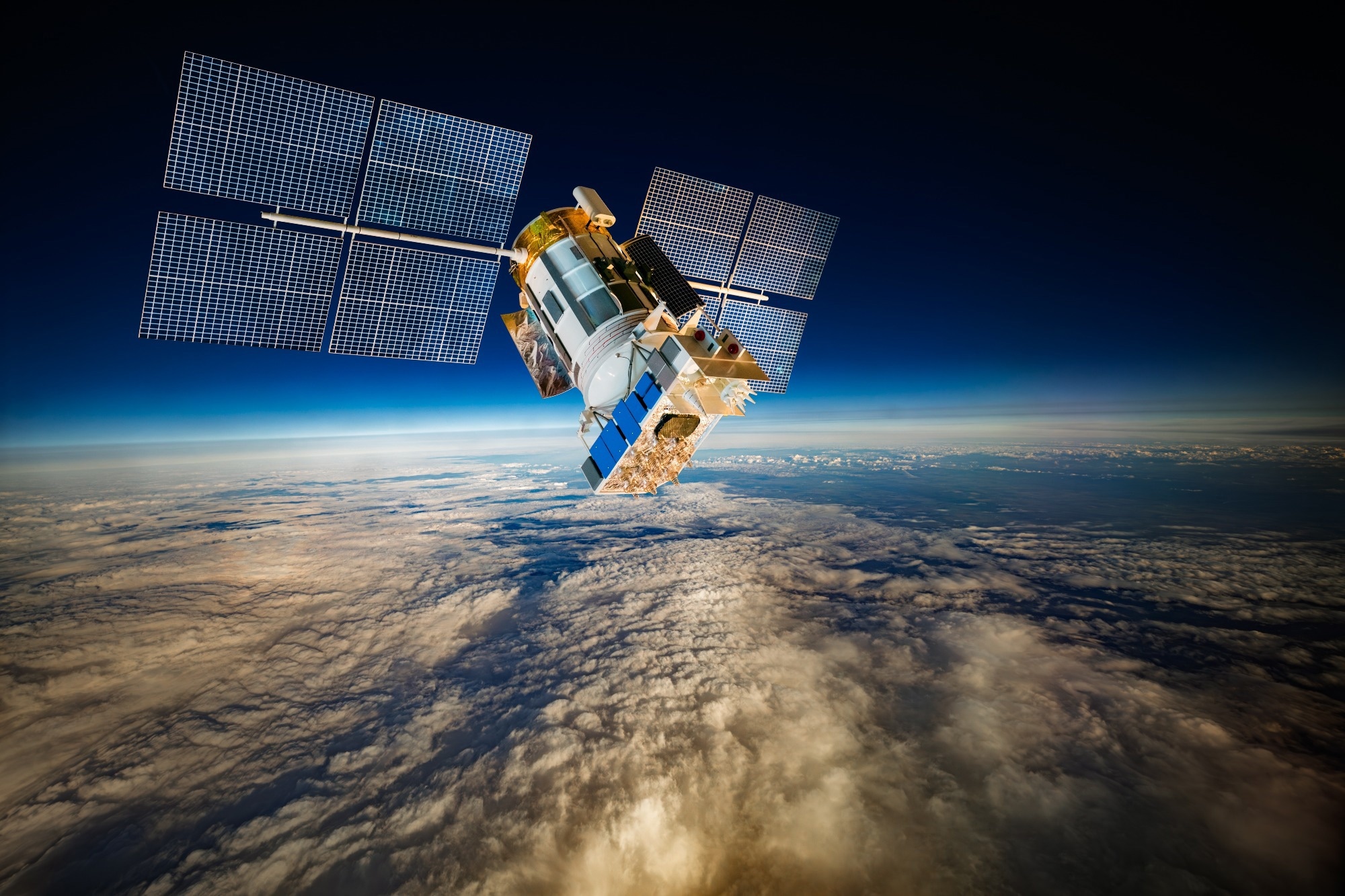 Study: Satellite identification and attitude measurement using a multi-reflector laser ranging beacon. Image Credit: Andrei Armiagov/Shutterstock.com
By extracting invariant distance ratios from laser echoes received on the ground, the researchers calculated satellite orientation without requiring any onboard electrical power system or sources. Their proposed design boasts a theoretical attitude measurement precision of up to 0.001° under ideal conditions, thereby pointing to its potential as a solution for satellite tracking as the number of spacecraft in low-Earth orbit continues to increase.
The Challenges of Space Traffic Management
The growing number of small satellites and large communication constellations, such as Starlink and OneWeb, makes it harder to distinguish
individual satellites, especially when multiple CubeSats operate in close proximity.
This phenomenon, known as “CubeSat confusion,” can hinder tracking and collision avoidance. Additionally, the increasing density of orbital objects raises the risk of cascading collisions, which is known as the “Kessler effect,” highlighting the urgent need for reliable identification systems.
Satellite identification serves as a “license plate” system for spacecraft, requiring reliable identifiers that can be recognized from the ground. Conventional identification approaches often use active radio-frequency transponders or optical beacons that rely on onboard electrical power and can fail if a spacecraft loses power.
However, passive optical identification using CCRs provides a viable alternative. CCRs reflect incoming laser pulses toward their source, enabling ground stations to perform satellite laser ranging (SLR) without necessitating electrical power. Their low mass and long operational lifetime make them suitable for satellite identification and tracking.
Technical Design of the L-Shaped Reflector System
To develop a passive optical system capable of satellite identification and attitude measurement, researchers designed an L-shaped arrangement of four CCRs. Each CCR was a 30 mm-diameter fused-silica reflector with a silver-coated rear surface.
Three reflectors were positioned collinearly, with the ratios of their spacing forming an invariant optical identification code. The fourth reflector was placed off-axis to provide the geometric constraint necessary for determining the satellite’s three-dimensional orientation.
The system used SLR to measure distances between the ground station and each reflector. The system transmitted ultra-short laser pulses toward the satellite and recorded the round-trip flight times of the reflected echoes.
The resulting range differences among the four CCRs were projected onto the line-of-sight (LOS) direction and processed using a range-differential identification code discriminant (RDICD) framework. The spacing ratios among the collinear reflectors remain unchanged as viewing angles vary, allowing the resulting geometric signature to serve as a passive identification code.
Download a free copy of this page here!
The optical framework was first evaluated through numerical simulations based on the orbit of the HY-2B Earth observation satellite at an altitude of approximately 970 km. The simulations used dual-station SLR observations to assess the geometric configuration's ability to effectively identify the satellite and determine its attitude.
A physical experiment was conducted at an observation facility in Shanghai using a rotating target positioned 2 km from the optical system. This target contained four CCRs arranged in the proposed L-shaped configuration. A solid-state Nd: YAG laser emitted 532 nm pulses at a repetition rate of 2 kHz.
The reflected echoes were captured by a 60 cm-aperture Ritchey-Chrétien telescope and detected using an avalanche photodiode (APD). The target was continuously rotated while the system recorded the independent laser echo sequences, allowing for comparison of measured range differences with predicted attitude changes.
High Precision in Attitude Measurement
The simulation demonstrated that the L-shaped optical beacon consistently produced an identification code, regardless of satellite orientation. Using common-view observations from two SLR stations, the RDICD calculations reliably recovered the geometric ratio of 0.5. The same data was used to determine the satellite’s three-axis attitude, with the estimated orientation differing from the reference orientation by no more than 0.001°.
The physical field experiment successfully resolved individual laser echoes as the L-shaped target rotated. The 532 nm ranging system captured all eight possible structural reflection sequences. The measured invariant values averaged approximately 0.638 and 1.615, compared to target ratios of 0.62 and 1.61.
These discrepancies were attributed to near-field atmospheric beam jitter and optical divergence during the 2 km test range.
The analysis assessed the identification capacity of the configuration under SLR measurement precision. With a maximum CCR spacing of 1 m, a ranging precision of 3 mm, and a minimum baseline-to-line-of-sight angle of 40°, the system could generate a theoretical maximum of up to 107 unique identification codes. This allows multiple satellites in the same region to carry distinct passive optical signatures without modifying the existing laser ranging stations.
Toward Power-Free Satellite Identification in Orbit
The L-shaped arrangement effectively provides passive satellite identification and three-axis attitude measurement through differential laser ranging. The geometric configuration encodes identification information in the spacing ratios between the reflectors, while the off-axis reflector supplies additional information for attitude estimation.
This passive configuration operates without onboard electrical power and integrates seamlessly with existing SLR infrastructure. Its low mass makes it suitable for spacecraft where payload size is limited. This approach could support identification within satellite constellations and enable tracking of non-cooperative spacecraft.
Future work could focus on enhancing ranging precision and detection sensitivity using advanced single-photon detectors, including superconducting nanowire single-photon detectors. Further testing under actual orbital conditions would be necessary to evaluate the system's performance across various spacecraft configurations and tracking scenarios.
Journal Reference
Tang, K., et al. (2026). Satellite identification and attitude measurement using a multi-reflector laser ranging beacon. Communications Engineering. DOI: 10.1038/s44172-026-00775-5, https://www.nature.com/articles/s44172-026-00775-5.
Disclaimer: The views expressed here are those of the author expressed in their private capacity and do not necessarily represent the views of AZoM.com Limited T/A AZoNetwork the owner and operator of this website. This disclaimer forms part of the Terms and conditions of use of this website.