The speed of light in a vacuum is a fundamental physical constant (exactly 299,792,458 m/s), but it decreases significantly when light enters material media. Understanding the mechanisms behind this slowdown is critical to the optimization of high-speed fiber-optic communication, the design of precision laser systems, and the development of advanced lithography for semiconductor manufacturing. This reduction in speed is not a result of light "colliding" with atoms, but rather a complex electromagnetic interaction between the incident wave and the material's electronic structure.
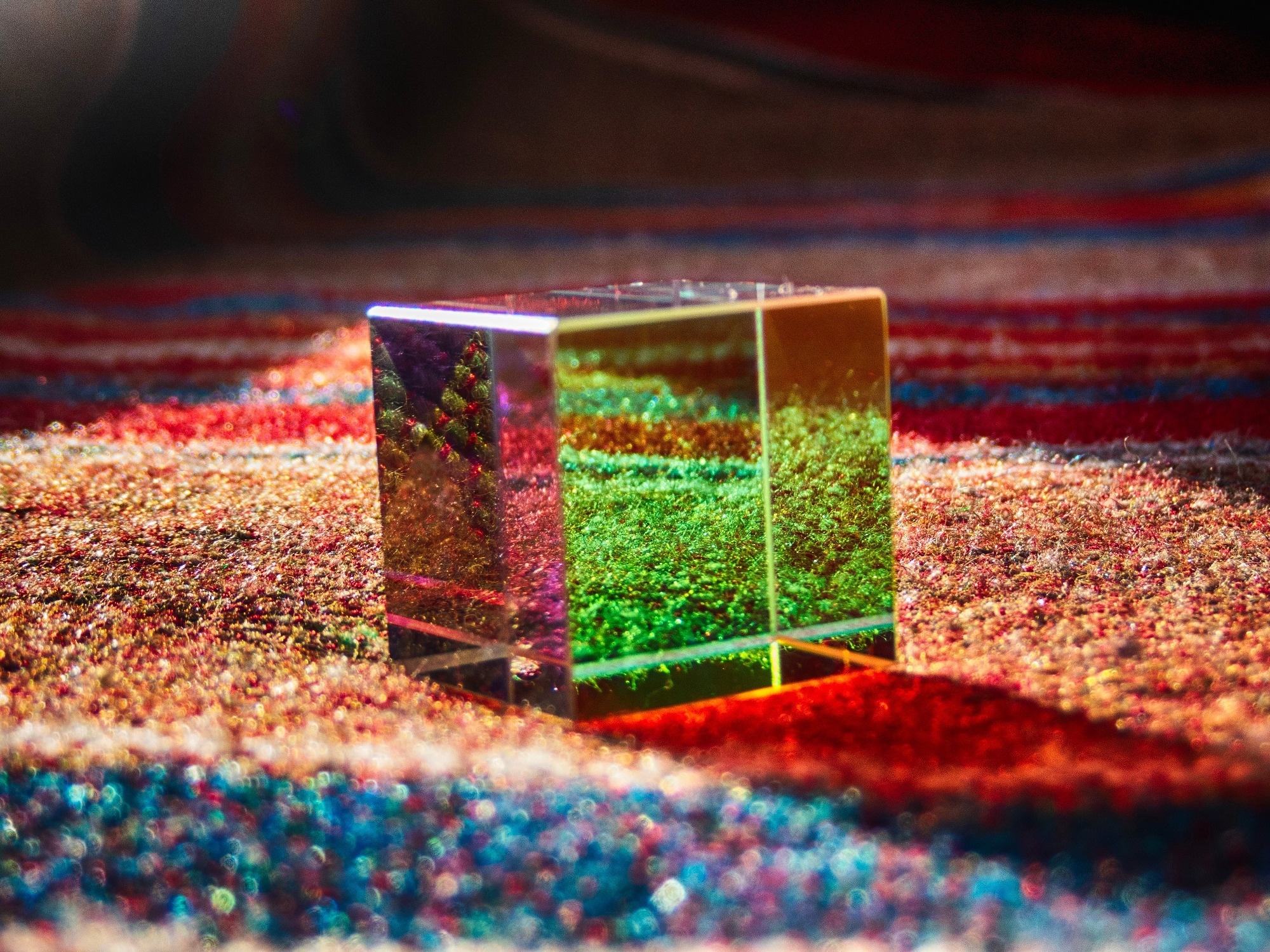
Image Credit: Yaroshenki Denys/Shutterstock.com
The Nature of Light Propagation
Light propagates as an electromagnetic wave consisting of oscillating electric and magnetic fields. When these fields encounter a material medium, they interact with charged particles, primarily the electrons bound to atoms and molecules.1 The electric field of the incoming light wave exerts a force on these electrons, driving them into oscillatory motion. These oscillating charges act as microscopic dipoles that radiate their own secondary electromagnetic waves.
The light observed within the material is the macroscopic result of the interference between the original vacuum wave and these secondary radiated waves. This superposition creates a phase shift that manifests as a reduced propagation velocity. This effect is quantified by the refractive index (n), defined as the ratio of the speed of light in a vacuum (c) to its speed in the medium (v). As light passes through a medium, the collective response of these microscopic interactions introduces a measurable delay, characterizing the material's optical density. 2
No time now? Download the PDF of the article for later
What Determines the Refractive Index?
Several intrinsic material properties govern the magnitude of the refractive index, primarily electronic polarizability. This property measures how easily an atom's electron cloud is distorted by an external electric field. Materials with highly polarizable or delocalized electrons, such as those found in heavy-atom glasses or semiconductors, typically exhibit higher refractive indices.3
Atomic and molecular density also play significant roles. A higher concentration of atoms per unit volume increases the number of interactions light encounters per unit of distance. For instance, water has a refractive index of approximately 1.33, whereas diamond, characterized by a dense carbon lattice, has an exceptionally high index of approximately 2.42. What’s more, the molecular structure influences how these fields propagate; anisotropic crystals can lead to birefringence, where light travels at different speeds depending on its polarization and direction of travel.4
The Lorentz oscillator model provides the mathematical framework for these interactions, treating bound electrons as damped harmonic oscillators driven by the light's electric field. This model explains how the refractive index is fundamentally linked to the material's resonant frequencies. Typical benchmarks include n ≈ 1.5 for crown glass and n ≈ 1.0003 for air at standard temperature and pressure.5
Dispersion and Frequency Dependence
The speed of light in a medium is not a single value but varies with the frequency of the light, a phenomenon known as dispersion. This occurs because the electronic oscillators in a material respond more strongly to frequencies that are closer to their natural resonance. In most transparent materials, blue light (shorter wavelength) travels more slowly and is refracted more sharply than red light (longer wavelength). 6
Dispersion introduces specific technical challenges. In imaging systems, it leads to chromatic aberration, where different colors fail to focus at the same point, necessitating the use of achromatic lens designs. In telecommunications, it causes pulse spreading, where different frequency components of a signal pulse travel at different speeds, eventually overlapping and degrading data integrity.
Crucially, researchers distinguish between phase velocity and group velocity. Phase velocity describes the speed of individual wavefronts, while group velocity characterizes the speed at which a light pulse, and therefore information, propagates through the material. In dispersive media, the group velocity is typically lower than the phase velocity, and managing this "group velocity dispersion" (GVD) is essential for the operation of ultrafast femtosecond lasers.7
Material Engineering and Light Control
Modern photonics increasingly relies on engineered materials to manipulate light speed beyond the limits of natural substances. Photonic crystals, nanostructured materials with periodic variations in refractive index, can create photonic bandgaps that forbid certain wavelengths from propagating or force them to travel at extremely low speeds, a state known as "slow light".8
Metamaterials represent an even more advanced approach, using sub-wavelength structures to achieve optical properties not found in nature, such as a negative refractive index. Recent developments in silicon photonics have utilized these structures to enhance nonlinear interactions, allowing for the creation of compact optical buffers. A 2024 study by researchers at the University of Illinois demonstrated a reconfigurable slow-light platform using erbium-doped lithium niobate on a chip, which successfully slowed light by nearly a thousandfold to facilitate quantum information processing.9
Applications and Industrial Relevance
The ability to control light speed is the foundation of the multi-billion-dollar telecommunications industry. Engineers use dispersion-shifted fibers and dispersion-compensating modules to ensure that data pulses remain distinct over thousands of kilometers of undersea cables. Without precise control of the refractive index and dispersion, the high-bandwidth internet required for modern data centers would be physically impossible.
In the semiconductor industry, immersion lithography exploits the refractive index of liquids (such as highly purified water) to "shrink" the effective wavelength of light used to etch silicon wafers. This allows for the fabrication of smaller transistors, directly enabling the continued advancement of computing power.10 Additionally, in medical imaging, techniques such as Optical Coherence Tomography (OCT) rely on the precise timing of light reflected through biological tissues, where the refractive index of different ocular or skin layers must be accounted for to produce accurate 3D maps.
Future Perspectives in Light Control
Research is now focused on the transition from electronic to all-optical computing. Researchers aim to create optical transistors that operate at terahertz speeds by utilizing nonlinear optical materials where the refractive index changes based on light intensity. Moreover, the field of quantum optics is exploring "stopped light" via electromagnetically induced transparency (EIT). In these systems, light pulses are effectively brought to a halt within atomic vapors or doped crystals, stored as atomic excitations, and later released. This capability is viewed as a prerequisite for developing quantum repeaters and robust quantum memory for future global quantum networks.
Check out our intro to quantum imaging techniques here
References
- Born, M., & Wolf, E. (2019). Principles of Optics: Electromagnetic Theory of Propagation, Interference and Diffraction of Light (7th ed.). Cambridge University Press. https://doi.org/10.1017/9781108769914
- Hecht, E. (2017). Optics (5th ed.). Pearson Education. https://www.worldcat.org/isbn/9780133977226
- Fox, M. (2010). Optical Properties of Solids (2nd ed.). Oxford University Press. https://www.worldcat.org/isbn/9780199573363
- Kittel, C. (2004). Introduction to Solid State Physics (8th ed.). Wiley. https://www.worldcat.org/isbn/9780471415268
- Jackson, J. D. (1999). Classical Electrodynamics (3rd ed.). Wiley. https://www.worldcat.org/isbn/9780471309321
- Agrawal, G. P. (2013). Highly nonlinear fibers. In Nonlinear Fiber Optics (5th ed., Chapter 11). Academic Press. https://doi.org/10.1016/B978-0-12-397023-7.00011-5
- Boyd, R. W. (2020). Nonlinear Optics (4th ed.). Academic Press. https://www.worldcat.org/isbn/9780128110027
- Joannopoulos, J. D., Johnson, S. G., Winn, J. N., & Meade, R. D. (2008). Photonic Crystals: Molding the Flow of Light (2nd ed.). Princeton University Press. https://www.worldcat.org/isbn/9780691124568
- Illinois Quantum Information Science and Technology Center. (2024). Illinois Grainger Engineers develop reconfigurable slow-light platform for on-chip photonic engineering. IQUIST News. https://iquist.illinois.edu/news/79523
- Peng, S., French, R. H., Qiu, W., Wheland, R. C., Yang, M., Lemon, M. F., & Crawford, M. K. (2005). Second generation fluids for 193 nm immersion lithography. Proceedings of SPIE, 5754. https://doi.org/10.1117/12.606448
Disclaimer: The views expressed here are those of the author expressed in their private capacity and do not necessarily represent the views of AZoM.com Limited T/A AZoNetwork the owner and operator of this website. This disclaimer forms part of the Terms and conditions of use of this website.