Experience precision profiling from UV to THz, designed to quickly and accurately capture the unseen.
With its broadband array, the Pyrocam IV laser beam profiling camera precisely records and evaluates wavelengths ranging from 13 nm to 3000 µm.
It is designed to analyze NIR, CO2, and THz sources, with a solid-state, high-resolution 320 × 320 pyroelectric array, a broad dynamic range, fast data acquisition rates, and CW or pulsed modes.
- 320 × 320 pyroelectric array with a pitch of 80 µm
- CW Beams with an Integrated Chopper
- GigE interface for communication
- BeamGage Professional software is provided
Software
BeamGage Professional
All of BeamGage Standard's features are included in BeamGage Professional. All of the beam profiling cameras are supported by BeamGage Professional, which also includes a .NET automation interface to push data to bespoke applications and window partitioning to enable analysis of numerous beams on a single camera.
Specifications
Source: MKS Ophir
| . |
. |
| Product Name |
Pyrocam IV |
| Spectral Range |
13 nm – 3000 μm |
| Beam Size |
1.6 to 25.4 mm |
| Communication Interface |
GigE |
| Sensor Type |
Pyroelectric Array |
| Compatible Light Sources |
CW, Pulsed up to 1 KHz |
| Active Area |
25.6 × 25.6 mm |
| Sensor Recess |
19.7 mm |
| Elements |
320 × 320 |
| Effective Pixel Pitch |
80 µm |
| Dynamic Range |
60 dB |
| Full Resolution Frame Rate |
100 fps |
| Saturation Intensity |
Chopped Mode: 3 W/cm2 (25 Hz) and 4.5 W/cm2 (50 Hz)
Pulsed Mode: 15 mJ/cm2 |
| Software |
BeamGage Professional |
| CE Compliance |
Yes |
| UKCA Compliance |
Yes |
| China RoHS Compliance |
Yes |
Features
Pyrocam Pyroelectric Beam Profiler Camera Overview
Pyrocam Measures IR and UV Lasers
Video Credit: MKS Ophir
BeamGage® Laser Profiling Software
There are two versions of BeamGage®: standard and professional. Each grows upon the one before it, offering more flexibility and capability as needed to accommodate nearly any configuration requirement.
In compliance with ISO standards, the software conducts thorough data analysis on the same parameters and provides a quantitative assessment of various beam spatial features. It is also possible to use pass/fail limit analysis for each parameter.
Camera Based Laser Beam Profiling With BeamGage
Video Credit: MKS Ophir
BeamGage® Software Measurements
- ISO standard beam parameters
- Centroid and peak location
- Dslit, Denergy, D4σ
- Divergence
- Major and minor axis
- Ellipticity, eccentricity
- Gaussian fit
- Beam Rotation
- Flat-top analysis/uniformity
- Pointing stability
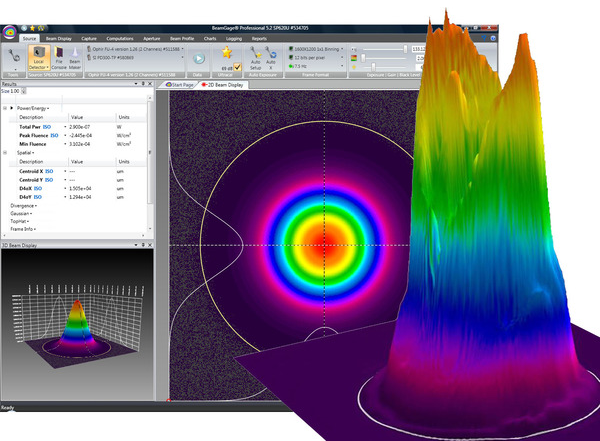
Image Credit: MKS Ophir
Laser Beam Profiler Accessories
To obtain a signal suitable for measurement, beam manipulation may occasionally be required during beam-profiling studies on a laser. Occasionally, the beam must be properly sized.
In order to picture, the laser's strength must frequently be lowered to a specific threshold. With the help of laser beam profiler accessories, users can achieve the ideal beam widths and power levels for the most precise measurements.
Designing a Laser Beam with BeamMaker
By generating a theoretical beam, BeamMaker assists engineers, technicians, and researchers in understanding the modal content of a beam. The ideal beam profile can be created in BeamMaker by entering the mode, width, size, height, angle, intensity, and noise content.
Then, the laser is set up to operate as intended, and the theoretically predicted measurements are compared with the actual beam. Knowing how much the actual beam differs from the intended beam is the end outcome.
Fundamentals of Laser Measurement and Beam Profiling
Is the laser beam profile shaped appropriately for the intended use? In addition to discussing the advantages of profiling the laser beam, this video explains the principles of laser beam profiles: before and after laser beam profiles are displayed in a number of case studies.
Fundamentals of Laser Measurement & Beam Profiling -- Ophir-Spiricon
Video Credit: MKS Ophir
Measuring Laser Focus Spot Size in an Industrial Medical Device Application
This detailed tutorial demonstrates the installation of a camera-based beam-profiling system on an industrial single-pulse laser welding system. Additionally, it will show the user how to evaluate the laser's energy per pulse, its temporal pulse form, and its focused spot all at once.
Measuring Laser Focus Spot Size in an Industrial Medical Device Application
Video Credit: MKS Ophir