A CQD (colloidal quantum dot) sensor in the BGP-GigE-SP301Q beam profiler camera provides remarkable resolution and allows precise characterization of laser beams over a broad wavelength range. Due to its sophisticated capabilities, it is ideal for demanding applications such as military systems, remote sensing, optical communication, LiDAR for autonomous vehicles, and precision material processing.
- GigE communication interface
- Wavelength range: 400–1700 nm
- 640 × 512-pixel resolution with a 15 μm pitch
- BeamGage Professional software included
Software
BeamGage Professional
BeamGage Professional has all the features of BeamGage Standard, with some extras. BeamGage Professional supports all of Ophir's beam profiling cameras, features window partitioning for analyzing several beams on a single camera, and includes a .NET-based automation interface for pushing data to bespoke applications.
Specifications
Source: MKS Ophir
| . |
. |
| Product Name |
SP301Q |
| Spectral Range |
400–1700 nm |
| Beam Size |
150 μm to 7.7 mm |
| Communication Interface |
GigE |
| Sensor Type |
CQD |
| Compatible Light Sources |
CW, Pulsed |
| Active Area |
9.6 × 7.7 mm |
| Sensor Recess |
12.5 mm |
| Elements |
640 × 512 |
| Effective Pixel Pitch |
15 μm |
| Dynamic Range |
55 dB |
| Full Resolution Frame Rate |
60 fps |
| Saturation Intensity |
0.3 mW/cm2 |
| Software |
BeamGage Professional |
| CE Compliance |
Yes |
| UKCA Compliance |
Yes |
| China RoHS Compliance |
Yes |
Features
BeamGage® Laser Profiling Software
BeamGage® comes in two versions: standard and professional. Each builds on the one before it, providing additional flexibility and capabilities as needed to meet practically any configuration requirement.
In accordance with ISO standards, the software performs extensive data analysis of the same parameters and provides a quantitative evaluation of numerous spatial aspects of the beam. Each of these parameters can also be evaluated using pass/fail limit analysis.
Camera Based Laser Beam Profiling With BeamGage
Video Credit: MKS Ophir
BeamGage® Software Measurements
- ISO standard beam parameters
- Flat-top analysis/uniformity
- Centroid and peak location
- Major and minor axis
- Dslit, Denergy, D4σ
- Divergence
- Ellipticity, eccentricity
- Gaussian fit
- Beam rotation
- Pointing stability
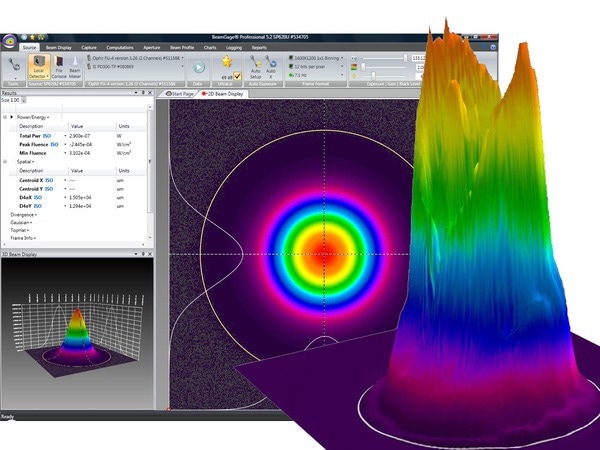
Image Credit: MKS Ophir
Laser Beam Profiler Accessories
When performing beam-profiling experiments on a laser, beam manipulation may be required to obtain a measurement-appropriate signal. The beam may need to be correctly sized: if it is too small, it must be increased; if it is too large, it must be decreased.
To capture images, the laser's strength must be regularly reduced to a particular threshold. Users can employ the laser beam profiler accessories to obtain the optimal beam widths and power levels for the most accurate measurements.
Designing Laser Beam with BeamMaker
BeamMaker helps technicians, engineers, and academics understand a beam's modal content by constructing a theoretically generated beam. In BeamMaker, specify the mode, width, size, intensity, height, angle, and noise content to create the optimal beam profile.
Then, set up the laser to operate as expected and compare the theoretical measurements to the actual beam. The ultimate result is determining how much the actual beam varies from the desired beam.
Fundamentals of Laser Measurement and Beam Profiling
Is the laser's beam profile adequately tailored for its intended use? This video discusses the benefits of laser beam profiling and the basics of laser beam profiles. Several case studies show the before and after laser beam profiles.
Fundamentals of Laser Measurement & Beam Profiling -- Ophir-Spiricon
Video Credit: MKS Ophir
Measuring Laser Focus Spot Size in an Industrial Medical Device Application
This extensive guide will illustrate how to install a camera-based beam profiling system on industrial single-pulse laser welding equipment. Furthermore, it will demonstrate how to measure the laser's energy per pulse, temporal pulse form, and focused spot all at once.
Measuring Laser Focus Spot Size in an Industrial Medical Device Application
Video Credit: MKS Ophir