Optical fiber has already transformed the modern world. New research now suggests it could do even more. A new flat fiber fabrication technique produces a high fidelity sensor for a wide range of applications, from batteries to bridges, according to a recently-published study.
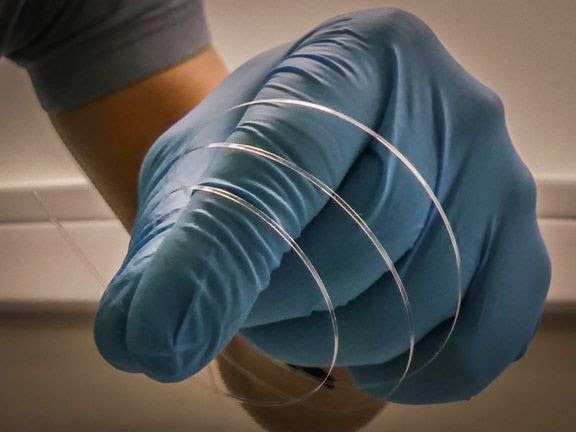 A section cut from more than 100 m of flat optic fiber developed by researchers at KTH Royal Institute of Technology and University of Southampton. In lab demonstrations, the fiber proved 1000 times more sensitive than standard optic fiber in measuring pressure. Image Credit: Pawel Maniewski, KTH Royal Institute of Technology.
Researchers from KTH Royal Institute of Technology in Stockholm and the University of Southampton in the UK have developed a new type of flat silica optical fiber that performs differently from conventional round fiber. The work, published in Nature Communications, introduces a high-aspect-ratio platform that can be engineered to respond strongly to pressure, temperature and other physical changes.
By creating a ribbon-like geometry with controlled internal microstructure, the team showed that the shape of fiber can be used as a functional part of a sensor. Instead of the widely-used technique of flattening a round fiber, the researchers created a method to preform it from the beginning, and they used laser-based glass processing to add internal features like air channels or metal fillings.
In laboratory demonstrations, the flat fiber showed pressure sensitivity up to 1,000 times higher than standard circular fiber designs. The team also demonstrated an enhanced temperature sensing version by filling part of the internal microstructure with a tin-based alloy.
“This is not just a different looking fiber,” KTH researcher Pawel Maniewski says. “It is a new design space for optical fiber.”
“By changing the geometry, we can make the glass itself much more responsive to the physical world around it.”
The breakthrough builds on collaboration between KTH and Southampton in laser-based glass processing, speciality fiber manufacture and optical sensing. The result is a fiber that remains compatible with existing optical systems while offering new mechanical and sensing capabilities.
The potential applications are wide ranging. Flat fibers could be embedded into composite materials to give aircraft, drones and infrastructure a better sense of internal strain and pressure. The same platform could also support smarter battery technology, where pressure and temperature changes inside cells can provide early signs of abnormal behavior.
Unlike electronic sensors, optical fibers are immune to electromagnetic interference, lightweight, compact and capable of operating in harsh environments. These features make them attractive for aerospace, energy systems, biomedical devices and advanced manufacturing.
The researchers believe the work points towards a broader shift in fiber technology. Rather than using optical fiber only to transmit light, future systems could use the fiber geometry itself to shape how materials sense, respond and communicate.
“This gives optical fiber a new dimension,” says Chris Holmes, professor at Southampton University. “The next step is to take this platform from proof-of-concept sensing towards real systems, including intelligent drones, advanced composites and safer energy technologies.”