Reviewed by Frances BriggsDec 18 2025Reviewed
Researchers have produced the fastest soft X-ray pulse that lasts just 19.2 attoseconds. It's an unprecedented way to observe matter at its most fleeting and fundamental scale.
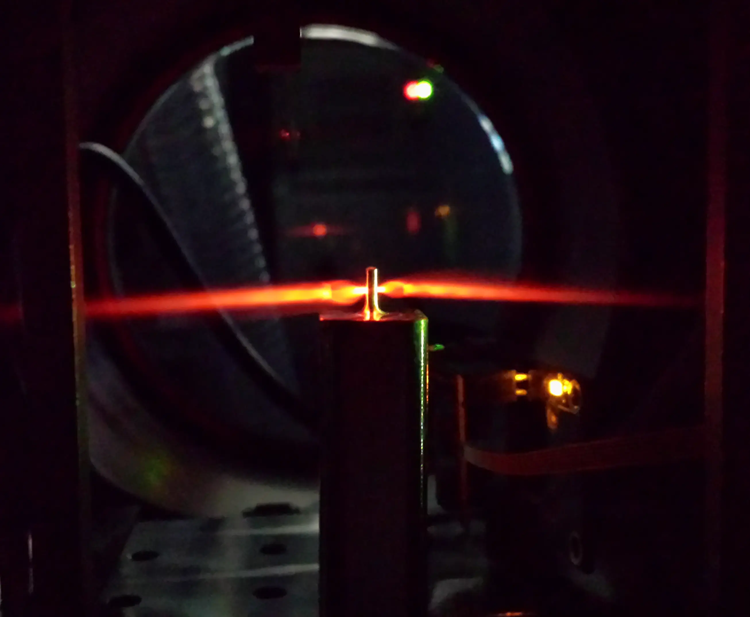 The image captures the generation of attosecond pulses, in which ultrashort laser pulses interact with a neon gas jet. This interaction initiates high-harmonic generation, yielding the shortest attosecond soft X-ray pulse ever produced. Image Credit: ICFO
ICFO researchers achieved a remarkable milestone, producing the shortest soft X-ray pulse ever recorded. This pulse represents the swiftest flash of light, surpassing the atomic unit of time (24.2 attoseconds), which corresponds to the duration required for an electron to complete a single orbit around a hydrogen atom, often referred to as the "atomic year."
The study was published in the journal Ultrafast Science.
This advancement allows for the observation of matter's behavior and interactions at atomic and subatomic levels with unparalleled temporal resolution.
Electrons play a crucial role in determining various phenomena: the progression of chemical reactions, the electrical conductivity of materials, the energy transfer in biological molecules, and the functioning of quantum technologies.
The dynamics of electrons occur on attosecond timescales, which are far too rapid for traditional measurement instruments.
The researchers have succeeded in generating a soft X-ray pulse lasting 19.2 attoseconds, effectively creating a camera that can capture these fleeting dynamics in real time with unparalleled detail, thus allowing for the observation of previously unobserved processes.
Flashes of light within the soft X-ray spectral range facilitate fingerprint identification, enabling scientists to monitor the reorganization of electrons around specific atoms during reactions or phase transitions.
The generation of such a brief isolated pulse required advancements in high-harmonic generation, sophisticated laser engineering, and attosecond metrology. Collectively, these innovations empower researchers to observe electron dynamics, which are crucial in defining material properties, at their inherent timescales.
The path to this achievement began in 2015, when Prof. Jens Biegert’s team made significant strides in generating attosecond pulses in the soft X-ray domain by successfully isolating bursts of this light.
These pulses elucidated the interaction between electrons and the crystal lattice in solids, revealing the timing and mechanism of a molecular ring's opening, which serves as a precursor to processes such as polymerization. The technique for accurately determining the duration had constraints that can now be addressed, culminating in the demonstration of the shortest pulse ever recorded.
When I came to the group and saw the striking traces, I had to look into this with a new pulse retrieval method. Finally, we can say that, to the best of our knowledge, we have confirmed the shortest pulse of light in the world!
Dr. Fernando Ardana-Lamas, Study First Author, ICFO
“This new capability paves the way for breakthroughs in physics, chemistry, biology, and quantum science, enabling direct observation of processes that drive photovoltaics, catalysis, correlated materials, and emerging quantum devices. The sky is the limit,” said Prof. Biegert, reflecting on the future of attosecond soft X-ray pulses below the atomic unit of time.
Journal Reference:
Ardana-Lamas, F., et al. (2025) Brilliant Source of 19.2-Attosecond Soft X-rayPulses below the Atomic Unit of Time. Ultrafast Science. DOI: 10.34133/ultrafastscience.0128. https://spj.science.org/doi/10.34133/ultrafastscience.0128.