Reviewed by Frances BriggsDec 9 2025Reviewed
Thulium fiber lasers, useful in medicine and industry, are frequently power-limited due to heat buildup, but a new approach offers a solution.
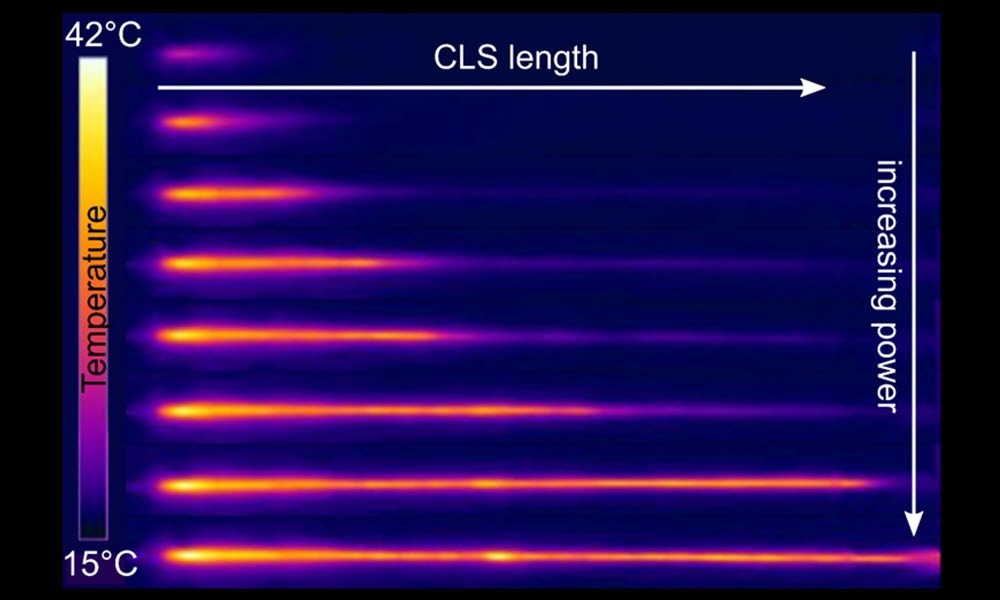 Study: Index-adapting cladding light stripper for high-power thulium fiber lasers. Image Credit: T. Lühder/Fraunhofer IOF.
A novel single-material cladding light stripper (CLS) design from Fraunhofer IOF overcomes the limitations of traditional CLS devices by using a material with a self-adjusting refractive index that spreads heat. The study was published in Advanced Photonics Nexus.
Thulium fiber lasers, operating at a 2-µm wavelength, are valuable in medicine, materials processing, and defense due to their longer wavelength, which causes less damage from stray light compared to common 1-µm ytterbium lasers. Thulium lasers have been limited to approximately 1 kW of output power for over a decade, primarily due to nonlinear effects and heat buildup.
Inband pumping, which replaces diode pumping at 793 nm with laser pumping at 1.9 µm, is a promising method to increase efficiency and reduce heat. This approach, however, presents new challenges for fiber components, particularly the cladding light stripper (CLS).
CLS devices are essential for removing unwanted light in the fiber's outer cladding, preventing degradation of beam quality and component damage. For inband-pumped thulium lasers, CLS must be capable of handling high powers at longer wavelengths.
Conventional polymer-based CLS designs are inadequate because most polymers absorb strongly at 2 µm, leading to intense localized heating and rapid burnout at only a few watts.
Alternative CLS methods, such as etched or laser-processed fibers, can handle higher powers but are less effective at removing low-angle light, which is crucial for pump lasers. Existing multimaterial CLS designs, which use layers with increasing refractive index along the fiber to dissipate heat, are complex and difficult to implement.
Due to its significant negative thermo-optic coefficient, the material's refractive index begins just above that of glass and declines with increasing temperature.
At lower power levels, the CLS strips light effectively. As power increases, the heated areas become less efficient, allowing the remaining light to be transmitted to cooler areas. This distributes heat along the fiber, preventing concentrated heat at the beginning and avoiding critical overheating.
This is a game-changer for quick lab experiments at medium powers.
Dr. Tilman Lühder, Lead Author, Fraunhofer Institute for Applied Optics and Precision Engineering IOF
The team validated their concept through simulations and experiments on 125 µm and 400 µm diameter fibers, covering all relevant thulium wavelengths.
Their results demonstrated the stripping of over 20 W of signal light at 2 µm and up to 675 W at 793 nm, establishing a new record for single-material CLS designs.
Bending the fiber further enhanced performance, achieving stripping efficiencies exceeding 40 dB. While designed for thulium lasers, this approach is adaptable to other laser systems, such as erbium (1.5 µm) and ytterbium (1 µm) lasers, by adjusting the refractive index.
This technology has the potential to overcome the long-standing power limitations of thulium fiber lasers, particularly in inband-pumped configurations.
The Fraunhofer team's design offers a practical and scalable method for robust, high-efficiency light stripping at challenging wavelengths, paving the way for next-generation fiber laser systems.
Journal Reference:
Lühder, T., et al. (2025) Index-adapting cladding light stripper for high-power thulium fiber lasers. Advanced Photonics Nexus. DOI:10.1117/1.APN.4.6.066005. https://www.spiedigitallibrary.org/journals/advanced-photonics