Reviewed by Frances BriggsJan 21 2026Reviewed
A self-driving laboratory using multiple AI systems designed, ran, and interpreted experiments to rapidly improve how LED light can be directed.
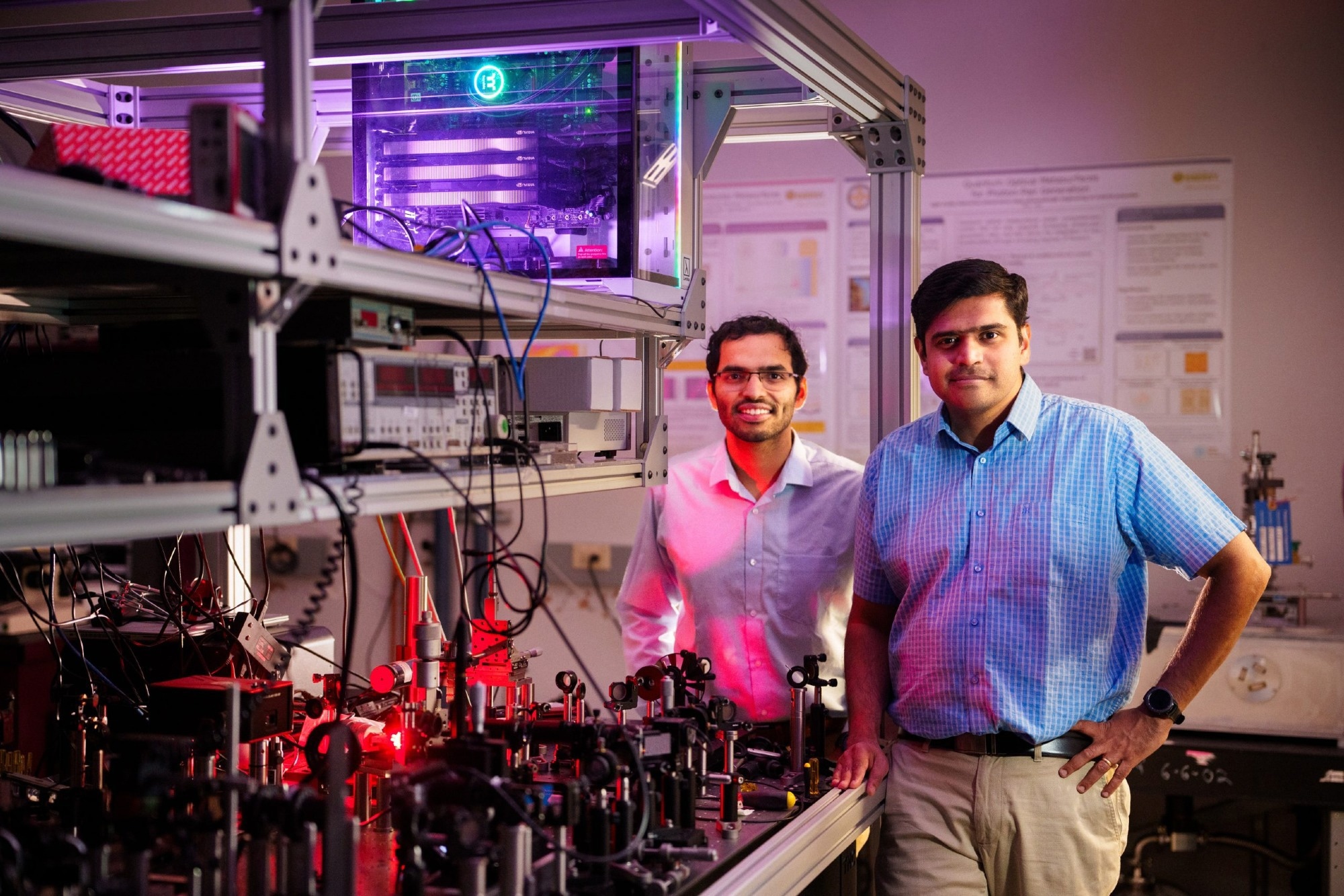 Sandia National Laboratories scientists Saaketh Desai, left, and Prasad Iyer, modernized an optics lab with a team of artificial intelligences that learn data, design and run experiments, and interpret results. Image Credit: Craig Fritz
Physicists at Sandia National Laboratories demonstrated a trio of AI 'lab partners' and revealed their significantly improved methods for directing LED light. The study was published in Nature Communications.
In 2023, a group of physicists from Sandia National Laboratories made a significant announcement: they discovered a method to direct LED light. If this technique is further developed, it could potentially lead to the replacement of lasers with more affordable, compact, and energy-efficient LEDs across various technologies, including UPC scanners, holographic projectors, and self-driving vehicles.
The researchers initially believed that years of careful experimentation would be necessary to perfect their method.
The same team has revealed that a trio of artificial intelligence lab partners has enhanced their best outcomes by four times. This improvement was achieved in just five hours.
The study illustrates how AI is evolving from a simple automation tool into a catalyst for clear and understandable scientific discovery.
We are one of the leading examples of how a self-driving lab could be set up to aid and augment human knowledge.
Prasad Iyer, Study Author, Center for Integrated Nanotechnologies, Sandia National Laboratories
Initially, the team employed a generative AI model to comprehend and streamline their intricate data.
The team supplied this refined data set to a second AI, known as an active learning agent, and linked it to an optical apparatus.
The team directed it to formulate an experiment based on the acquired data, execute it on the apparatus, evaluate the outcomes, and then iterate the process by devising a new experiment informed by its results.
By the 300th experiment, which took approximately five hours, it had markedly enhanced what the researchers had dedicated years to developing.
But there are a few setbacks associated with AI. A query is input, and an answer is produced; however, users frequently find it challenging to understand the reasoning behind the AI's response.
We could potentially do infinite nonsensical experiments without having any meaningful results.
Prasad Iyer, Study Author, Center for Integrated Nanotechnologies, Sandia National Laboratories
This is due to the black box issue associated with AI.
When a scientist uncovers something new, they explain the rationale behind their findings. This is essential for the advancement of science, as it allows other scientists to either expand upon the idea or refute it.
The researchers acknowledged the need to ensure that any conclusions drawn from AI are comprehensible.
We are constraining ourselves to finding good experiments that will advance our understanding of the domain. Therefore, there is a high emphasis on interpreting why something worked or didn’t work.
Saaketh Desai, Postdoctoral Researcher, Center for Integrated Nanotechnologies, Sandia National Laboratories
To resolve the 'black box' problem, they implemented a secondary AI to serve as a specialized fact-checker. Unlike the primary model, this second system was specifically trained to derive the underlying mathematical equations that explain complex data trends.
The team established a fully autonomous "self-driving lab." As the agent planned and executed experiments by creating a feedback loop between the active learning agent and the equation learner, the second AI simultaneously derived mathematical formulas to explain the results.
This closed-loop system quickly uncovered a systematic way to steer spontaneous emission: The light produced by LEDs. The findings were significant. Light-steering efficiency improved by an average of 2.2 times over a 74-degree angle, with peak performance reaching 4x at specific points.
The AI provided a solution the Sandia team had not previously explored, introducing a novel paradigm for light-matter interactions at the nanoscale. While Desai notes that the platform’s potential for scientific discovery is vast, its reliance on significant computational resources, specifically a Lambda Labs workstation equipped with three high-end NVIDIA RTX A6000 GPUs, may limit its accessibility to better-funded institutions.
“For next steps, we are generally interested in interpretable optimization schemes and arriving at explainable decisions using AI. We are interested in applying this to the steering problem, as well as other material science problems in general,” said Desai.
Journal Reference:
Desai, S., et al. (2025) Self-driving lab discovers principles for steering spontaneous emission beyond conventional Fourier optics. Nature Communications. DOI: 10.1038/s41467-025-66916-0. https://www.nature.com/articles/s41467-025-66916-0.