Reviewed by Frances BriggsJan 13 2026Reviewed
Researchers at the Korea Advanced Institute of Science and Technology (KAIST) have introduced a technology that more than doubles the efficiency of light emission in OLEDs.
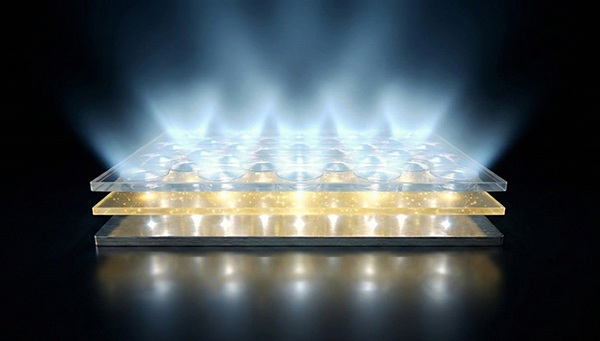 Quasi-Planar Light Extraction OLED Technology. Image Credit: Korea Advanced Institute of Science and Technology (KAIST)
KAIST reported the research team's findings in Nature Communications, which include the creation of a novel near-planar light outcoupling structure and an OLED design methodology that can significantly minimize light loss within OLED devices.
Organic light-emitting diodes (OLEDs) are widely used in smartphones and televisions due to their exceptional color accuracy and slim, flexible planar design. Nevertheless, internal light loss has hindered further enhancements in brightness.
OLEDs consist of several layers of ultrathin organic films stacked on top of each other. As light traverses these layers, it is frequently reflected or absorbed, often resulting in over 80 % of the light produced within the OLED being lost as heat before it can escape.
Light outcoupling structures such as hemispherical lenses or microlens arrays (MLAs) have been employed to extract light from OLEDs.
However, hemispherical lenses protrude considerably, complicating the maintenance of a flat form factor, while MLAs need to cover a much larger area than the size of individual pixels to achieve adequate light extraction. This imposes constraints on attaining high efficiency without interference from adjacent pixels.
The research team proposed a new design strategy for OLEDs that optimizes light extraction within the dimensions of each individual pixel, enhancing the brightness of OLEDs while maintaining a planar structure.
This method considers the limited pixel sizes actually used in practical displays, in contrast to traditional designs that assume OLEDs have infinite resolution. The greater amount of light can be emitted externally, even from pixels of identical size.
The team has created a novel “near-planar light outcoupling structure” that facilitates efficient light emergence in the forward direction without excessive dispersion. This structure is remarkably thin – comparable in thickness to current microlens arrays – yet it attains light extraction efficiency that is almost equivalent to that of hemispherical lenses with the same lateral dimensions.
As a result, it has a minimal impact on the flat form factors of OLEDs and can be easily implemented in flexible OLED displays.
The researchers have successfully achieved a twofold improvement in light-emission efficiency, even in small pixels, by integrating the innovative OLED design with a near-planar light outcoupling structure.
This technology facilitates the creation of brighter displays without increasing the power consumption, while preserving the flat structure of OLED. It is anticipated to enhance battery longevity and minimize the heat production in mobile devices, including smartphones and tablets. The enhancements in display lifespan are expected.
A small idea that came up during class was developed into real research results through the KAIST Undergraduate Research Program (URP).
MinJae Kim, Study First Author, Korea Advanced Institute of Science and Technology (KAIST)
“Although many light outcoupling structures have been proposed, most were designed for large-area lighting applications, and many were difficult to apply effectively to displays composed of numerous small pixels.
"The near-planar light outcoupling structure proposed in this work was designed with constraints on the size of the light source within each pixel, reducing optical interference between adjacent pixels while maximizing efficiency,” said Seunghyup Yoo, Professor, Korea Advanced Institute of Science and Technology (KAIST).
Seunghyup Yoo emphasized that this approach is relevant not only for OLEDs but also for upcoming display technologies that incorporate materials such as perovskites and quantum dots.
Journal Reference:
Kim, M., et al. (2025) Near-planar light outcoupling structures with finite lateral dimensions for ultra-efficient and optical crosstalk-free OLED displays. Nature Communications. DOI: 10.1038/s41467-025-66538-6. https://www.nature.com/articles/s41467-025-66538-6