In a recent article published in the journal Physical Review Letters, researchers presented the first search for a dark matter (DM)-produced infrared line using spectroscopic data from the James Webb Space Telescope (JWST).
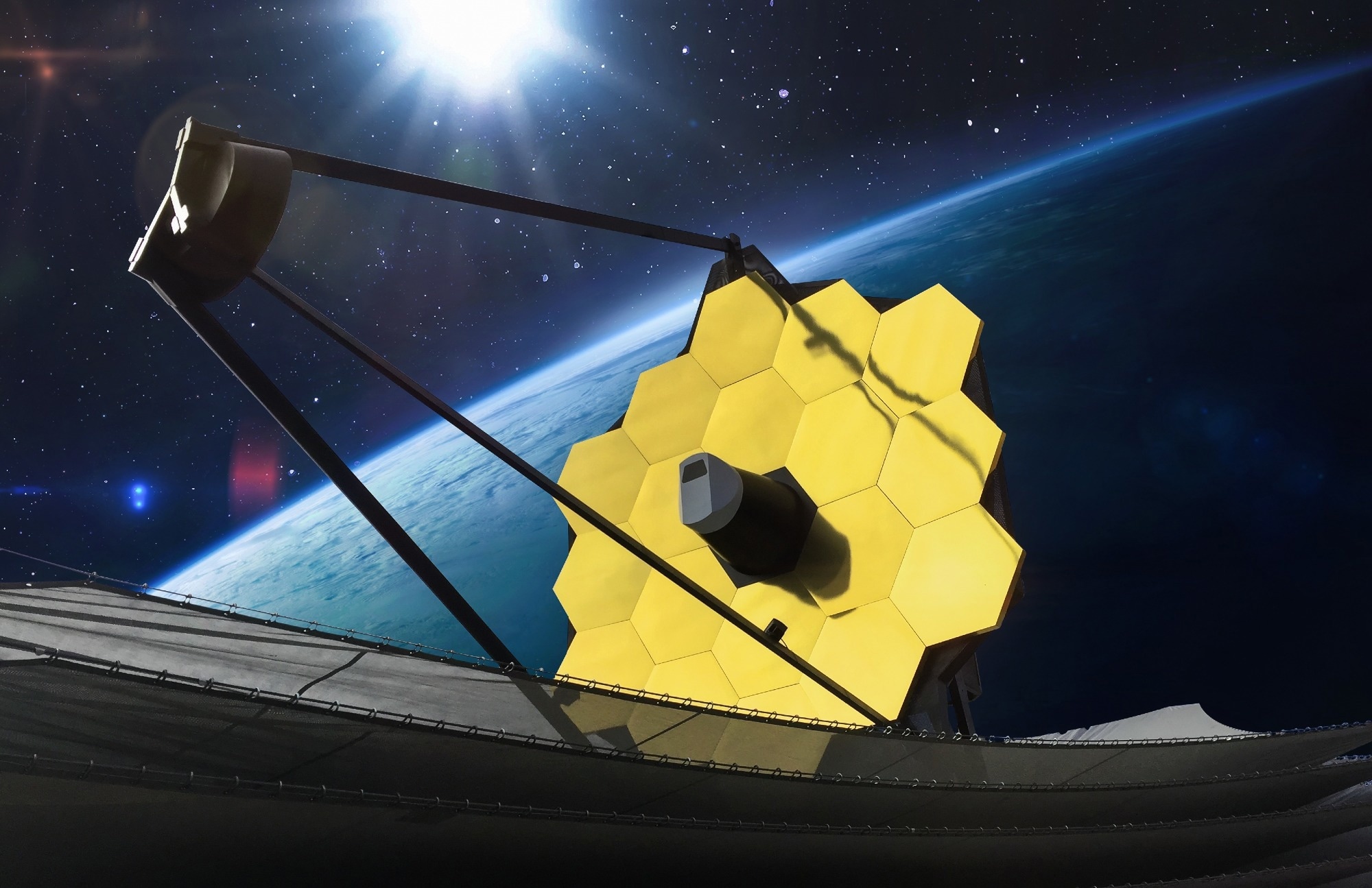
Image Credit: Dima Zel/Shutterstock.com
Background
The JWST is a high-sensitivity, high-resolution infrared telescope, making it uniquely suited for this search. Its instruments cover the wavelength range relevant for 1 eV DM decay. Specifically, this work focuses on observations made using the Near-Infrared Spectrograph (NIRSpec) Integral Field Unit (IFU). NIRSpec IFU measurements are particularly well-suited for blank-sky DM searches because they provide both spatial and spectral information over a field of view, and they can collect sky spectra in tandem with observations of bright targets.
The Current Study
The constraints on DM line emission were derived using two distinct statistical approaches. The core strategy hinges on the fact that a large fraction of JWST's total observing time includes blank sky observations used for sky subtraction, allowing the search to be progressively improved as more public data becomes available.
The first approach is the Total Flux Limit, which is the most conservative and does not rely on a detailed background model. A test statistic is constructed that sums up the squared difference between the predicted DM flux and the observed flux only when the predicted DM flux is greater than the observation.
The second and more constraining approach is the Continuum Model Constraint. This method exploits the characteristics of the JWST background spectrum, which is dominated by continuum emission that varies smoothly over large wavelength scales, much larger than the narrow DM line width. This allows for the possibility of discovering a DM line even without a specific physical background model. When no signal is observed, a stringent constraint is imposed by requiring that the dark matter flux remain below the level of intrinsic variations in the measured spectrum. The test statistic used for this approach includes the predicted DM flux and a component P representing a generic, smooth continuum. This continuum is modeled using a cubic-spline interpolant defined by five points across the analysis window. This method is verified to be robust against spurious exclusions due to downward data fluctuations by employing a power constraint procedure, and it is also robust against the presence of astrophysical emission or background absorption lines, as the continuum model effectively models these broad features.
Results and Discussion
The analysis, which utilized NIRSpec IFU measurements collected in tandem with observations of the galaxy GN-z11, found no significant detection of DM line emission. Despite the non-detection, the study successfully constrained the lifetime of decaying DM, confirming the competitiveness of infrared astronomy for this type of search.
The constraints derived from this initial data set significantly improve upon current bounds in the literature across the mass range of 0.8 to 2.5 eV. Specifically, the study excluded a DM lifetime of ?? < 2.6 x 1026 s for a DM mass of 1 eV.
Focusing on Axionlike Particles (ALPs), one of the most compelling DM candidates in this mass range, the study constrained the ALP-photon coupling ??????????. The maximum constraint excluded couplings down to ?????????? > 1.25× 10⁻¹¹ GeV−1 for ???? = 2.19 eV.
The blank sky approach is a major feature of this work, as it means the results can be immediately improved by incorporating all currently available public JWST data. The total integration time of public data currently available from NIRSpec IFU and MSA, using the relevant gratings, spans 1.6 x 10⁶ s over 1.7 calendar years. Scaling the results to this accumulated data predicts that testing lifetimes up to 3 x 1027 s, corresponding to ALP-photon couplings down to 5 x 10-12 GeV-1, is feasible across the full NIRSpec mass window of 0.5 to 4 eV.
Conclusion
This work successfully implemented the first constraints on the lifetime of decaying DM using spectroscopic measurements from the James Webb Space Telescope. By leveraging public blank sky observations, a strategy that will allow continuous updates and strengthening of bounds as the JWST mission proceeds, the study confirmed the powerful capabilities of infrared astronomy in searching for and constraining crucial DM candidates. The use of NIRSpec IFU measurements, specifically chosen for their suitability for blank-sky DM searches, resulted in considerable improvements to existing constraints on decaying DM in the mass range of 0.8 to 2.5 eV. Future analysis incorporating the full current and future JWST data will further extend the limits on lifetimes and ALP-photon couplings into new, unexplored parameter space.
Source:
Journal Reference
Ryan J. and Elena P. (2025). Hunting Dark Matter Lines in the Infrared Background with the James Webb Space Telescope. Physical Review Letters 134, 071002. DOI: 10.1103/PhysRevLett.134.071002, https://journals.aps.org/prl/abstract/10.1103/PhysRevLett.134.071002