Researchers at the University of Oxford have presented a method for interpreting the interactions between materials and polarized light, which may facilitate advancements in biomedical imaging and material design. The study, published in Advanced Photonics Nexus, focuses on enhancing the analysis of a crucial optical characteristic known as the retarder.
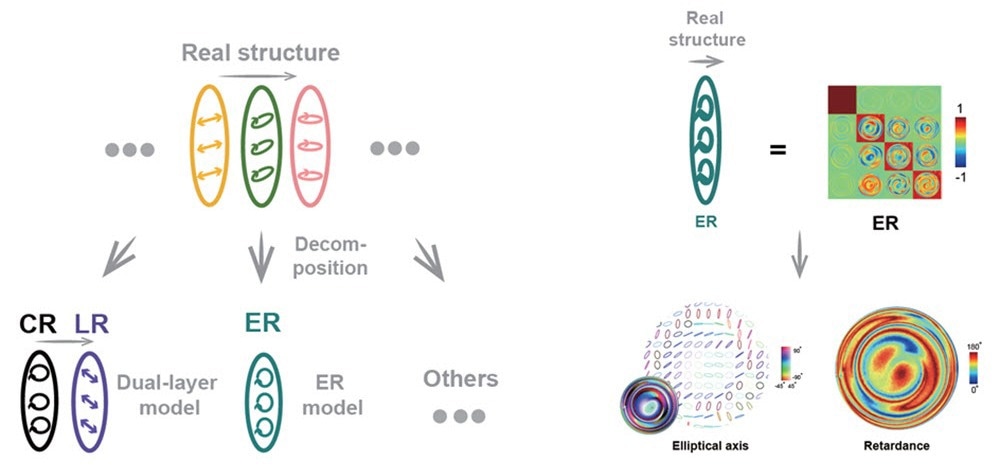 In polarization analysis, the real structure of a retarder sample may consist of multiple layers or a continuous, non-layered structure (left). Conventional approaches typically model the sample as a circular retarder (CR) followed by a linear retarder (LR), which may lead to misinterpretations. A method that employs an elliptical retarder (ER) model avoids this issue by characterizing the overall properties of any retarder without requiring prior knowledge of its internal structure. On the right, an example of a liquid-crystal droplet, which has a continuous, nonlayered structure. Its ER decomposition demonstrates the spatial distributions of the elliptical fast axis and retardance. Image Credit: R. Zhang et al., doi 10.1117/1.APN.4.6.066015
In the field of optics, a retarder refers to a material or device that alters the orientation of light waves as they traverse through it. Light waves possess an orientation termed polarization, and a retarder modifies the phase relationship between various components of that light – essentially causing a delay in one segment of the wave relative to another.
This characteristic is extensively utilized in technologies such as LCD screens, microscopes, and imaging systems, as it can uncover concealed details regarding a material's structure.
For many years, researchers have relied on Mueller matrix polarimetry, a method that utilizes a 16-element matrix to demonstrate how a sample alters the polarization of light. A significant element of this matrix is the retarder component.
Historically, scientists have presumed that the behavior of a retarder can be categorized into two straightforward types: a linear retarder (which delays light along a single axis) and a circular retarder (which rotates the orientation of linear polarization). Actual materials frequently exhibit intricate or indeterminate internal structures, rendering this assumption unreliable.
Runchen Zhang and team, under the guidance of Professor Chao He at the University of Oxford, suggested employing a more comprehensive method – utilizing the elliptical retarder model for any retarder. This method characterizes the retarder using three parameters – the orientation of the elliptical axis, the degree of ellipticity, and the elliptical retardance – rather than confining it to a layered model.
This parameter set, initially introduced by Lu and Chipman but not widely adopted, effectively captures the complete properties of the retarder without necessitating prior knowledge of the material's structure.
Experiments conducted on liquid crystal samples demonstrated that the elliptical model prevents the misinterpretations that are often associated with traditional techniques. It accurately characterized samples with layered configurations as well as droplets that lack distinct layers.
This methodology streamlines the analysis of polarization data for retarders with complex or unknown structures. It has the potential to enhance biomedical imaging, where bulk tissues frequently comprise multiple layers with differing properties, and to improve the design of structured-light modulation devices, such as cascaded waveplates or spatial light modulators. The authors acknowledge that additional refinements are necessary to resolve phase ambiguities; however, the model offers an alternative perspective for more adaptable polarization analysis.
Journal Reference:
Zhang, R., et al. (2025) Elliptical vectorial metrics for physically plausible polarization information analysis. Advanced Photonics Nexus. DOI:10.1117/1.APN.4.6.066015. https://www.spiedigitallibrary.org/journals/advanced-photonics-nexus/