Why Copper Struggles at Higher Speeds?
How Light Carries More Data
Where Copper Still Holds Ground
Moving Optics Closer to the Chip
Challenges with Optical Interconnects
Conclusion
References and Further Reading
Every time an AI model trains across thousands of processors, enormous volumes of data must travel between chips, boards, and racks. For decades, copper wires handled most of that traffic inside computers, while optical fiber carried data across longer distances between buildings and cities. That division of labor is now shifting because modern AI hardware demands bandwidth at a scale that strains the physics of electrical signaling.
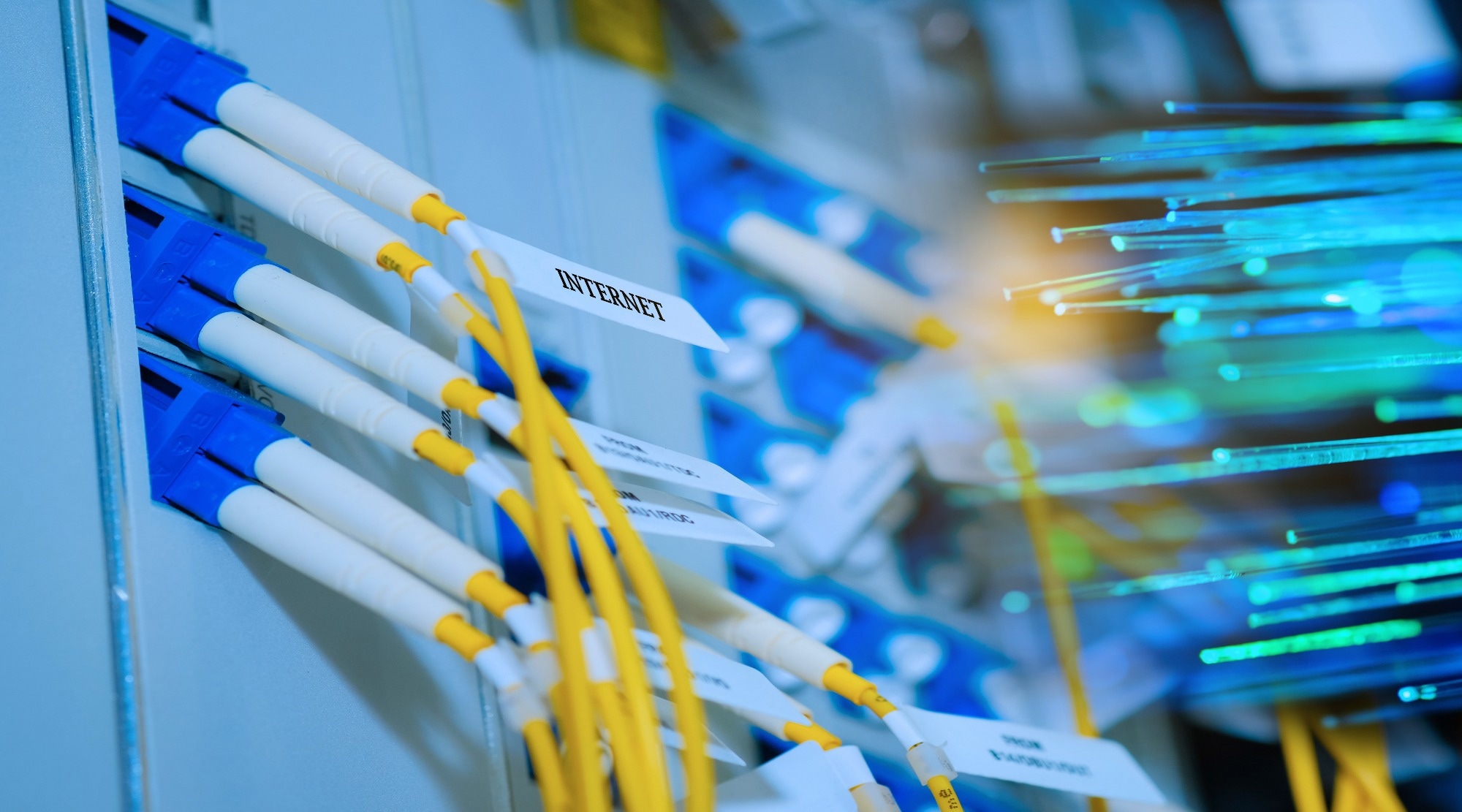 Image Credit: Anucha Cheechang/Shutterstock
Currently, over 90% of inference operations in large language models are slowed by data transfer bottlenecks between components. This article explores the limitations of copper at high speeds, the advantages of light for carrying more data efficiently, and the areas where electrical connections still excel. It also highlights the engineering challenges that will determine the future of optical interconnects in the bandwidth race.1,2
Why Copper Struggles at Higher Speeds?
The core weakness of copper is that the energy required to transmit each bit increases with wire length and signal speed. Faster signals lose strength more quickly as they travel. To address this, chips use serializer/deserializer (SerDes) circuits to restore distorted pulses at the receiving end. Each jump in data rate forces these circuits to work harder and consume more power.1
This trade-off has steadily shortened the distance copper can cover. Passive direct-attached copper cables reach only about 5 m at 100 Gbps/lane. A recent Nature Reviews Electrical Engineering article reports that copper has reached 200 Gbps over a one-meter high-performance cable, with the power cost climbing steeply beyond that length. Each new generation of speeds further shrinks copper's useful range.1,3
Short distances are a major challenge in AI clusters, where many processors need to share data as if they were a single machine. If cables can connect only a few racks, designers can’t spread processors across a larger area without losing bandwidth. Each processor can also have only a limited number of electrical connections along its edge, which engineers call shoreline bandwidth density.1
How Light Carries More Data
Optical interconnects avoid these losses because light traveling through glass fiber weakens far less over distance than electrical signals in copper. Light is also unaffected by electromagnetic interference, so neighboring fibers do not disturb one another the way densely packed wires can. These properties give optical links higher bandwidth, lower latency over long runs, and lower energy per bit once distances stretch beyond a few meters.2
A single fiber can also carry multiple data streams simultaneously through a technique called dense wavelength-division multiplexing. Different streams ride on a different color of light, and the colors travel together without mixing. This approach multiplies capacity without adding more cables, thereby relieving crowding at the chip edge. Silicon photonics makes the technology practical by building optical components in the same factories that produce conventional chips.1
Where Copper Still Holds Ground
Copper offers key benefits for very short connections, especially within a server rack. Active optical modules typically consume 2.5 to 4 times as much power as active copper cables. This is because optics have to change electrical signals into light and back again. Copper also has lower delay for time-sensitive tasks like memory loading and storing, where every nanosecond matters for performance.4
Engineers continue to push the limits of copper technology. Marvell has developed a 224-Gb long-reach SerDes that sent signals over 2.5 m of co-packaged copper cable and backplane, with an energy cost of around 4 pJ/bit. Results like these keep copper a strong choice for connecting processors within a tray or rack because of its low cost and simplicity.5
Moving Optics Closer to the Chip
The biggest problem in today’s optical connections is the pluggable transceiver. This module fits into the front panel of a switch. To send electrical signals to it, the signals must travel a few centimeters across a circuit board. This process uses a lot of power for signal processing. Nvidia estimates that pluggable optics consume about 10% of the total Graphics Processing Unit (GPU) compute power in an artificial intelligence (AI) data center, with lasers accounting for more than half of that share.6
Co-packaged optics address this problem by placing small optical engines directly beside the switch chip inside the same package. The shorter electrical path removes much of the signal-processing burden. Nvidia claims its co-packaged switches deliver 3.5 times better power efficiency and need about one-quarter as many lasers, while Micas Networks also reports about 40% power savings compared to standard pluggable systems.6
There is still room for improvement in energy use. A report published in MDPI Photonics cites about 15 pJ/bit for SerDes circuits in pluggable designs and sets a goal of less than 5 pJ/bit for co-packaged optics. Longer-term research aims for about 100 fJ/bit across a full optical system, which would reduce transmission energy by more than 100-fold.1,2
Challenges with Optical Interconnects
Lasers remain one of the hardest components to integrate on a chip. Silicon emits light poorly due to its indirect bandgap, so most designs rely on external lasers, which add alignment steps, optical interfaces, and heat. Coupling light between fibers and chips also wastes part of the signal, and this loss largely determines a link's power budget and packaging cost.1
Download the PDF of this page here
Temperature creates another challenge for compact optical components called microring modulators. These tiny rings respond to a narrow band of wavelengths, and a temperature shift of only a few kelvins can push them out of alignment. Keeping them tuned requires extra control circuits and power. Packaging, manufacturing yield, and field reliability also need further proof before operators trust optics deep inside their systems.1
Conclusion
The bandwidth battle between optical and electrical interconnects comes down to distance, power, and density. Copper is still the cheapest and fastest option for short distances of a meter or two, and new SerDes designs keep improving its range. However, for longer distances and especially at the chip level, light provides more bandwidth for less power and space than electrical signals.
Technologies like co-packaged optics, wavelength multiplexing, and silicon photonics are breaking down the limits that once kept fiber optics mainly for long-distance networks. The main challenges now are with lasers, connection losses, temperature control, and large-scale manufacturing. As AI systems require more data and become larger, the technology that transfers data most efficiently will shape the future of computing, and this advantage increasingly goes to light.
References and Further Reading
- Wan, Y. et al. (2025). Integrating silicon photonics with complementary metal–oxide–semiconductor technologies. Nature Reviews Electrical Engineering, 3(1), 15-31. DOI:10.1038/s44287-025-00223-0. https://www.nature.com/articles/s44287-025-00223-0
- Liu, Q., Bian, Y., & Xiong, J. (2025). Progress in Passive Silicon Photonic Devices: A Review. Photonics, 12(9), 928. DOI:10.3390/photonics12090928. https://www.mdpi.com/2304-6732/12/9/928
- Tan, I-Hsing. (2026). Beyond the Copper Wall: Scaling AI Clusters with VCSEL-Based Near-Package Optics (NPO). Broadcom Newsroom. https://www.broadcom.com/company/news/articles/innovation/beyond-the-copper-wall-scaling-ai-clusters-with-vcsel-based-near-package-optics-npo-
- Khasraghi, K. J. (2025). How 224G SerDes IP is Enabling the Transition to Linear Drive Optics. Synopsys. https://www.synopsys.com/articles/224g-serdes-ip-linear-drive-optics.html
- Chakravarti, A. (2026). 224G Long-Range SerDes for Scale-up and Scale-inside. Marvell Blogs. https://www.marvell.com/blogs/224g-long-range-serdes-scale-up-scale-inside.html
- Moore, S. K. (2025). A Crucial Optical Technology Has Finally Arrived Nvidia’s endorsement of co-packaged optics means the time is right. IEEE Spectrum. https://spectrum.ieee.org/co-packaged-optics
Disclaimer: The views expressed here are those of the author expressed in their private capacity and do not necessarily represent the views of AZoM.com Limited T/A AZoNetwork the owner and operator of this website. This disclaimer forms part of the Terms and conditions of use of this website.