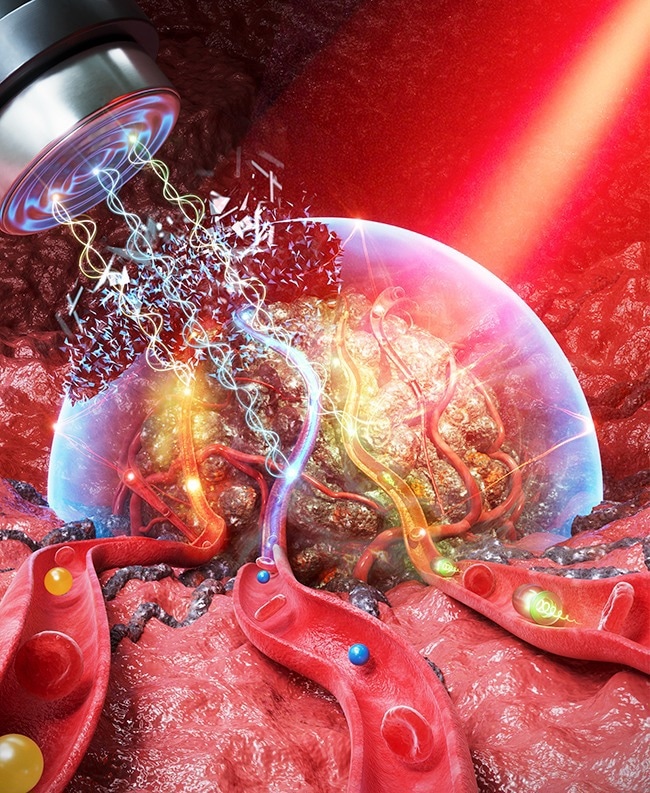
Image Credit: Pohang University of Science and Technology
These limitations exist despite its improved optical contrast and ultrasonic spatiotemporal resolution.
Along with these issues, contrast-enhanced photoacoustic imaging has practical obstacles, such as a lack of efficient cell-specific targeting due to poor delivery efficiency and difficulty creating therapeutically translatable agents.
To enable the development of this field, it is essential to pinpoint the limits of conventional photoacoustic imaging. This can be done by creating contrast-enhancing agents, which should be used in conjunction with high-performance image acquisition devices to overcome the limitations of photoacoustic imaging.
Concerning SNR/contrast, spatial resolution, targeted delivery, and clinical application, the research team reviews the last four years of studies to find solutions to the technical and practical difficulties of photoacoustic imaging.
The team also offers an in-depth evaluation of possible approaches to each problem, including photoswitching agents, near-infrared-II agents, super-resolution localization agents, and micromotor agents.
The team proposes ideas for future research approaches that could allow next-generation contrast-enhanced photoacoustic imaging to stimulate further advancements in this framework.
National Research Foundation of Korea (NRF) grants funded by the Ministry of Science and ICT (MSIT) and the Ministry of Education, Institute of Information and Communications Technology Planning and Evaluation (IITP) grant funded by the MSIT, the Korea Medical Device Development Fund grant funded by the Korea government (MSIT, MOTIE, the Ministry of Health and Welfare, the Ministry of Food and Drug Safety), Korea Evaluation Institute of Industrial Technology (KEIT) grant funded by the Ministry of Trade, Industry and Energy (MOTIE), and BK21 FOUR program supported the study.