Sponsored by MKS OphirReviewed by Olivia FrostAug 3 2026
This article looks at the diverse applications and key parameters driving the widespread adoption of lasers in microprocessing. The intricacies of laser technology and its transformative impact on modern manufacturing are explored, from marking and engraving to cutting smartphone cover glass.
Image Credit: yurakrasil/Shutterstock.com
Common Microprocessing Applications
Microprocessing encompasses a diverse array of manufacturing steps across a wide range of industries. This advanced technique can meet the intricate demands of brittle, thin materials such as semiconductors, glass, and ceramics.
Notable examples of microprocessing applications include:
- Annealing of amorphous silicon to produce polycrystalline silicon
- Separating flexible OLED displays from glass substrates (lift-off)
- Ablation and passivation in photovoltaic cell production
- Marking and engraving
- Drilling vias in PCBs
- Cutting smartphone cover glass
Key Parameters in Laser Microprocessing
Several parameters must be considered when harnessing the power of lasers for microprocessing, with each parameter influencing process efficacy and precision.
- Wavelength: Wavelength dictates energy absorption, transmission, and reflection in materials. UV lasers are typically popular choices in microprocessing applications due to their high absorption rates.
- Average Power: Average power directly affects process throughput, determining how quickly operations can be completed.
- Laser Power Stability: Stable laser power ensures consistency in process outcomes. This is key to maintaining uniformity in terms of product quality.
- Pulse Duration: Proper management of pulse duration is essential to achieve desired effects while minimizing heat dispersion; shorter pulses facilitate more efficient and cleaner processing.
Heat cannot dissipate to its surroundings due to the localized absorption of laser energy both in terms of time (short pulse) and in space (focus beam). This helps achieve the desired effect with a much smaller HAZ (heat-affected zone), wasting significantly less energy on unwanted heating.
Lasers with shorter pulse durations of nanoseconds, picoseconds, and femtoseconds are used for this reason. For example, a 1 μJ pulse in a femtosecond laser does far more work and is much cleaner than a 1 μJ pulse in a microsecond laser. Ultra-short-pulse lasers’ high efficiency means pulse energy can remain relatively low, in the µJ range.
It is possible to achieve high process throughput by increasing the average power. This is done by increasing the repetition rate to 100s of kHz and MHz.
Picosecond and femtosecond pulses both reduce the HAZ and allow for processing of materials that are otherwise transparent, enabling new processes and improving existing ones. This is due to multiphoton absorption.
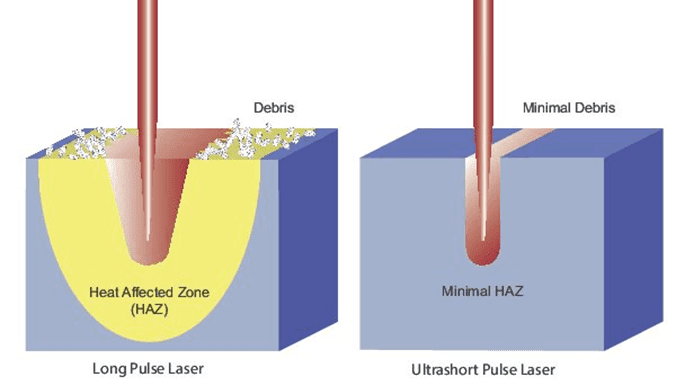
Illustration of material ablation with long- and ultra-short-pulse lasers. The heat-affected zone (HAZ) is shown to be much smaller with the ultra-short-pulse laser. Image Credit: MKS Ophir
Source: MKS Ophir
| Laser type |
Wavelength |
Pulse duration |
Pulse repetition rate |
Comments |
| Carbon dioxide (CO2 laser) |
9.3 μm,
10.6 μm |
10s of μs |
1– 10 kHz |
Mature technology used in processing of organic, textiles, paper, wood, leather, PCBs |
| Excimer laser |
193 nm, 248 nm, 308 nm |
20–30 ns |
10s Hz to
1 kHz |
Gas laser emitting in the UV. Used in the SEMI industry. |
| Diode-pumped solid-state laser |
343–355 nm
515–535 nm
1030–1070 nm |
ns, ps, fs |
kHz to mHz |
Rapidly growing. Utilized crystals doped with elements such as neodynium (Nd) or ytterbium (Yb). |
| Fiber laser |
343–355 nm
515–535 nm
1030–1070 nm |
ns, ps, fs |
kHz to mHz |
Rapidly growing, uses doped fibers and non-linear crystals to generate high-quality laser beams that can be easily guided to the working area |
Process and Process Control
Companies are continually innovating to optimize laser parameters for improved performance in line with evolving industry demands. Reliable laser power measurement is central to this endeavor, but it is especially challenging in applications involving hard materials such as ceramics and glass.
Ophir is at the forefront of the development of specialized sensors tailored to diverse laser conditions. The company also leads the way in facilitating precise process control and developing groundbreaking microprocessing techniques.
Laser microprocessing underpins a significant amount of modern manufacturing, driving efficiency and innovation across a wide spectrum of industries. Ophir’s advanced laser measurement solutions allow companies to harness laser technology’s full potential, helping them meet the growing demands of the digital age.
Acknowledgments
Produced from materials originally authored by Dr. Efi Rotem from Ophir Photonic Group.

This information has been sourced, reviewed, and adapted from materials provided by MKS Ophir.
For more information on this source, please visit MKS Ophir.