The Radiant 10× Microscope Lens facilitates high-resolution imaging of minuscule components and features, including individual LEDs, display pixels, and subpixels. The lens offers magnification options of 5× or 10× and connects directly to a ProMetric® Imaging Colorimeter or Photometer, which is available in various resolutions to cater to specific application requirements.
When used with Radiant ProMetric or TrueTest™ Software, the Microscope Lens provides a compact, effective photometric measurement solution for monitoring the visual quality of displays and other devices.
Overview
Evaluate Individual Display Pixels
Measuring tiny light-emitting components is becoming increasingly necessary as display resolutions and pixel densities rise to ensure the accuracy of light output, color, and other features. This is especially important for emissive displays like OLED, LED, or microLED, since each pixel produces its own brightness and can consequently show differences in output between pixels.
These individual discrepancies can lead to display non-uniformity that is noticeable even from a distance, especially when the display is viewed at high brightness levels. Once these variations are measured, the differences in output between pixels can be quantified and corrected.
A display that seems completely uniform is the outcome of this pixel output normalization technique. To ensure accurate pixel output for a particular substrate or device pixel layout during production, these calibrations can also be carried over from the design phase.
Characterize Subpixel Patterns
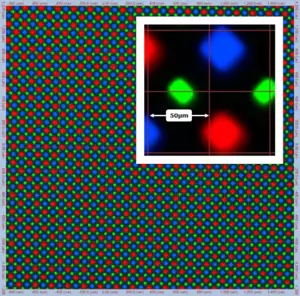
Image Credit: Konica Minolta Sensing Americas
Subpixel patterns, such as those represented in the image, can be difficult to describe without a high-resolution system and microscopic-capable optics. Designers can confirm exact subpixel layouts, geometries, and RGB color patterns by using the Microscope Lens, which provides 10× magnification of images from high-resolution imaging equipment.
As illustrated in the above image, users can attain remarkable detail within a very confined spatial area, enabling the accurate imaging of individual elements that are significantly separated by light regions.
Characterize Individual LEDs
Compared to the majority of other lamp types, LEDs (light-emitting diode sources) have a more complex physical makeup. Each emitter may have material, mechanical, or electrical defects that cause variations in brightness and color. Assessing individual LEDs is essential for ensuring the efficacy of LED-based systems and for achieving consistent brightness and color when LEDs are used in an array.
The Radiant Microscope Lens serves as a tool for assessing the characteristics of LEDs, whether individually or in an array, which include:
- LED edge contrast (uniformity falloff)
- LED uniformity
- The impact of cross-talk between LEDs (unwanted illumination of one LED by an adjacent LED in an array or panel)
- Cross-section plots that illustrate LED luminance uniformity
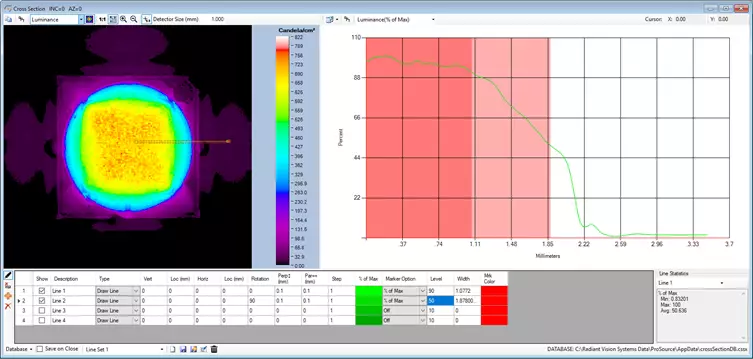
Measurement image of a single LED (left) and cross-section showing edge contrast of the LED (right), where luminance level falls off over a given distance in millimeters. Results shown in TrueTest Software. Image Credit: Konica Minolta Sensing Americas
Mount to ProMetric Photometers and Colorimeters
Designed for use with the Radiant ProMetric Y Imaging Photometer or the ProMetric I Imaging Colorimeter, the Microscope Lens is an optional mounting device. For improved stability, it is fastened with a special mounting bracket.
It offers a complete solution and the best way to measure displays by simply affixing a lens to a ProMetric image photometer or colorimeter, requiring little equipment, setup time, integration time, or experience.
The Microscope Lens can be easily detached and substituted with standard lenses for various measurement applications, including those that necessitate the full field of view, such as luminance and chromaticity uniformity, contrast, mura, and other characteristics.
Microscope Lens Key Features and Highlights
- Precise and dependable measurement of display luminance and chromaticity
- User-friendly measurement control and analysis software
- Enlargement of details captured by high-resolution image sensors
- Imaging for numerous data points, enhancing measurement efficiency
- A blend of value, superior performance, and adaptability, tailored for R&D and quality assurance
ProMetric Software, an advanced software suite that enables simple camera setup and operation, data collection, and picture analysis, is included with all Radiant ProMetric camera solutions. Additionally, it provides a wide range of data analysis and display features, such as bitmaps, radar plots, isometric plots, cross-section graphs, and CIE color charts. TrueTest Software offers a wide range of radiant display measurement features for additional measurement and test sequencing possibilities.
Specifications
Source: Konica Minolta Sensing Americas
| Parameter |
Microscope Lens (10×) |
| Primary Application |
High-resolution measurement of small display and component features |
| Magnification |
10× |
| Working Distance |
20 mm (to front of lens) |
| Working F Number |
F/33.5 |
| Numerical Aperture |
0.15 |
| Paired Radiant Camera |
I2 or Y2 |
I8 |
I29 |
16-G or Y16-G |
I61 or Y61 |
| Approx. Field of View |
0.8 x 0.6 mm |
1.8 x 1.4 mm |
3.6 x 2.4 mm |
1.5 x 0.8 mm |
3.6 x 2.4 mm |
Spatial Resolution
(by camera sensor size) |
0.55 µm |
0.27 µm |
0.37 µm |
| Measurement Capabilities |
Luminance, radiance, luminous intensity, radiant intensity, power, radiant flux, CIE chromaticity coordinates, correlated color temperature (CCT) |
| Dimensions |
Length: 330 mm | Maximum diameter: 70 mm |
Specifications subject to change without notice.
Compatible Products
- ProMetric I Series Colorimeters: I2, I8, I16, I29, I61
- ProMetric Y Series Photometers: Y2, Y16, Y29, Y43, Y61
System Recommendations
- Additional system requirements vary by camera.
- Windows® 10, 64-bit
- ProMetric Imaging Photometer or Colorimeter
- TrueTest™ Software
- 16–32 GB RAM
Applications
Typical Applications
The Microscope Lens is ideal for taking incredibly detailed pictures. Both offline and inline applications can benefit from this camera/lens combination's photometric imaging efficiency, as it enables:
- High-resolution imaging of very small components and their features
- Characterization for display design and R&D
- Assessment of display pixels and pixel structures, including at the subpixel level
- Examination of individual LEDs, such as microLEDs
- Quality control measurements at the end of the line