Optical Surfaces Ltd has supplied a 305-millimeter (mm) diameter spherical mirror to the GSI Helmholtz Zentrum für Schwerionenforschung to facilitate experiments on electron acceleration in medium-density gas jets.
Within this project, the researchers also aimed to develop X-ray and gamma-ray sources for use as diagnostic tools in high-energy-density experiments. To do this, they required an ultra-smooth mirror.
The GSI Helmholtzzentrum für Schwerionenforschung, based in Darmstadt, Germany, operates a world-class particle accelerator research facility and is the only facility capable of accelerating ions of every chemical element on Earth.
The PHELIX (Petawatt High-Energy Laser for heavy ion experiments) system at the Insitute is designed to deliver focused laser beams with energy up to one kilojoule or power up to 500 terawatts and intensities of over 1021 W/cm2.
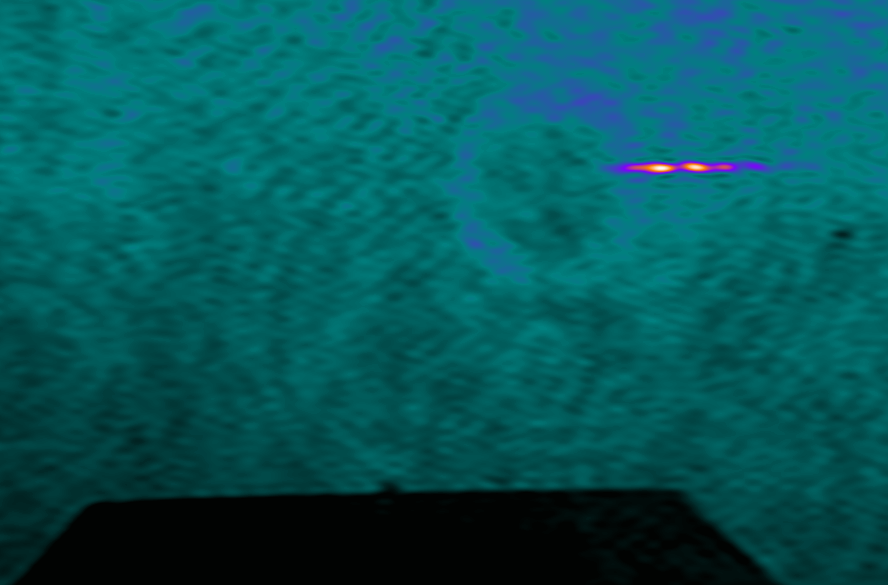
A snapshot of laser-plasma interaction with the gas nozzle (black region). The “bright line” is coming from the self-emission of the plasma where the PHELIX laser intensity is the highest. Image Credit: GSI/FAIR
Intensities as high as this are essential for laser-driven particle acceleration experiments involving protons to electrons.
Dr Johannes Hornung, a scientific assistant from the GSI Plasma Physics department, said, “Our experiments on electron acceleration in gas jets required a high F-number final focusing mirror to achieve a good focal spot quality with a long Rayleigh length to enable a large interaction length with the gas jet.”
This would not have been possible with the lower F-number focusing optics we previously used with PHELIX. Optical Surfaces supplied the necessary new component according to our demanding specifications.
Dr. Johannes Hornung, Scientific Assistant, Physics Department, GSI Plasma
Dr Aris Kouris from Optical Surfaces commented, “We were extremely pleased to have been selected for this prestigious project. There were several critical performance parameters we had to achieve to produce the required spherical mirror with a very long radius of curvature.”
“It was required to have a high damage threshold (>2 J/cm2) to avoid damage [to] the coating for high laser energies (200 J) that are used in experiments, combined with a very high reflectivity (>99.5%) to avoid losses and a reduction of the laser intensity. The most crucial parameter, however, was the high-quality surface finish, to achieve a very good energy distribution in the beam focus.”
“Operating in our uniquely stable production facility and using proprietary polishing techniques, our skilled craftsmen were able to produce a uniform mirror surface accuracy of l/90 RMS and a surface quality of better than 40:20 scratch/dig.”
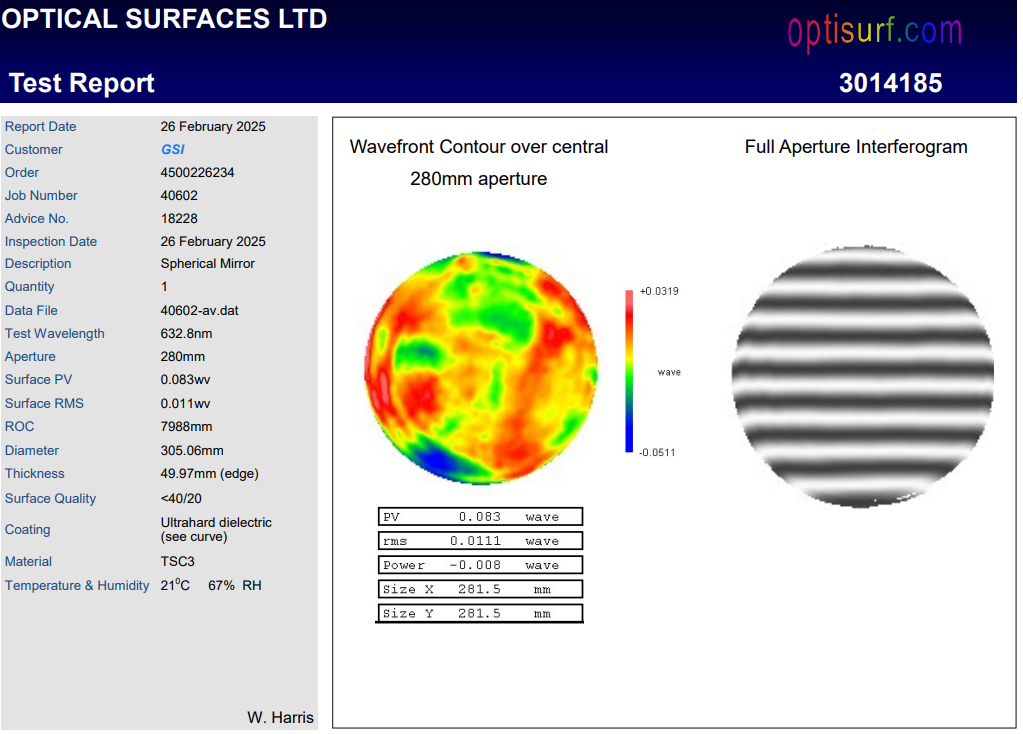
Test report on GSI spherical mirror demonstrating high surface quality. Image Credit: Optical Surfaces Ltd.
This information has been sourced, reviewed, and adapted from materials provided by Optical Surfaces Ltd.
For more information on this source, please visit Optical Surfaces Ltd.