Optical Surfaces Ltd. has supplied a range of ultra-high-quality plano-convex lenses to the MAX IV Laboratory at Lund University, Sweden.
The supplied lenses will function as key focusing elements in diagnosing the beam in MAX IV Laboratory’s state-of-the-art 3 GeV synchrotron storage ring. This ring, when compared to most other beamlines, uses a much longer wavelength region of the synchrotron radiation.
The MAX IV Laboratory is an internationally renowned synchrotron facility offering scientists the highest-quality X-rays for groundbreaking materials and life sciences research, employing spectroscopy, diffraction, scattering, and imaging techniques in its work.
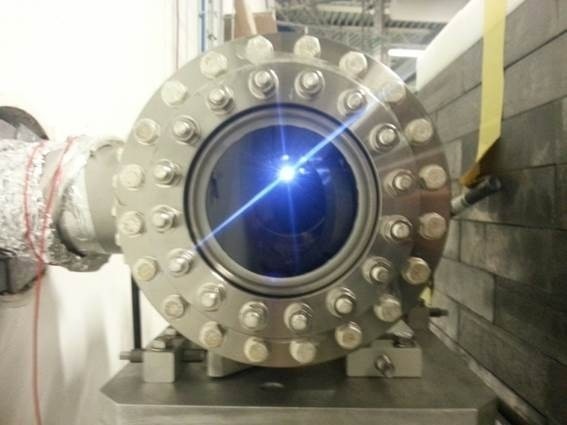
Intense synchrotron light extracted from the Max IV Laboratory diagnostic beam line and focused by the ultra-high precision plano-convex lens. Image Credit: L. Isaksson
The laboratory uses Kirchhoff’s diffraction theory as a basis for its measurements, adapting it to the synchrotron radiation emission and focusing in the near-ultraviolet-to-visible range. As a result, scientists can use optical setups based on transmission optics.
To achieve this, the MAX IV Laboratory research team needed focusing lenses with surface accuracies of λ/20 PV that offered good transmission down to 200 nanometers (nm).
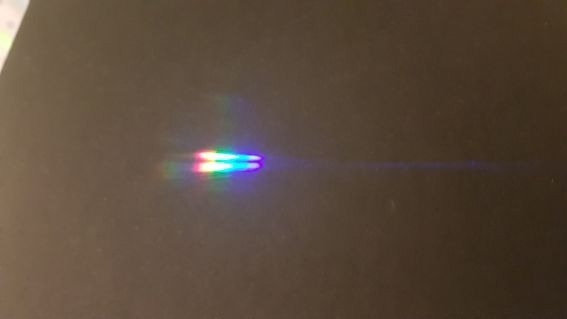
Visible and near UV light, dispersed by a prism, positioned just before the focal plane of the focusing plano-convex lens. Image Credit: Optical Surfaces Ltd.
Åke Andersson, a researcher in the MAX IV Laboratory accelerator development group, said, “In 2019, we chose Optical Surfaces to supply the original high-precision plano-convex lenses at the heart of our beam-focusing set-up because of their extensive experience of delivering critical ultra-high-precision optics to synchrotron facilities around the world.”
“In 2023, leading-edge accelerator science results from our 3 GeV storage ring, based on the diagnostic beam lines using these focusing lenses, [were] presented in the reputed journal, Physical Review Letters.”
Andersson added, “Exposed to high-intensity synchrotron radiation over a period of years, we found that carbon complex growth on the lens surface facing the light was lowering their performance. We have implemented actions to reduce this effect, including, earlier this year, ordering several new sets of lenses from Optical Surfaces, which will enable us to continue and expand our synchrotron X-ray research work.”

This information has been sourced, reviewed, and adapted from materials provided by Optical Surfaces Ltd.
For more information on this source, please visit Optical Surfaces Ltd.