Optical Surfaces has developed a novel approach to delivering modular, large-beam collimators, a key component in the assembly and testing of free-space optical (FSO) communication systems.
FSO communication uses light to transmit data wirelessly through air or space, and this type of cable-free data transmission offers ultra-high bandwidth and better security compared to traditional radio-frequency (RF) systems.
The collimator in an FSO communication system serves as a tool for both testing and alignment, ensuring that the emitted light beam is parallel and optimized, and is crucial for maintaining the intensity of the system’s signals and minimizing losses over long distances, even up to thousands of miles.
Optical Surfaces uses a zero-expansion parabolic mirror, manufactured to better than λ/10 peak-to-valley (PV) surface accuracy, to produce the high stability and performance of its pre-aligned modular beam collimator kits.
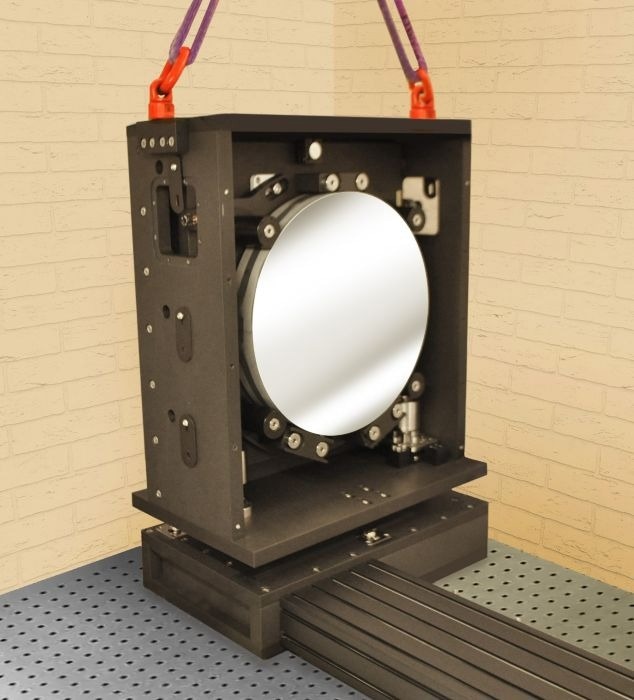
Easy-assembly modular large beam collimator system. Image Credit: Optical Surfaces Ltd.
It also uses an off-axis design for its modular beam collimators, meaning they do not produce any central obscuration, achieving highly efficient transmissions as a result. Additionally, the all-reflecting design of these beam collimators is achromatic, and with aluminum or magnesium fluoride coatings, can operate from ultraviolet (UV) to infrared wavelengths without the need for adjustments.
Dr Aris Kouris of Optical Surfaces commented, “The design and precise alignment of an FSO communications system is critical for the system’s performance, as it directly affects the quality of the transmitted signal and the accuracy of the communications link.”
Kouris added, “Traditionally, large diameter FSO communication systems have required a large, heavy, and expensive reflective beam collimator. Benefiting from a lightweight modular design, our pre-aligned beam collimator kits overcome these shortfalls.
The introduction of kinetic mounting on these pre-aligned modules makes the assembly of complete large diameter beam collimator systems faster, more precise, and highly reproducible. The high stability, unmatched performance, and easy assembly of our modular large diameter beam collimator kits is generating considerable interest throughout the FSO communications community.
Dr. Aris Kouris, Optical Surfaces Ltd.

This information has been sourced, reviewed, and adapted from materials provided by Optical Surfaces Ltd.
For more information on this source, please visit Optical Surfaces Ltd.