Optical Surfaces Ltd offers custom off-axis parabolic mirrors with a wide variety of coating options optimized for the most demanding high-power laser, defence, aerospace, spectroscopy and astronomy applications.
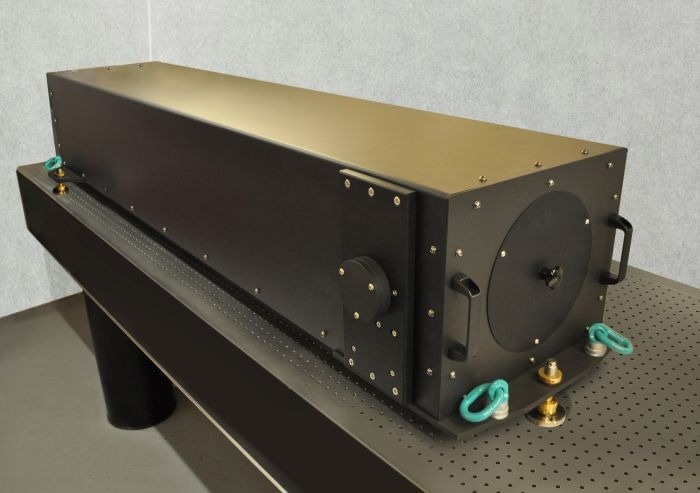 A reflective beam collimator incorporating OAP mirrors for MTF testing of military optical systems. Image Credit: Optical Surfaces Ltd.
Off-axis parabolic mirrors (OAP’s) combine the achromatic and diffraction limited imaging properties of a parabolic mirror with the ability to deviate the light path off-axis, which is useful for most imaging or beam delivery systems. OAP’s offer the ability to focus collimated light without introducing spherical aberration. In addition, unlike a centered parabolic mirror, an OAP mirror advantageously allows more interactive space around the focal point without disrupting the beam.
Benefiting from an ultra-stable manufacturing environment, and employing proprietary production techniques, Optical Surfaces highly skilled engineers are world renowned for producing large diameter prototype and custom OAP mirrors with unmatched surface accuracy (> lambda / 20 peak-to-valley), slope errors and surface microroughness of less than 1 nm.
Dr Aris Kouris of Optical Surfaces commented, “Few companies in the world can produce off-axis parabolic mirrors of sufficient quality to enable Petawatt and Zettawatt lasers to focus their massive energy down onto targets only a few microns in size. As a result, we have been selected by world leading high power laser research groups including AWE, ELI, LULI and CLF Rutherford as well as a growing number of academic centers of excellence to provide key OAP mirrors and other related optics for a range of demanding high-power laser applications”.
Drawing upon many decades of experience - Optical Surfaces Ltd has written an informative guide to enable users to get top performance from their off-axis parabolic mirrors. This illustrated guide includes an introduction to OAP geometry as well as step-by step instruction on initial alignment; tips to correct for errors in focus and tilt, set off-axis distance and rotation as well as a final alignment procedure to ensure optimized performance.