When selecting filter sets for experimental purposes, it’s necessary to consider more than just the optical properties of fluorophores. To improve speed and contrast, the newest microscope technology has also introduced options for where to place these filters; placement is no longer constrained by the filter cube.
This article will explore various possibilities for combining the newest technologies in widefield fluorescence, contrasting different filter types and their pros and cons.
Table 1 provides an introduction to different filter configurations. This example shows the excitation filters, dichroic mirrors, and emission filters for a three-color experiment requiring UV, blue, and green excitation. Each of the filter’s colors highlights the wavelength of transmitted light; solid colors represent single-band filters while split colors represent multi-band filters.
Source: Chroma Technology Corp.
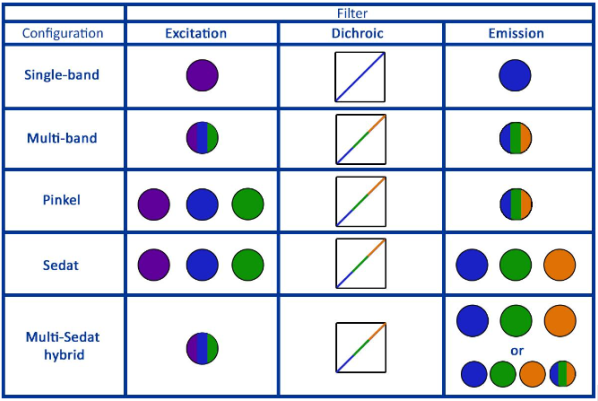
Speed and Contrast: Trade-Offs in Filter Configurations
Single-band filters deliver the most contrast; however, for multi-channel imaging, a whole filter cube housed in a filter wheel can slow down the process. At the same time, full multi-band filter sets eliminate latency caused by mechanical movement. Mechanical movement reduces channel switching speeds, particularly when waiting for vibrations to settle. Bypassing this heightens temporal resolution and the details that can be taken from live cell imaging tests.
The downside to multi-band filter sets is the risk of bleed-through, which can reduce contrast. Pinkel and Sedat configurations sit midway in the speed-versus-contrast trade-off and are considered the most interesting options when seeking the best of both worlds.
LEDs: The Preferred Illumination Technology for Widefield Fluorescence
In the last 10 years, LEDs have become the chosen illumination technology for widefield fluorescence applications. They have replaced traditional mercury (Hg) and metal-halide lamps thanks to superior performance, convenience, and environmental credentials. LED illumination systems are stable over time and generate precise experimental outcomes.
In addition, electronic control options such as TTL triggering improve temporal resolution, enabling the recording of the most dynamic events during live-cell imaging. Some models also enable high-speed imaging by housing single-band excitation filters inside the light source. Positioned in front of LED channels, these enable a Pinkel or Sedat configuration, and similarly to full multi-band configurations, stave off mechanical movement latency in the excitation light path.
Pinkel and Sedat Considerations
A Pinkel set may compromise fluorophore specificity owing to the multi-band emission filter in the emission path; the Sedat configuration is preferred if specificity is prioritized. In these cases, adding an image splitter in the emission light path makes it possible to use a Sedat filter set while still avoiding mechanical movement. However, this demands a larger optical power budget.
Considerations for Multi-Sedat Hybrid Sets
Not all imaging experiments share the same aims; therefore, filter sets that provide an additional layer of flexibility can be helpful in lab settings. The Multi-Sedat hybrid set is ideally suited when swapping between applications that require high speed and greater specificity.
In these configurations, a multi-band excitation and emission filter is located in the filter cube for high-speed use cases. For experiments that require a higher degree of specificity, it is possible to house single-band emission filters in a filter wheel and switch them into the light path as required.
The Future of High-Speed Multi-Color Imaging
In the ever-changing world of microscopy and fluorescence imaging, choosing the optimal filter configurations and illumination technology is crucial for achieving desired experimental outcomes. As discussed, more filter setups are now possible, inviting thinking beyond the traditional filter cube. It is still crucial, however, to bear the trade-off between speed and specificity in mind.
Single-band filters are superb for specificity, while multi-band filter sets deliver speed by eliminating mechanical movements that can slow the imaging process. However, these technologies come with a risk of bleed-through, which may reduce specificity. Pinkel and Sedat configurations offer a balance of speed and specificity, making them ideal for researchers seeking both.
This is a great example of complementary technologies working hand in hand to improve live cell imaging. It is always recommended to consider the bigger picture of filter configurations when upgrading imaging equipment.
Acknowledgments
Produced using materials originally authored by Brad Reynolds and Isabel Goodhand, PhD, from CoolLED.

This information has been sourced, reviewed and adapted from materials provided by Chroma Technology Corp.
For more information on this source, please visit Chroma Technology Corp.