As manufacturers seek faster, more reliable methods for detecting surface defects and ensuring part quality, portable 3D optical inspection has emerged as a powerful alternative to traditional lab-based measurements.
In this interview, Jenna Perryman, Product Manager for the 4Di InSpec line at 4D Technology, discusses how vibration-immune optical metrology is transforming on-site surface defect and roughness measurement. She explains how the technology enables automation, improves yield, and supports digital transformation across aerospace, automotive, and medical manufacturing environments.
To begin, could you please briefly introduce yourself and describe your role as Product Manager for the 4Di InSpec line?
My name is Jenna Perryman, and I serve as the Product Manager for the 4Di InSpec line. In this role, I’m responsible for overseeing the product lifecycle, ensuring that we deliver solutions most useful to our customers in addressing surface-related challenges. Our capabilities range from detecting shop floor defects – such as scratches, pits, and corrosion – to measuring surface roughness and performing automated edge break inspection.
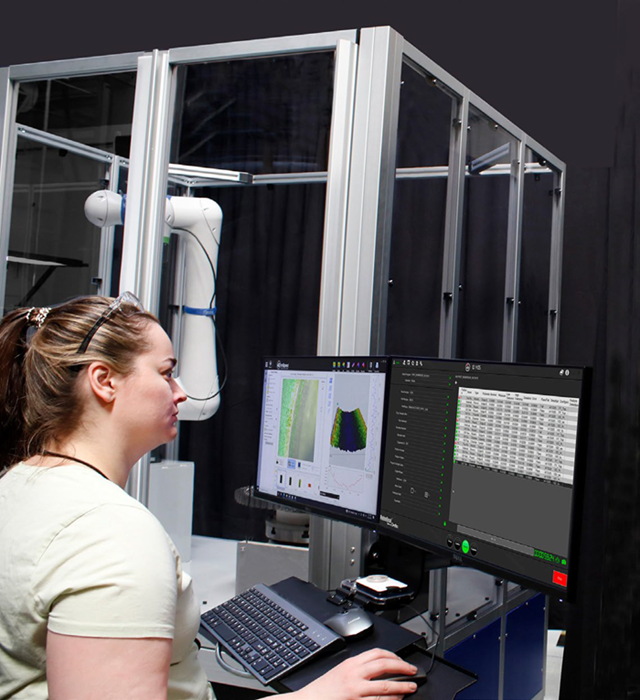
An inspector reviewing pass-fail results from a 4Di InSpec automated measurement system. Image Credit: 4D Technology
Surface defects and roughness, even at the micron level, can significantly impact component performance. What are the biggest challenges manufacturers face in reliably detecting these issues on the production floor?
Some of the most significant challenges to detecting surface defects and measuring them right on the production floor include:
- Variability in surface conditions: Components can have different finishes, coatings, or geometries, which often makes it difficult for a single system to measure everything.
- Harsh production environments, such as inconsistent lighting, vibration, and other environmental factors, can compromise detection accuracy, repeatability, or even the ability to measure a feature of interest. Often, to achieve a micron-level accuracy in environments like this, it requires removing the part or creating a replica and sending it to a quiet QC lab for measurement. This process introduces significant inefficiencies and slows overall throughput.
- Overcoming traditional probe contact measurement challenges that can scratch the parts or quickly wear down the probe tip to the point that the tip geometry changes, and therefore becomes less accurate and repeatable.
- Achieving a micron-level detection accuracy and repeatability without requiring the part to be moved to an inspection lab.
- Subjective and inconsistent traditional detection equipment, whether manual visual inspection or conventional detection. As a result, inspectors tend to err on the side of caution, scrapping or reworking parts that may actually meet specifications.
How does the 4Di InSpec portfolio address some of the significant limitations of traditional defect inspection methods, particularly those involving manual checks or lab-based equipment?
The 4Di InSpec portfolio uses a unique, patented vibration-immune technology that eliminates one of the most significant barriers to accurate shop floor inspection – environmental stability.
The 4Di InSpec optical inspection gauge and the 4Di InSpec SR surface roughness gauge quickly detect defects and surface roughness directly on the production floor, without sacrificing speed or accuracy. They are both high-resolution, area measurements, enabling an accurate representation of the surface versus traditional line scans. The 4Di InSpec has an 8 mm x 8 mm field of view and can measure defects of 2 um in less than one second. The 4Di InSpec SR has an even higher resolution, with a field of view of 1 mm x 0.8 mm and a measurable roughness range (Sa) from 10 nm to 30 um.
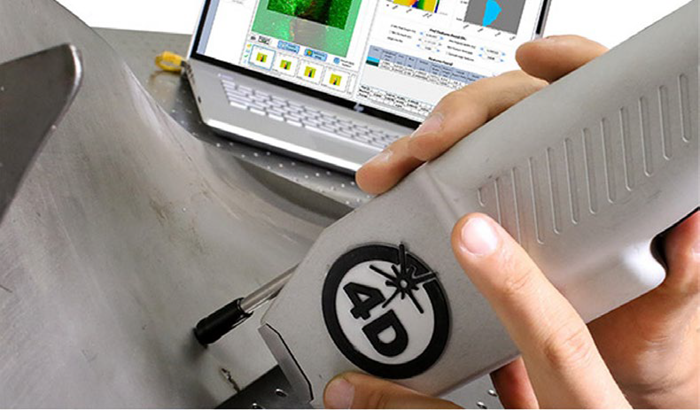
A 4D InSpec optical gage measuring feature depth on a complex geometry. Image Credit: 4D Technology
It’s accurate, portable, and easy to use, so manufacturers can reduce rework levels and maintain high throughput while achieving reliable, repeatable results. By accurately assessing features and defects, the 4D InSpec provides much more precise part disposition than visual inspection. Dramatic reductions in scrap and rework have led to 20-40 % improvements in yield.
Automation is clearly a focus for many manufacturers. Could you explain how 4Di InSpec enables automated defect inspection, and what this means for improving consistency and speed in production?
Our 4Di InSpec and InSpec SR systems seamlessly integrate with Fanuc CRX cobots to enable the automated inspection of complex components in a fraction of the time. One of our customers in the aerospace industry has successfully reduced an inspection process that previously required 12-14 hours of skilled inspection labor to a 10-minute automated program, producing a clear report of hundreds of pass/fail locations.
The ability to perform 3D surface measurements directly on the shop floor is a major innovation. What technical features make this possible without sacrificing measurement accuracy or detail?
The 4Di InSpec technology uses polarized light to construct 3D surface data that is accurate within .0001” (~2 um). Since it uses the wavelength of light as a reference measurement, it is a non-contact method. It’s as simple to use as shining a flashlight, making it portable. With minimal training, any inspector can take accurate measurements, regardless of the size or location of the part being inspected.
Shop floor environments are often noisy and unstable. How does the 4Di InSpec maintain reliable performance in these conditions, where traditional optical profilers might struggle?
The 4Di InSpec is designed for use in harsh conditions. It uses vibration-insensitive technology in a portable, rugged device. The one-button operation and easy alignment enable real-time, high-resolution data capture in all conditions.
How adaptable is the 4Di InSpec system for various industries, such as aerospace, automotive, or medical devices, where inspection needs and tolerances can differ significantly?
The 4Di InSpec portfolio is designed to be flexible and robust, with systems that can measure surface defects or roughness.
We have successfully measured precision-machined components in numerous industries, including aerospace, automotive and medical devices. As long as the defects of interest are larger than 2 μm, or roughness is greater than about 10 nm, our solutions are engineered to deliver accurate measurements on a wide range of materials and finishes. With a lateral resolution of about 10 um for our defect measurements, and about 1 um for our roughness measurements, even fine features are readily measurable.
As more manufacturers adopt innovative factory technologies, what role do you see 3D optical inspection tools, such as the InSpec series, playing in digital transformation strategies?
The 4Di InSpec sensor is particularly well-suited for robotic automation because it is immune to vibration, allowing for minimized settling time between robot movements. This novel technology also enables in-situ measurements in the milling, grinding, and polishing processes, and even multi-sensor automated applications.
As manufacturers embrace digital transformation, portable 3D optical inspection tools, such as the 4Di InSpec series, play a critical role in bridging quality assurance with smart factory initiatives. These systems provide high-resolution, real-time surface quality feedback that can be integrated directly into MES and analytics platforms. Unlike traditional inspection methods, the 4Di InSpec solution delivers actionable insights without slowing production.

Surface defect, feature, and roughness measurements from 4D Technology’s 3D optical gauges. Image Credit: 4D Technology
Looking ahead, are there any upcoming features or developments in the InSpec product line that customers should be excited about?
We are excited to fully release the 4Di InSpec SR in early 2026. On the automation side, we are focused on making system integration even easier for our customers. For example, we recently released a Fanuc plugin that enables seamless integration between our 4Di InSpec products and Fanuc’s CRX cobots for automated measurements.
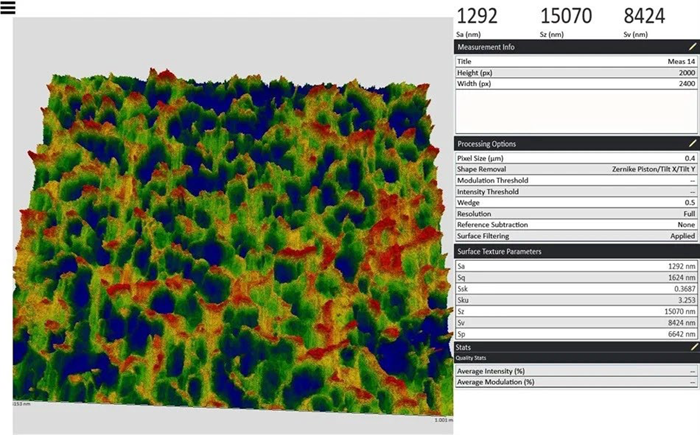
The 4D InSpec SR quickly quantifies roughness on the shop floor. Image Credit: 4D Technology
Looking further ahead, multi-sensor, automated systems are the next big step. Imagine a single robot equipped with dual sensors that can measure surface roughness, surface features, and inspect defects all in one system setup, significantly increasing efficiency and delivering even greater value to manufacturers.
Where can readers find more information?
https://4dtechnology.com/industrial-measurement-products/4d-inspec/
About Jenna Perryman
Jenna Perryman is a Principal Program Manager at 4D Technology, where she leads initiatives to bring innovative products to market in the industrial 3D optical gauges sector. Jenna is responsible for 4D Technology’s 4D InSpec and 4D InSpec SR product lines as well. Her expertise bridges advanced optical metrology and practical industrial applications, driving the development of cutting-edge tools that transform inspection processes across diverse industries.
About 4D Technology
4D Technology, a subsidiary of Onto Innovation, designs and manufactures optical surface gauges, surface roughness profilers and other metrology for accurate 3D, non-contact, high-resolution measurement of precision surfaces. 4D's gauges measure in < 1 second with one-button operation and can be used anywhere in the factory or lab - either handheld or combined with collaborative robots for high-volume automation.
Improve quality, reduce scrap and rework, and improve labor utilization and turnaround times with our industrial portfolio, including:
- 4D InSpec®: the first handheld, precision instrument for non-contact surface defect measurement, with a measurement area of 8 mm x 8 mm. Now with improved resolution down to 2 um!
- 4D InSpec XL®: a surface defect gauge with expanded measurement area of 16 mm x 16 mm and improved resolution down to 5 um!
- 4Di InSpec AMS: a fully automated 3D, optical inspection system to measure hundreds of callouts in minutes! Quantify features such as chamfer, radius, edge break, and thread geometries and defects such as pits, dings and scratches.
- New: 4D InSpec SR: the industry’s first handheld, nm-level resolution surface roughness system for precision machined surfaces, enabling high-resolution 3D (areal) roughness of hard-to-reach areas and large samples right on the shop floor.

This information has been sourced, reviewed and adapted from materials provided by 4D Technology.
For more information on this source, please visit 4D Technology.
Disclaimer: The views expressed here are those of the interviewee and do not necessarily represent the views of AZoM.com Limited (T/A) AZoNetwork, the owner and operator of this website. This disclaimer forms part of the Terms and Conditions of use of this website.