Since its inception as an employee-owned business in 1991, Chroma has produced optical filters for fluorescence in situ hybridization (FISH) procedures. The company's current generation of sputtered ET FISH filter sets has been refined to offer the ideal balance of brightness, contrast, and color distinction.
By providing optimized FISH filter sets, a lifetime warranty, and specialized technical and application support, Chroma simplifies the process for its customers.
Filters That Do Not Need Replacing
Chroma’s modern ET-sputtered filters for FISH are made from durable, hard-coated materials that resist delamination and are backed by a lifetime warranty.
Chroma’s ET FISH filter sets are fine-tuned to deliver an optimal balance of contrast, brightness, color separation, and registration (alignment).
- Multi-band filter sets provide a less bright DAPI counterstain, ensuring that additional signals are not obscured by an overly intense DAPI signal.
- A wider range of filter options helps reduce bleedthrough. Prevent gold or aqua bleedthrough into the green channel, and eliminate gold and orange bleedthrough into the red channel.
- A wider variety of single-band, dual-band, triple-band, and quad-band sets provide increased flexibility for hybridization.
- Zero-pixel-shift filter sets ensure flawless image registration.
Product Highlights
Chroma's ET FISH filter sets enhance the primary image attributes when observing FISH samples, allowing the user to:
- Score slides with greater ease
- Limit eye strain
- Decrease uncertainty
- Save time
- Boost throughput
Providing Users With More Options
Hybridize Red and Orange Probes Together
The 49311 filter set from Chroma removes orange entirely, enabling the imaging of both targets within the same cells.
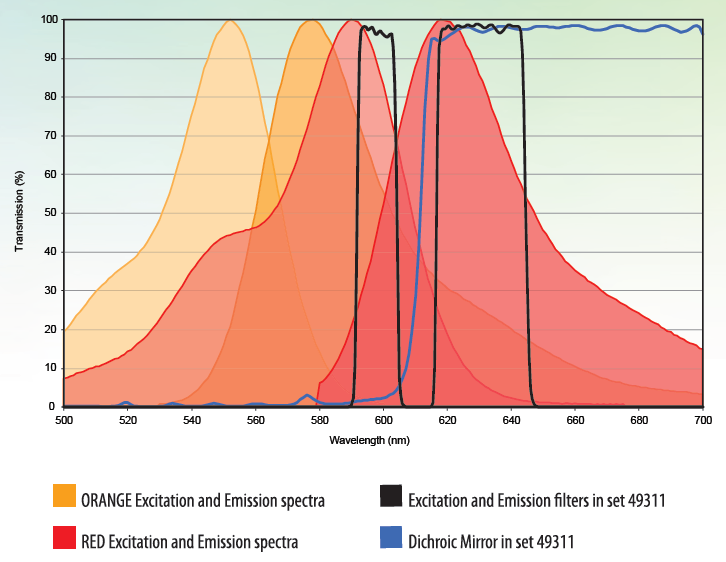
Image Credit: Chroma Technology Corp.
Quad Set Allows Simultaneous Visualization of DAPI/Aqua/Green/Orange/ Red
A slight counterstain will not overshadow the aqua signal when using Chroma's 69014 collection.
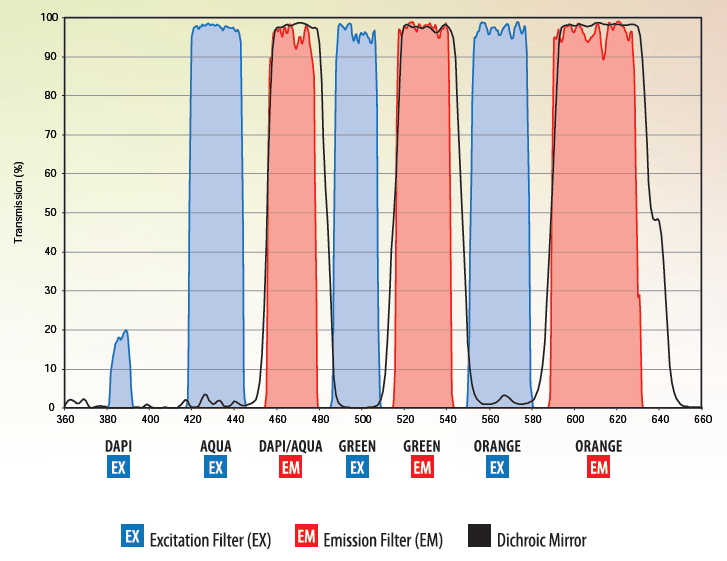
Image Credit: Chroma Technology Corp.
Optimized filter selections ensure peak functionality.
The Problem: Poor Filter Choice
- Low brightness/too dim
- Low contrast
- Images offset
- Poor color separation
The Solution: Appropriate Filter Choice
- Optimize the passband
- Zero-pixel-shift filters
- Maximize signal-to-noise ratio
- Maximize emission signal
- Evaluate slides with greater speed and dependability to enhance efficiency and precision
ET FISH filter sets. Source: Chroma Technology Corp.