NANORO M : Super Resolution Scanning Optical Microscope
The Nanoro M was designed to make the most of the SMAL lens by leveraging the microsphere's unique optical properties. It has the Aerotech ANT95XY stage, which provides exceptional repeatability and a 50 mm scan and motion range with a 5 µm resolution.
The Nanoro M has a vertical travel of 60 mm at high speed with a minimum step size of 100 nm, thanks to its optical block mounted on a Marzhauser linear stage.
A dependable Marzhauser joystick controls the system, enabling smooth, accurate, and speed-adjustable motion in the X, Y, and Z axes.
General Specifications
Source: LIG Nanowise
| General |
| XY motion range: |
5 cm x 5 cm |
| Scan range: |
5 cm x 5 cm |
| Image stitching |
YES |
| Z travel: |
6 cm |
| Z minimum increment |
100 nm |
| Type of illumination |
LED (400–800 nm) |
| Camera type: |
CMOS |
| Image visualization |
Nanoro Software/External screen |
| Turret: |
Manual with four slots for RMS lens type |
| Dimensions and weight |
| Height: |
63 cm |
| Length: |
30 cm |
| Depth: |
40 cm |
| Weight: |
20 kg |
| Joystick |
Wired |
| Controller |
External |
High-precision image stitching was used to achieve a 50 mm x 50 mm scan for large area scanning. Super-resolution imaging requires ultra-fine-focus control, enabled by 60 mm of Z travel with 100 nm precision.
Real-time, true-color imaging with sub-100 nm resolution is provided using a high-performance CMOS camera. White LEDs ensure steady, low-heat lighting that is ideal for delicate samples by producing brilliant, consistent white light illumination.
Want to know more? Get in touch here
Iris Motion System
The motorized iris adjustment on the microscope facilitates precise alignment of the microsphere with the light beam. This guarantees constant super-resolution performance, ensuring steady and repeatable near-field coupling.
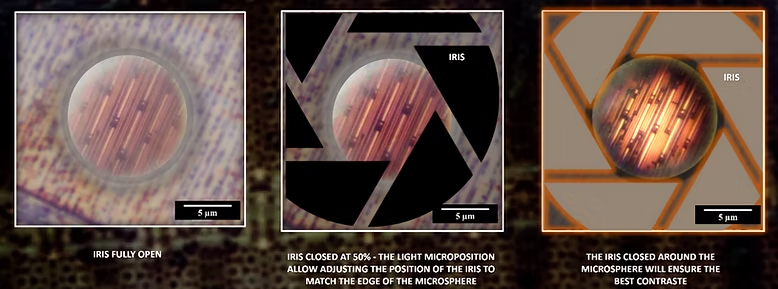
Image Credit: LIG Nanowise
Nanoro Software Suite
Advanced scanning and stitching algorithms enable users to create large area, high resolution images while clearly visualizing nanostructures through an intuitive workflow.
Microscope functions including XYZ motion, iris adjustment, and light intensity control can all be operated using either software or a joystick.
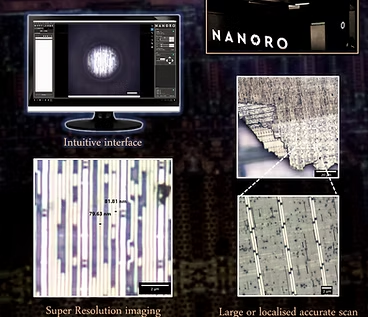
Image Credit: LIG Nanowise